Kore.ai
Kore.ai is an enterprise conversational and agentic AI platform used to build, deploy, govern and observe AI agents for customer experience and employee experience work — contact center automation, voice AI, IT and HR service desks, agent assist, quality assurance and no-code agent orchestration. The company ships two API estates. The newer Agent Platform ("Artemis") on agents.kore.ai exposes an ABL Runtime API for chat, streaming, workflow invocation and session usage, an Agent Blueprint Language (ABL) DSL, and a 45-tool stdio MCP server (@koreai/arch-mcp-tools) that turns the platform's own control plane into agent tooling. The longer-established AI for Service estate on platform.kore.ai exposes a large REST surface across Automation AI, Search AI, Contact Center AI, Agent AI, Quality AI and Case Management, authenticated with JWT apps and governed by an assigned API-scope model. Kore.ai is headquartered in Orlando, Florida and is recognized as a Leader in the Gartner Magic Quadrant for Conversational AI, the Forrester Wave for Conversational AI Platforms and the Everest Group PEAK Matrix for Agentic AI Products.
Kore.ai publishes 5 API contracts indexed on the APIs.io network, including AI for Service Platform APIs, Chat API, Conversation API, and 2 more. Tagged areas include Company, Artificial Intelligence, Conversational AI, Agents, and Agent Platform.
The Kore.ai catalog on APIs.io includes 1 event-driven AsyncAPI specification and 1 Spectral governance ruleset.
Kore.ai’s developer surface includes documentation, API reference, getting-started guide, support, engineering blog, signup flow, changelog, and 37 more developer resources.
Kin Score
 Kin Score
How this is scored →
scored 2026-11-13 · rubric v0.28.0
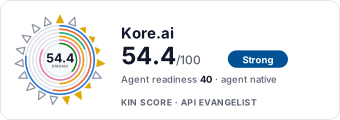 It updates itself when the score changes. Paste this where you link to your API docs:
<a href="https://apis.io/providers/koreai/"><img src="https://apis.io/badge/koreai/card.svg" alt="Kore.ai on APIs.io — Kin Score by API Evangelist"></a>Other styles, a README pill and a shields.io endpoint are on the badge page.
- Agentic Access Contract +10 pts — agentic_access artifact present (x-agentic-access), graded by author Ask about this →
- A2A Agent Card +8 pts — a2a/
-a2a.yml manifest, graded on conformance.grade against A2A 1.0.0 Ask about this → - Request/Response Examples +7 pts — share of operations carrying request/response examples; else an Examples / Code Samples link Ask about this →
- Registration Without a Human +6 pts — a `registration_endpoint` in the served RFC 8414 / OIDC discovery document Ask about this →
- Delegated User Identity +6 pts — a served discovery document listing authorization_code in grant_types_supported (served), else an oauth2 authorizationCode flow or openIdConnect declared in an OpenAPI (documented) Ask about this →
- Documented Reversibility +6 pts — a reversal operation in the contract, graded up when a window is documented too Ask about this →
- Contract Quality scores 53.4 — up to +11.7 composite points Ask about this →
- Access Clarity scores 53.2 — up to +9.4 composite points Ask about this →
- Contract Governance scores 31.8 — up to +8.2 composite points Ask about this →
Markets this provider is in provisional
The Kin Score Market layer reads a provider inside its market: its position, and how deep its integrations go. Depth is only comparable within a position. Provisional and unweighted: not part of the Kin Score or agent readiness.
| Market | Position | Depth | Registered MCP server | Declares compatibility |
|---|---|---|---|---|
| Cloud Marketplaces (distribution) | builds-on | 47.0 | - | - |
| Zoom App Marketplace and Partner Ecosystem (builders and partners on Zoom) | builds-on | 47.0 | - | - |
Registered MCP server and declares compatibility are report only — not weighted. Undeclared means we found nothing we can read, so there is no number: we never infer integrations.
Standards implemented 4
Standards this provider implements or carries. De facto ones are profiled and measured by the API Commons; formal ones come from the standards directory and are linked by the provider's own tags. The evidence column says how each claim was established — not that it was made.
APIs 5
Individual APIs this provider publishes, each with its own machine-readable definition.
Kore.ai AI for Service Platform APIs
The AI for Service REST estate — Automation AI (bot lifecycle, NLP training, analytics, admin, data tables), Search AI (answer generation, content and chunk management, ingestio...
Kore.ai Arch MCP Server
A stdio Model Context Protocol server, @koreai/arch-mcp-tools, that exposes the Kore.ai Agent Platform control plane to an MCP client as 45 tools across build, evaluate, optimiz...
Kore.ai Chat API
The Chat API from Kore.ai — 5 operation(s) for chat.
Kore.ai Conversation API
The Conversation API from Kore.ai — 3 operation(s) for conversation.
Kore.ai Workflows API
The Workflows API from Kore.ai — 4 operation(s) for workflows.
MCP Servers 1
Model Context Protocol servers that expose these APIs to AI agents.
Agent Skills 3
Packaged agent skills for driving this provider's APIs from an AI assistant.
Kore.ai API pricing
Pricing Plans 1
Published pricing tiers and plan structures.
Rate Limits 1
Documented rate limits and quota policies.
Kore.ai Rate Limits
RATE LIMITSTerms of Service 1
What its API terms permit and prohibit, quoted from its own page.
Privacy & Data 1
Its role, the data it processes, retention and transfers, quoted from its own privacy page.
Eligibility 1
Who may sign up and where, quoted from its own terms.
Data License 1
How its data and outputs may be reused, quoted from its own terms.
FinOps 1
Cost, billing, and metering signals for API financial operations.
Kore.ai Finops
FINOPSEvent Specifications 1
AsyncAPI definitions for this provider's event-driven and streaming APIs.
Koreai Webhooks
ASYNCAPISpectral Rules 1
Spectral governance rulesets for linting and validating these APIs. Counts are the severity each rule declares, not results of running them.
Kore.ai API Rules
SPECTRALOpenAPI Overlays 3
Overlays applied on top of this provider's contracts. Each card says who wrote it: a document the provider publishes, or one API Evangelist derived or generated.
Security Posture 3
Authentication, domain security, vulnerability disclosure, and trust-center signals.
Kore.ai Trust Center
SOC 2 Type 2, PCI DSS, ISO/IEC 27001:2022, GDPR, CCPA, EU AI Act, DESC Cloud Service Provider
SECURITYResources
Get Started 4
Portal, sign-up, and the first successful call
Documentation 2
Reference material describing how the API behaves
Agent Surfaces 3
MCP servers, agent skills, and machine-readable catalogs
Design & Contract 8
Pagination, idempotency, versioning, errors, and events
Scroll for all 8
Build 5
SDKs, sample code, and the tooling you integrate with
Access & Security 4
Authentication, authorization, and security posture
Operate 5
Status, limits, changes, and where to get help
Commercial 5
Pricing, plans, and the legal terms of use
Company 3
The organization behind the API
Other 5
Properties that don't map to a standard resource type
Source (apis.yml)
Kore.ai API — frequently asked questions
Does Kore.ai have an API?
Yes. APIs.io lists 5 APIs from Kore.ai, including Kore.ai AI for Service Platform APIs, Kore.ai Arch MCP Server and Kore.ai Chat API, and 2 more.
Is there an OpenAPI specification for the Kore.ai API?
Yes. APIs.io indexes 3 OpenAPI specifications for Kore.ai, each linked for download from this page.
How do I authenticate with the Kore.ai API?
Kore.ai uses bearer-token authentication (0 schemes). The details are profiled on APIs.io as Kore.ai Authentication.
Does Kore.ai have an MCP server?
Yes. APIs.io lists 1 MCP server for Kore.ai: Local (stdio) MCP server requiring OAuth; 45 tools listed.
Is the Kore.ai API ready for AI agents?
Kore.ai has a Kin Score of 58.2 out of 100 (strong) and an Agent Readiness score of 39.6 (agent-native), scored by API Evangelist on 2026-11-13.
Work with this as data
Every provider here is available over the APIs.io API and to AI agents over MCP.