Fi Money
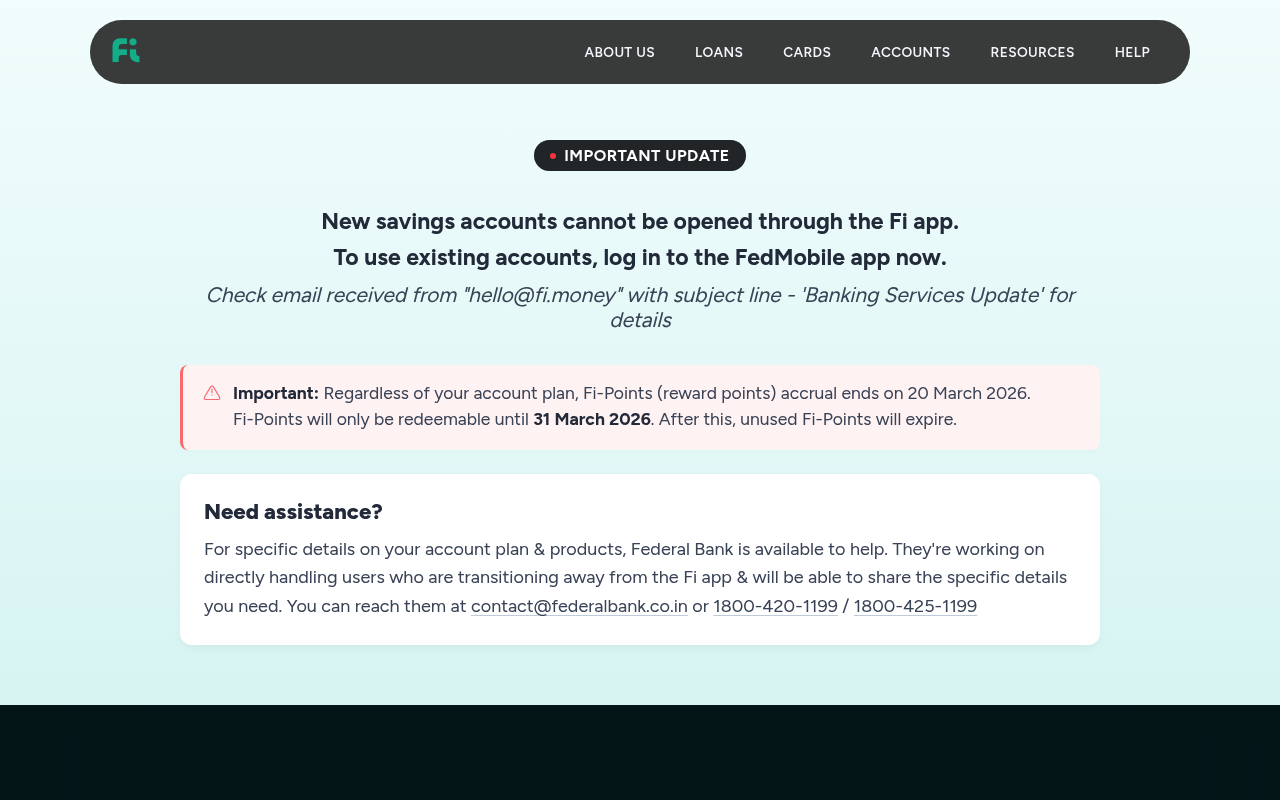
Fi Money is a Bengaluru, India based money-management application and consumer fintech operated by Epifi Technologies, founded in 2019 by ex-Google Pay (Tez) executives Sujith Narayanan and Sumit Gwalani together with Neeraj Bhope and Prasanna Ranganathan. Fi is not a chartered bank; it delivers a millennial-focused mobile experience layered on top of partner RBI-licensed Federal Bank, providing zero-balance digital savings accounts, a Visa debit card, deposits, mutual funds, Indian and US stocks, EPF tracking, credit cards, personal loans, jump-style automated savings rules ("FIT Rules"), and an AI-powered money assistant. Fi has raised roughly US$169M across multiple rounds from investors including Sequoia Capital India (Peak XV), Ribbit Capital, Temasek, Alpha Wave, and B Capital, and serves Indian retail consumers via iOS and Android apps. There is no classic public REST developer API or partner banking-as-a-service surface; Fi's only developer-facing interface is the Fi MCP (Model Context Protocol) server — a JSON-RPC streaming endpoint at https://mcp.fi.money:8080/mcp/stream that lets users connect their own Fi account to LLM clients (Claude Desktop, Cursor, Windsurf, Gemini, ChatGPT) and call read-only tools such as fetch_net_worth, fetch_credit_report, fetch_epf_details, fetch_bank_transactions, fetch_mf_transactions, and fetch_stock_transactions to expose their net worth, holdings, EPF balance, credit report, and transactions to AI assistants. A hackathon-friendly mock server (epiFi/fi-mcp-dev, Go) and developer documentation (epiFi/mcp-docs) are published publicly on GitHub.
Fi Money is profiled on the APIs.io network. Tagged areas include Fintech, Neobank, Consumer Banking, Personal Finance, and Money Management.
Fi Money’s developer surface includes privacy policy, FAQ, engineering blog, GitHub presence, and 19 more developer resources.
Kin Score
 Kin Score
How this is scored →
Kin Score
How this is scored →scored 2026-10-17 · rubric v0.24.0
Markets this provider is in provisional
The Kin Score Market layer reads a provider inside its market: its position, and how deep its integrations go. Depth is only comparable within a position. Provisional and unweighted: not part of the Kin Score or agent readiness.
| Market | Position | Depth | Registered MCP server | Declares compatibility |
|---|---|---|---|---|
| India Stack (Account Aggregator, ONDC, UPI, DigiLocker, Aadhaar) | undeclared | - | - | - |
Registered MCP server and declares compatibility are report only — not weighted. Undeclared means we found nothing we can read, so there is no number: we never infer integrations.
Standards implemented 1
Standards this provider implements or carries. De facto ones are profiled and measured by the API Commons; formal ones come from the standards directory and are linked by the provider's own tags. The evidence column says how each claim was established — not that it was made.
Security Posture 1
Authentication, domain security, vulnerability disclosure, and trust-center signals.
Resources
Get Started 1
Portal, sign-up, and the first successful call
Documentation 1
Reference material describing how the API behaves
Agent Surfaces 4
MCP servers, agent skills, and machine-readable catalogs
Build 1
SDKs, sample code, and the tooling you integrate with
Access & Security 2
Authentication, authorization, and security posture
Operate 2
Status, limits, changes, and where to get help
Commercial 2
Pricing, plans, and the legal terms of use
Company 7
The organization behind the API
Scroll for all 7
Other 3
Properties that don't map to a standard resource type
Source (apis.yml)
Work with this as data
Every provider here is available over the APIs.io API and to AI agents over MCP.