Robinhood
Robinhood Markets is a US financial-services company offering commission-free trading of stocks, ETFs, options, and cryptocurrency, plus retirement accounts, a cash/spending card, and 24-hour markets. For developers, Robinhood publishes the Crypto Trading API, a REST interface at trading.robinhood.com that lets an account holder view buying power and holdings, pull market data (best bid/ask and estimated fill prices), enumerate supported trading pairs, and place, retrieve, and cancel crypto orders (market, limit, stop-loss, and stop-limit). The API authenticates each request with an API key plus an Ed25519 request signature carried in the x-api-key, x-timestamp, and x-signature headers. Robinhood was added to the API Evangelist network as a VC-portfolio lead and enriched from its public developer surface.
Robinhood publishes 5 API contracts indexed on the APIs.io network, including Account API, Holdings API, Market Data API, and 2 more. Tagged areas include Company, Fintech, Cryptocurrency, Trading, and Brokerage.
Robinhood’s developer surface includes documentation, API reference, getting-started guide, support, engineering blog, authentication, and 23 more developer resources.
What this lets a business do 1
Business capabilities this provider's published APIs can perform, derived from its own contracts. Browse all capabilities →
Kin Score
 Kin Score
How this is scored →
Kin Score
How this is scored →scored 2026-10-17 · rubric v0.24.0
Markets this provider is in provisional
The Kin Score Market layer reads a provider inside its market: its position, and how deep its integrations go. Depth is only comparable within a position. Provisional and unweighted: not part of the Kin Score or agent readiness.
| Market | Position | Depth | Registered MCP server | Declares compatibility |
|---|---|---|---|---|
| Capital Markets and Trading | regulated | 60.3 | - | - |
Registered MCP server and declares compatibility are report only — not weighted. Undeclared means we found nothing we can read, so there is no number: we never infer integrations.
APIs 5
Individual APIs this provider publishes, each with its own machine-readable definition.
Robinhood Account API
Crypto trading account details and buying power.
Robinhood Holdings API
Current cryptocurrency positions.
Robinhood Market Data API
Best bid/ask quotes and estimated execution prices.
Robinhood Orders API
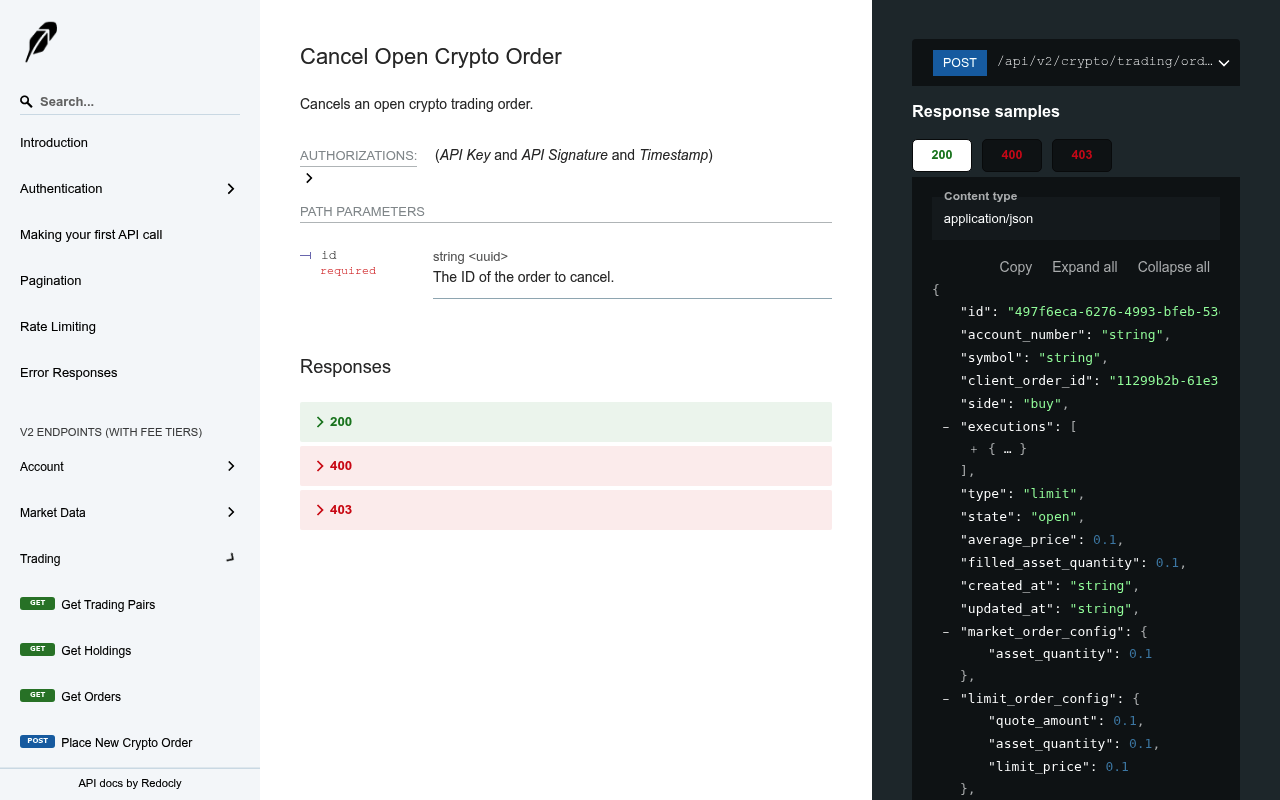
Place, list, retrieve, and cancel crypto orders.
Robinhood Trading Pairs API
Supported crypto trading pairs and their constraints.
Open Collections 6
Open, tool-agnostic API collections (OpenAPI-derived and Bruno).
API Collection
OPEN COLLECTIONRobinhood Crypto Trading Account API
OPEN COLLECTIONRobinhood Crypto Trading Account Holdings API
OPEN COLLECTIONRobinhood Crypto Trading Account Market Data API
OPEN COLLECTIONRobinhood Crypto Trading Account Orders API
OPEN COLLECTIONRobinhood Crypto Trading Account Trading Pairs API
OPEN COLLECTIONOpenAPI Overlays 1
Overlays applied on top of this provider's contracts. Each card says who wrote it: a document the provider publishes, or one API Evangelist derived or generated.
Robinhood Crypto Trading Overlay
UNRECORDEDSecurity Posture 3
Authentication, domain security, vulnerability disclosure, and trust-center signals.
Agentic Access 1
Recommended x-agentic-access execution contracts for AI agents.
Resources
Get Started 2
Portal, sign-up, and the first successful call
Documentation 2
Reference material describing how the API behaves
Agent Surfaces 5
MCP servers, agent skills, and machine-readable catalogs
Design & Contract 6
Pagination, idempotency, versioning, errors, and events
Build 1
SDKs, sample code, and the tooling you integrate with
Access & Security 5
Authentication, authorization, and security posture
Operate 2
Status, limits, changes, and where to get help
Commercial 2
Pricing, plans, and the legal terms of use
Company 2
The organization behind the API
Other 2
Properties that don't map to a standard resource type
Source (apis.yml)
Work with this as data
Every provider here is available over the APIs.io API and to AI agents over MCP.