Emotive
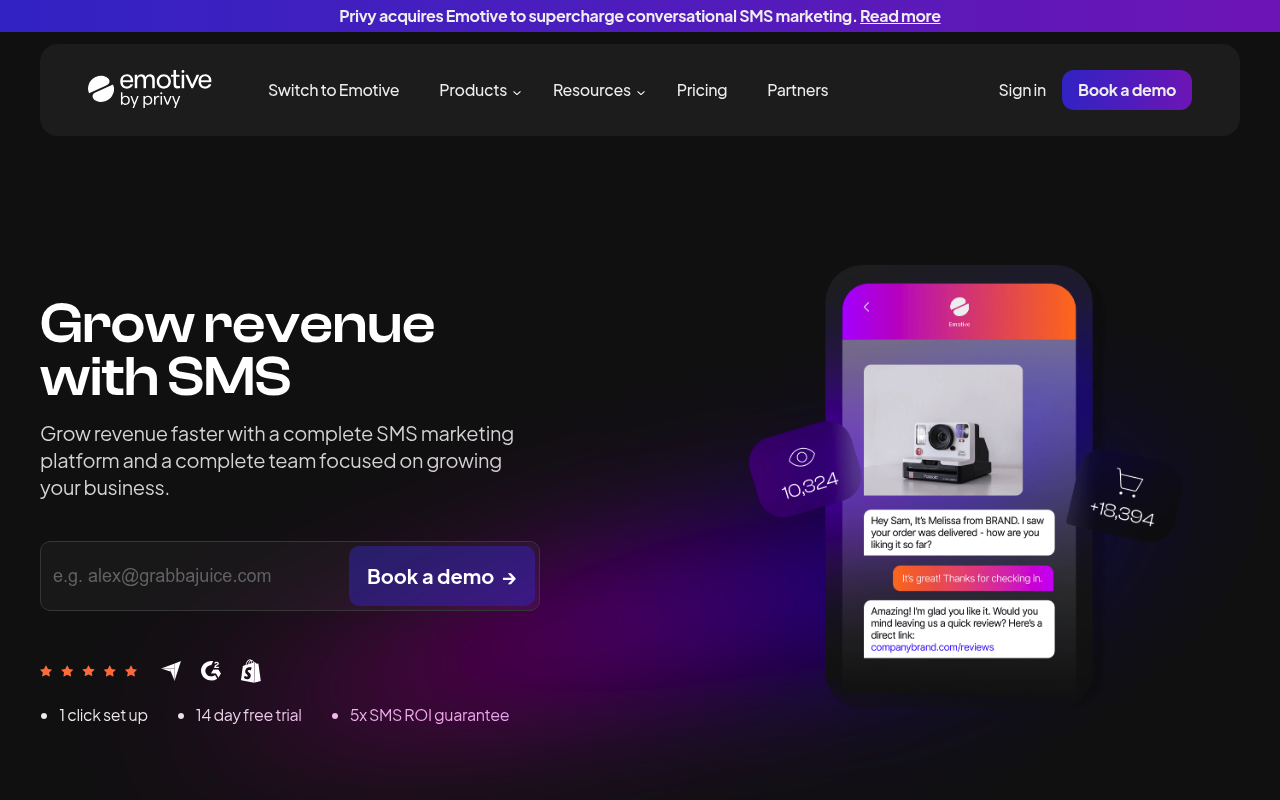
Emotive is an SMS marketing platform for eCommerce brands, combining two-way conversational text messaging, behavioral triggers, and automation with a dedicated managed service (TextPros) of ex-agency SMS strategists and copywriters. Its products include SMS Marketing campaigns and flows, CartAI cart-recovery pixel technology, multi-touch Attribution analytics, RealLink branded short links, and integrations with eCommerce platforms, email service providers, and business tools. Emotive markets a "5X ROI guarantee" to Shopify and other direct-to-consumer merchants. The company was surfaced as a portfolio company of CRV and was acquired by Privy. Emotive runs a real, publicly documented developer surface: an Open API for order tracking, manual opt-outs and custom events on api.emotiveapp.co; a Lists / Subscriber API documented in GitBook; and an API gateway at api-gw.emotiveapp.co that serves five OpenAPI 3.0.2 documents (Helpdesk, Sensus Webhooks, Auth Server, Segments, Experiences). Its Mintlify knowledge base publishes an llms.txt, an A2A agent card, a packaged Agent Skill and an anonymous remote MCP server.
Emotive publishes 36 API contracts indexed on the APIs.io network, including Admin API, Auth0 API, Authentication Source API, and 33 more. Tagged areas include Company, Marketing, SMS, Messaging, and E-Commerce.
The Emotive catalog on APIs.io includes 1 event-driven AsyncAPI specification.
Emotive’s developer surface includes pricing, engineering blog, support, documentation, API reference, getting-started guide, and 28 more developer resources.
What this lets a business do 2
Business capabilities this provider's published APIs can perform, derived from its own contracts. Browse all capabilities →
Kin Score
 Kin Score
How this is scored →
Kin Score
How this is scored →scored 2026-10-17 · rubric v0.24.0
APIs 36
Individual APIs this provider publishes, each with its own machine-readable definition.
Emotive Knowledge Base MCP Server
Anonymous remote MCP server published by Emotive's Mintlify knowledge base. Three tools — documentation search, a read-only virtual filesystem over the docs, and documentation f...
Emotive Admin API
The Admin API from Emotive — 1 operation(s) for admin.
Emotive Auth0 API
The Auth0 API from Emotive — 5 operation(s) for auth0.
Emotive Authentication Source API
The Authentication Source API API from Emotive — 2 operation(s) for authentication source api.
Emotive Brand API
The Brand API from Emotive — 1 operation(s) for brand.
Emotive Brands API
The Brands API from Emotive — 9 operation(s) for brands.
Emotive Bulk Subscriber API
The Bulk Subscriber API from Emotive — 1 operation(s) for bulk subscriber.
Emotive Connections API
The Connections API from Emotive — 4 operation(s) for connections.
Emotive Custom Events API
Push arbitrary customer events that can trigger an Emotive Flow.
Emotive Experience API
The Experience API from Emotive — 2 operation(s) for experience.
Emotive Google API
The Google API from Emotive — 6 operation(s) for google.
Emotive Impersonate API
The Impersonate API from Emotive — 2 operation(s) for impersonate.
Emotive JWT API
The Jwt API from Emotive — 1 operation(s) for jwt.
Emotive Logout API
The Logout API from Emotive — 2 operation(s) for logout.
Emotive Messaging API
The Messaging API from Emotive — 1 operation(s) for messaging.
Emotive Opt Outs API
Manual unsubscribe of a phone number.
Emotive Orders API
Order tracking for custom eCommerce sites.
Emotive Password API
The Password API from Emotive — 2 operation(s) for password.
Emotive Product API
The Product API API from Emotive — 2 operation(s) for product api.
Emotive Profile Properties API
The Profile Properties API from Emotive — 2 operation(s) for profile properties.
Emotive QA API
The QA API from Emotive — 1 operation(s) for qa.
Emotive Search API
The Search API from Emotive — 2 operation(s) for search.
Emotive Segment Filter API
The Segment Filter API from Emotive — 1 operation(s) for segment filter.
Emotive Sensus Webhooks API
The Sensus Webhooks API from Emotive — 1 operation(s) for sensus webhooks.
Emotive Shopify API
The Shopify API from Emotive — 5 operation(s) for shopify.
Emotive Single Segment API
The Single Segment API from Emotive — 2 operation(s) for single segment.
Emotive Subscriber API
The Subscriber API from Emotive — 1 operation(s) for subscriber.
Emotive subscriber_engine Subscriber API
The subscriber_engine Subscriber API from Emotive — 1 operation(s) for subscriber_engine subscriber.
Emotive Sync API
The Sync API from Emotive — 1 operation(s) for sync.
Emotive Ticket Systems API
The Ticket Systems API from Emotive — 2 operation(s) for ticket systems.
Emotive Tickets API
The Tickets API from Emotive — 6 operation(s) for tickets.
Emotive Token API
The Token API from Emotive — 1 operation(s) for token.
Emotive User API
The User API API from Emotive — 3 operation(s) for user api.
Emotive Webhooks API
The Webhooks API from Emotive — 2 operation(s) for webhooks.
Emotive Zapier Me API
The Zapier Me API API from Emotive — 1 operation(s) for zapier me api.
Emotive OAUTH API
The Oauth API from Emotive — 2 operation(s) for oauth.
Scroll for all 36
MCP Servers 1
Model Context Protocol servers that expose these APIs to AI agents.
Emotive Knowledge Base MCP Server
Remote MCP server at help.emotive.io over streamable HTTP; 3 tools listed.
MCP SERVERPricing Plans 1
Published pricing tiers and plan structures.
Rate Limits 1
Documented rate limits and quota policies.
Emotive Rate Limits
RATE LIMITSEvent Specifications 1
AsyncAPI definitions for this provider's event-driven and streaming APIs.
Emotive Webhooks
ASYNCAPIOpenAPI Overlays 7
Overlays applied on top of this provider's contracts. Each card says who wrote it: a document the provider publishes, or one API Evangelist derived or generated.
Emotive Auth Overlay
GENERATEDEmotive Experiences Overlay
GENERATEDEmotive Helpdesk Overlay
GENERATEDEmotive Open Api Overlay
GENERATEDEmotive Segments Overlay
GENERATEDEmotive Sensus Webhook Overlay
GENERATEDEmotive Subscriber Engine Overlay
GENERATEDScroll for all 7
Security Posture 2
Authentication, domain security, vulnerability disclosure, and trust-center signals.
Resources
Get Started 3
Portal, sign-up, and the first successful call
Documentation 2
Reference material describing how the API behaves
Agent Surfaces 3
MCP servers, agent skills, and machine-readable catalogs
Design & Contract 3
Pagination, idempotency, versioning, errors, and events
Access & Security 2
Authentication, authorization, and security posture
Operate 5
Status, limits, changes, and where to get help
Commercial 4
Pricing, plans, and the legal terms of use
Company 2
The organization behind the API
Other 10
Properties that don't map to a standard resource type
Scroll for all 10
Source (apis.yml)
Work with this as data
Every provider here is available over the APIs.io API and to AI agents over MCP.