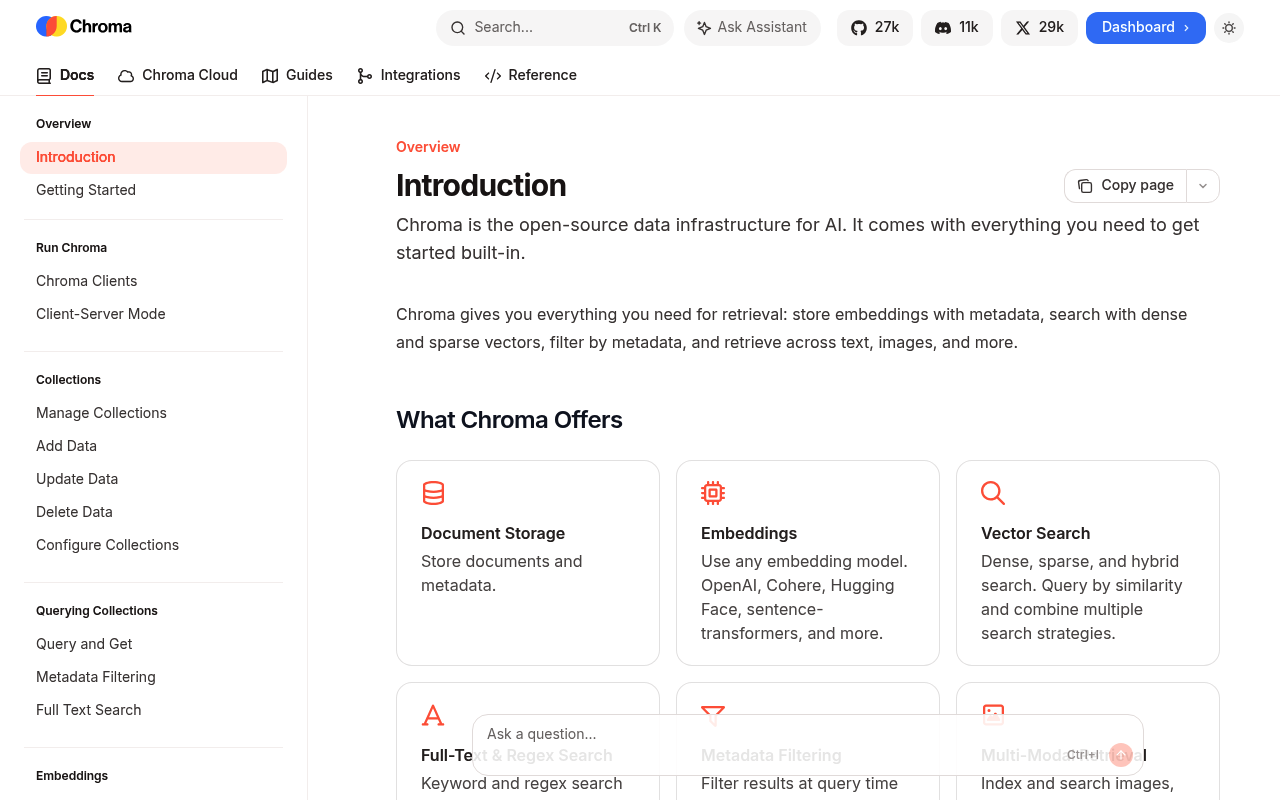
Chroma (Chroma DB) is an open-source AI-native embedding database designed to make it easy to build LLM applications by providing storage, retrieval, and management for vector embeddings, full-text search, regex search, and multi-modal retrieval (text, image, audio). Distributed under the Apache 2.0 license, Chroma can be self-hosted (single-node Python or distributed Rust-based deployment) or consumed via Chroma Cloud, a managed serverless vector database service offering usage-based pricing. Chroma is the open-source data infrastructure for AI agents and RAG (Retrieval-Augmented Generation) applications, with first-party SDKs for Python and JavaScript/TypeScript and integrations with leading embedding providers (OpenAI, Cohere, Hugging Face, sentence-transformers).
Chroma publishes 9 API contracts indexed on the APIs.io network, including Collections API, Databases API, Records API, and 6 more. Tagged areas include Artificial Intelligence, AI-Native, Apache 2.0, Cloud, and Embeddings.
The Chroma catalog on APIs.io includes 1 JSON-LD context and 1 Spectral governance ruleset.
Chroma’s developer surface includes authentication, documentation, developer portal, pricing, engineering blog, and 25 more developer resources.
Regulatory Posture applies to this provider. Its tags matched the
AI & Biometrics regime, so
Regulatory Posture carries 15 points of the composite.
If this regime is wrong for your business, say so on your
provider repo — the
applicability map is public and we will correct it.
Create-or-Update Ergonomics applies to this provider. This API accepts writes, so it
carries 10 points of the composite. It is scored from the published contracts
themselves: whether a caller can create-or-update in one call, whether the write accepts a key the caller already
holds, and whether the response says which branch ran. Without that, every write needs a search-and-branch in
front of it, and the first time that check is skipped a duplicate record is created.
Scored against the observed mean rather than raw — a provider at the catalog average is unchanged by this facet,
not penalised by it.
The six quality facets above are damped to 75 points between them,
because the conditional facet above carries the other
25. That is why each facet's contribution is shown against a damped
maximum: raising a quality facet moves the composite by 75% of its nominal
weight, not 100%. The full arithmetic is at apis.io/rating/.
Improve this rating by publishing the missing artifacts — every area above can be raised, and the full rubric is at apis.io/rating/. Every facet and dimension name above is a link: it opens that measurement's own page — what it means, the exact checks that feed it, how the whole catalog distributes on it, and the providers at the top of it. This rating is computed from github.com/api-evangelist/chroma: open an issue to ask a question, or submit a pull request to add artifacts.
Submit an artifact on GitHub — free →Manage your own listing — the Influence plan, $499/mo →
Markets this provider is in provisional
The Kin Score Market layer reads a provider inside its market:
its position, and how deep its integrations go. Depth is only comparable within a position. Provisional and unweighted:
not part of the Kin Score or agent readiness.
Registered MCP server and declares compatibility are report only — not weighted.
Undeclared means we found nothing we can read, so there is no number: we never infer integrations.
The Chroma Python Client is a first-party SDK for interacting with both self-hosted Chroma servers and Chroma Cloud. It provides a simple, developer-friendly interface with a co...
The Chroma JavaScript and TypeScript Client is a first-party SDK for interacting with Chroma from JavaScript or TypeScript applications. The v3 rewrite focused on reducing bundl...
Advanced search endpoints available exclusively in Chroma Cloud. Provides a unified interface for hybrid search operations combining vector similarity search with metadata filte...
Discovery needs no key. Ratings and market analysis are Pro.
Get an API key
Free tier, no form to fill in. Signing in shares your email address with us — we
store it to create your key and to recognise you if you sign in with another
provider. See our Privacy Policy and
Terms.
 Kin Score
How this is scored →