Blynk is a low-code / no-code IoT software platform that helps companies prototype, deploy, and remotely manage connected devices and applications across consumer and commercial markets. The platform combines four components — Blynk.Console (web dashboard), Blynk.Apps (white-labeled iOS and Android apps), Blynk.Edgent (device-side connection library), and Blynk.Cloud (managed backend) — into a full-stack offering that removes the need to build custom IoT infrastructure. Developers can build interactive mobile and web dashboards with a drag-and-drop builder, connect hardware over Wi-Fi, Cellular, LoRaWAN, Ethernet, or satellite, and operate fleets with provisioning, OTA firmware updates, multi-tenancy, automations, webhooks, and SOC 2 cloud infrastructure. Commercial customers use Blynk for branded consumer products, industrial monitoring, agriculture, energy and HVAC, smart cities, and smart buildings, with more than 5,000 companies and 1M+ developers on the platform. Blynk exposes two HTTPS REST APIs — the Device HTTPS API for telemetry and command exchange from individual hardware units, and the Platform HTTPS API (Enterprise plan) for full programmatic CRUD over devices, users, organizations, templates, automations, webhooks, and tags using OAuth2 client-credential authentication.
Blynk is listed with 3 APIs on the APIs.io network. Tagged areas include IoT, No-Code, Low-Code, Connected Devices, and Device Management.
Blynk’s developer surface includes developer portal, documentation, getting-started guide, signup flow, developer console, pricing, engineering blog, and 35 more developer resources.
Regulatory Posture applies to this provider. Its tags matched the
Energy & Utilities regime, so
Regulatory Posture carries 15 points of the composite.
If this regime is wrong for your business, say so on your
provider repo — the
applicability map is public and we will correct it.
Open Source Surface applies to this provider. This product is open source and we
read its repository directly, so Open Source Surface carries
10 points of the composite. It is scored from what the repository actually
publishes — a security policy, a contribution guide, a release history, a code of conduct — read live from the
provider rather than inferred from our own catalog pointers.
This facet adds; nothing was taken away to make room for it. An open-source project is not excused from
the commercial facets, because exemption would strip it of the points it does earn.
If we have the wrong repository, or this product is not open source, say so on your
provider repo and we
will drop the facet rather than have you publish against it.
Create-or-Update Ergonomics could not be measured. We hold no machine-readable contract for
this provider to read, so there is nothing to measure a write surface against. Excluded rather than scored zero:
never-measured and measured-empty are different facts. Publishing an OpenAPI is what makes this facet — and
several others — scorable at all.
The six quality facets above are damped to 75 points between them,
because both conditional facets apply and carry
25 points together. That is why each facet's contribution is shown against a damped
maximum: raising a quality facet moves the composite by 75% of its nominal
weight, not 100%. The full arithmetic is at apis.io/rating/.
Show this score on your site.
It updates itself when the score changes. Paste this where you link to your API docs:
<a href="https://apis.io/providers/blynk/"><img src="https://apis.io/badge/blynk/card.svg" alt="Blynk on APIs.io — Kin Score by API Evangelist"></a>
Other styles, a README pill and a shields.io endpoint are on the badge page.
Improve this rating by publishing the missing artifacts — every area above can be raised, and the full rubric is at apis.io/rating/. Every facet and dimension name above is a link: it opens that measurement's own page — what it means, the exact checks that feed it, how the whole catalog distributes on it, and the providers at the top of it. This rating is computed from github.com/api-evangelist/blynk: open an issue to ask a question, or submit a pull request to add artifacts.
Submit an artifact on GitHub — free →Manage your own listing — the Influence plan, $499/mo →
Markets this provider is in provisional
The Kin Score Market layer reads a provider inside its market:
its position, and how deep its integrations go. Depth is only comparable within a position. Provisional and unweighted:
not part of the Kin Score or agent readiness.
Registered MCP server and declares compatibility are report only — not weighted.
Undeclared means we found nothing we can read, so there is no number: we never infer integrations.
Token-authenticated HTTPS REST API used by individual devices to read and write datastream values, batch update multiple datastreams, retrieve historical data, set widget and da...
Enterprise-tier OAuth2 REST API for full programmatic CRUD across Blynk Cloud tenancy. Resources include devices (create from template, list, search, online status, tags, timeli...
Bi-directional low-latency streaming connection protocol used by the Blynk Library and Blynk.Edgent to maintain a persistent link between devices and Blynk.Cloud. Optimized for ...
Discovery needs no key. Ratings and market analysis are Pro.
Get an API key
Free tier, no form to fill in. Signing in shares your email address with us — we
store it to create your key and to recognise you if you sign in with another
provider. See our Privacy Policy and
Terms.
 Kin Score
How this is scored →
Kin Score
How this is scored →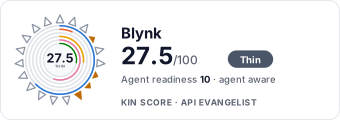 It updates itself when the score changes. Paste this where you link to your API docs: