Scratchpad is an AI-powered workspace for sales teams that sits on top of Salesforce, reducing the friction of keeping the CRM up to date. Reps manage notes, opportunities, tasks, and pipeline from a fast, lightweight interface that syncs everything back to Salesforce, with AI-native sheets and Kanban boards, an AI notetaker and call recorder, automated field updates, executive summaries, and CRM hygiene monitoring. The product connects to Salesforce via API and inherits its permissions and guardrails, and integrates with Slack, Zoom, and Gong. Founded in 2019 by Pouyan Salehi and Cyrus Karbassiyoon in San Francisco, and backed by Accel and Craft Ventures. Scratchpad publishes no REST API for its own Salesforce-native workspace, but the same company ships Clearskies (clearskies.cc), a Customer Context Graph delivered as a single remote MCP server at https://mcp.clearskies.cc/mcp, OAuth-protected with dynamic client registration and PKCE, that unifies Salesforce, HubSpot, Gong, Scratchpad, Gmail/Outlook, calendars, Slack, Linear, Jira and Pylon behind one endpoint for Claude, ChatGPT, Cursor, n8n and Retool. This profile captures Scratchpad identity, its commercial surface, its agent surface, and its security posture.
Scratchpad is listed with 1 API on the APIs.io network. Tagged areas include Company, Productivity, Sales, CRM, and Salesforce.
Scratchpad’s developer surface includes pricing, engineering blog, support, documentation, getting-started guide, signup flow, authentication, and 21 more developer resources.
Regulatory Posture applies to this provider. Its tags matched the
Horizontal (data, software, accessibility, platform) regime, so
Regulatory Posture carries 15 points of the composite.
If this regime is wrong for your business, say so on your
provider repo — the
applicability map is public and we will correct it.
Create-or-Update Ergonomics could not be measured. We hold no machine-readable contract for
this provider to read, so there is nothing to measure a write surface against. Excluded rather than scored zero:
never-measured and measured-empty are different facts. Publishing an OpenAPI is what makes this facet — and
several others — scorable at all.
The six quality facets above are damped to 85 points between them,
because the conditional facet above carries the other
15. That is why each facet's contribution is shown against a damped
maximum: raising a quality facet moves the composite by 85% of its nominal
weight, not 100%. The full arithmetic is at apis.io/rating/.
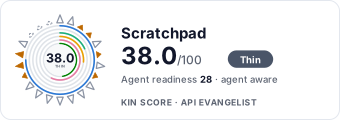
Show this score on your site.
It updates itself when the score changes. Paste this where you link to your API docs:
<a href="https://apis.io/providers/scratchpad/"><img src="https://apis.io/badge/scratchpad/card.svg" alt="Scratchpad on APIs.io — Kin Score by API Evangelist"></a>
Other styles, a README pill and a shields.io endpoint are on the badge page.
Raise your score.
Agent readiness — checks not met, largest first (exact, from this profile):
Idempotency+9 pts — OpenAPI mutating operations declare an idempotency key — a header, a request-body property, or a named de-duplication token whose own description says so (verified); else common[].type matches /idempoten/i (documented)
A2A Agent Card+8 pts — a2a/-a2a.yml manifest, graded on conformance.grade against A2A 1.0.0
Request/Response Examples+7 pts — share of operations carrying request/response examples; else an Examples / Code Samples link
Typed Event Surface+6 pts — AsyncAPI document, OR webhooks/callbacks objects in the as-published OpenAPI, OR common[].type includes Webhooks
6 more unmet checks in the Agent Readiness table above.
Kin Score — facets with the most composite points still available (weight × headroom):
The Kin Score Market layer reads a provider inside its market:
its position, and how deep its integrations go. Depth is only comparable within a position. Provisional and unweighted:
not part of the Kin Score or agent readiness.
Registered MCP server and declares compatibility are report only — not weighted.
Undeclared means we found nothing we can read, so there is no number: we never infer integrations.
Standards this provider implements or carries. De facto ones are profiled and measured by the API Commons; formal ones come from the standards directory and are linked by the provider's own tags. The evidence column says how each claim was established — not that it was made.
The Clearskies Customer Context Graph exposed as a single remote Model Context Protocol server. Connected AI clients (Claude, ChatGPT, Cursor, n8n, Retool) query unified, identi...
Calls without X-API-Key need no key. Calls with it need a paid plan — get a key.
Get an API key
Free tier, no form to fill in. Signing in shares your email address with us — we
store it to create your key and to recognise you if you sign in with another
provider. See our Privacy Policy and
Terms.
 Kin Score
How this is scored →
 It updates itself when the score changes. Paste this where you link to your API docs: