Rapidfolio
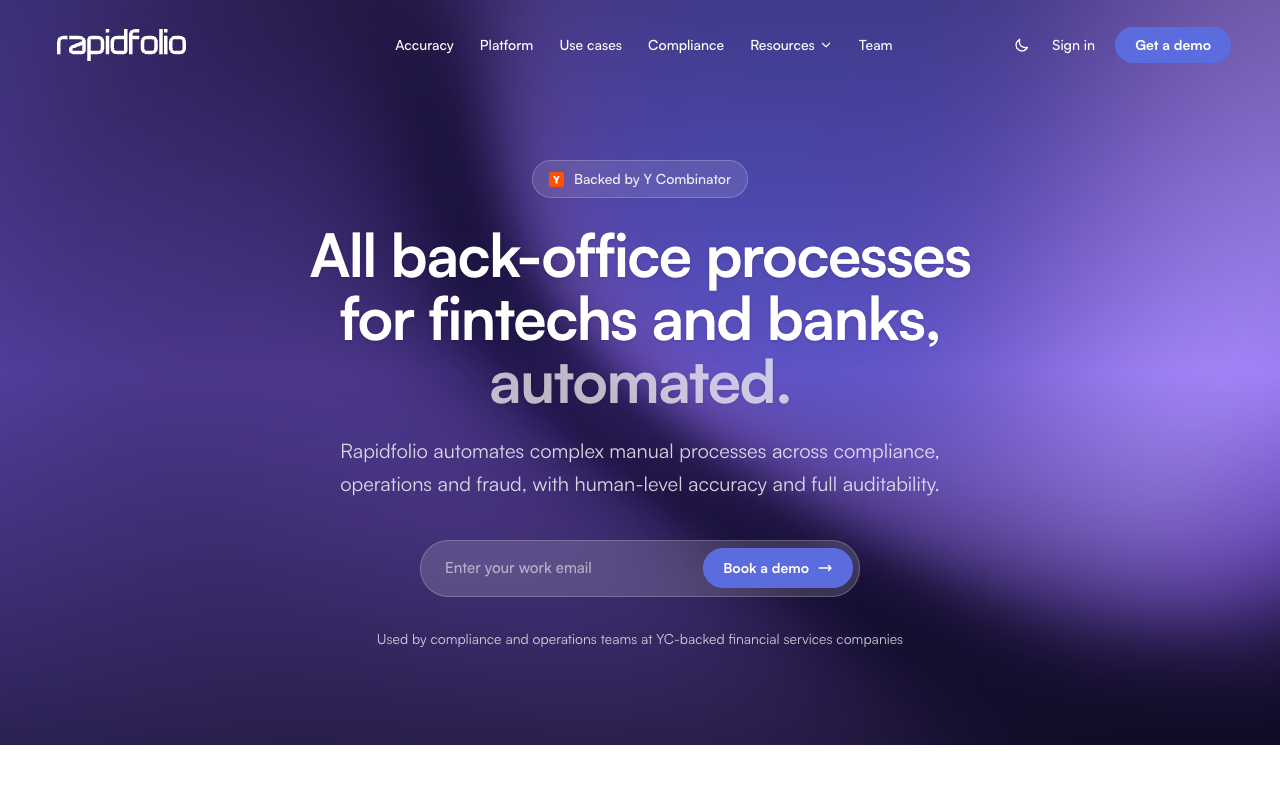
Rapidfolio is an AI operations platform for financial-services companies that automates back-office workflows — KYC/KYB and identity verification, lending underwriting, payment-dispute and fraud investigation, reconciliation, and OFAC/sanctions and regulatory reviews. Teams define procedures as visual workflow graphs (Tool Call, Human Review, Wait, and Condition nodes) and Rapidfolio's AI agent executes them with deterministic, auditable outputs and a complete per-run step log. It ships isolated Sandbox and Live environments, a Runner API and Dashboard API (API-key auth), HMAC-SHA256-signed webhooks, human-review approvals with idempotency keys, a Node.js Connection SDK for private connections to internal services, and 20+ built-in integrations (Slack, Jira, Linear, Stripe, GoCardless, Onfido, Alloy, Flagright, Xero). A Y Combinator (Summer 2026) company based in San Francisco.
Rapidfolio is listed with 1 API on the APIs.io network. Tagged areas include Company, Financial Services, Fintech, Workflow Automation, and Artificial Intelligence.
The Rapidfolio catalog on APIs.io includes 1 event-driven AsyncAPI specification.
Rapidfolio’s developer surface includes documentation, API reference, getting-started guide, signup flow, support, authentication, sandbox, and 18 more developer resources.
Kin Score
 Kin Score
How this is scored →
Kin Score
How this is scored →scored 2026-10-17 · rubric v0.24.0
APIs 1
Individual APIs this provider publishes, each with its own machine-readable definition.
Rapidfolio API
Runner API and Dashboard API for programmatically running procedures, managing runs, submitting human-review decisions, managing API keys, and subscribing to run events via webh...
Event Specifications 1
AsyncAPI definitions for this provider's event-driven and streaming APIs.
Rapidfolio Webhooks
ASYNCAPISecurity Posture 3
Authentication, domain security, vulnerability disclosure, and trust-center signals.
Resources
Get Started 4
Portal, sign-up, and the first successful call
Documentation 2
Reference material describing how the API behaves
Agent Surfaces 2
MCP servers, agent skills, and machine-readable catalogs
Design & Contract 4
Pagination, idempotency, versioning, errors, and events
Build 3
SDKs, sample code, and the tooling you integrate with
Access & Security 6
Authentication, authorization, and security posture
Operate 1
Status, limits, changes, and where to get help
Commercial 2
Pricing, plans, and the legal terms of use
Company 1
The organization behind the API
Source (apis.yml)
Work with this as data
Every provider here is available over the APIs.io API and to AI agents over MCP.