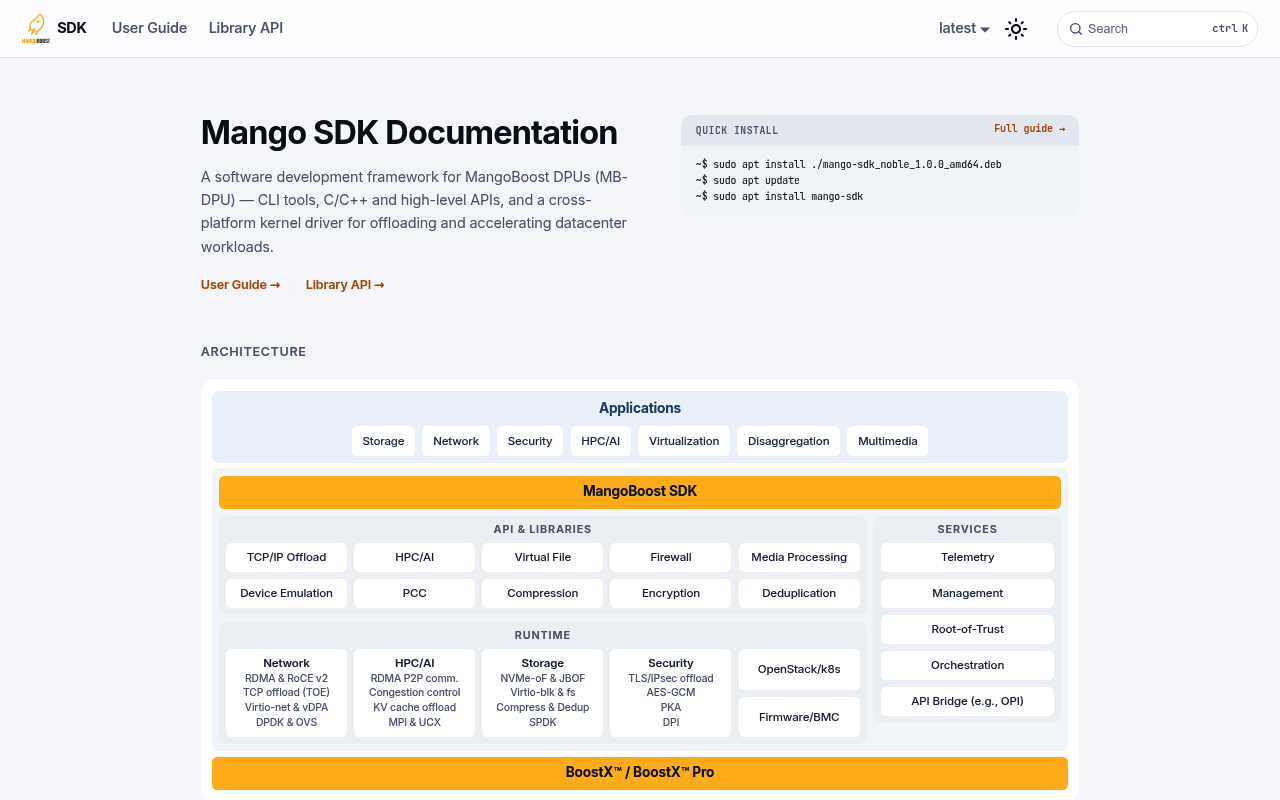
MangoBoost, Inc. builds full-stack Data Processing Unit (DPU) hardware and AI-infrastructure software for data centers. Founded in 2022 and headquartered in Seattle with operations in Canada and Korea, the company ships the Mango BoostX DPU family (RoCE AI / RDMA, NVMe-oF initiator and target, TCP Offload Engine), the Mango SDK — a C/C++ device library (libmango), CLI tools (mango-ctl, mango-smi) and an OPI-compliant gRPC storage bridge — and Mango LLMBoost, an enterprise LLM inference server that exposes a drop-in OpenAI-compatible REST API on customer-owned AMD Instinct GPUs. Its developer surface is self-hosted rather than SaaS: the LLMBoost server is distributed as a container plus the llmboost_hub (lbh) Python CLI, and the DPU is programmed through libmango and OPI gRPC on the card.
MangoBoost is listed with 3 APIs on the APIs.io network. Tagged areas include Company, Artificial Intelligence, Machine Learning, Infrastructure, and Data Center.
MangoBoost’s developer surface includes CLI, authentication, documentation, API reference, getting-started guide, support, engineering blog, and 21 more developer resources.
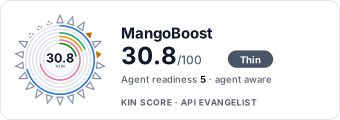
30.8/100thin▬ flatAgent5/100agent awareFront door AI6/6
dominant
Heartbeat100/100
alive
open core · Apache-2.0
Full breakdown ↓
scored 2026-11-06 · rubric v0.27.0 · Show this score on your site →
Regulatory Posture applies to this provider. Its tags matched the
Horizontal (data, software, accessibility, platform) regime, so
Regulatory Posture carries 15 points of the composite.
If this regime is wrong for your business, say so on your
provider repo — the
applicability map is public and we will correct it.
Open Source Surface applies to this provider. This product is open source and we
read its repository directly, so Open Source Surface carries
10 points of the composite. It is scored from what the repository actually
publishes — a security policy, a contribution guide, a release history, a code of conduct — read live from the
provider rather than inferred from our own catalog pointers.
This facet adds; nothing was taken away to make room for it. An open-source project is not excused from
the commercial facets, because exemption would strip it of the points it does earn.
If we have the wrong repository, or this product is not open source, say so on your
provider repo and we
will drop the facet rather than have you publish against it.
Create-or-Update Ergonomics could not be measured. We hold no machine-readable contract for
this provider to read, so there is nothing to measure a write surface against. Excluded rather than scored zero:
never-measured and measured-empty are different facts. Publishing an OpenAPI is what makes this facet — and
several others — scorable at all.
The six quality facets above are damped to 75 points between them,
because both conditional facets apply and carry
25 points together. That is why each facet's contribution is shown against a damped
maximum: raising a quality facet moves the composite by 75% of its nominal
weight, not 100%. The full arithmetic is at apis.io/rating/.
Show this score on your site.
It updates itself when the score changes. Paste this where you link to your API docs:
<a href="https://apis.io/providers/mangoboost/"><img src="https://apis.io/badge/mangoboost/card.svg" alt="MangoBoost on APIs.io — Kin Score by API Evangelist"></a>
Other styles, a README pill and a shields.io endpoint are on the badge page.
Raise your score.
Agent readiness — checks not met, largest first (exact, from this profile):
Idempotency+9 pts — OpenAPI mutating operations declare an idempotency key — a header, a request-body property, or a named de-duplication token whose own description says so (verified); else common[].type matches /idempoten/i (documented)
A2A Agent Card+8 pts — a2a/-a2a.yml manifest, graded on conformance.grade against A2A 1.0.0
Rate-Limit Signaling+7 pts — OpenAPI responses document X-RateLimit-* / RateLimit headers (verified), else a rate_limits artifact or RateLimits link (documented)
11 more unmet checks in the Agent Readiness table above.
Kin Score — facets with the most composite points still available (weight × headroom):
The Kin Score Market layer reads a provider inside its market:
its position, and how deep its integrations go. Depth is only comparable within a position. Provisional and unweighted:
not part of the Kin Score or agent readiness.
Registered MCP server and declares compatibility are report only — not weighted.
Undeclared means we found nothing we can read, so there is no number: we never infer integrations.
Standards this provider implements or carries. De facto ones are profiled and measured by the API Commons; formal ones come from the standards directory and are linked by the provider's own tags. The evidence column says how each claim was established — not that it was made.
LLMBoost is MangoBoost's enterprise LLM inference server. It serves the OpenAI REST API on /v1 so an existing OpenAI client migrates with a base-URL change: POST /v1/chat/comple...
The Mango SDK development package (libmango-dev) provides the C/C++ user API, libraries and example applications for programming MangoBoost DPU devices. Documented API groups ar...
MangoBoost ships an Open Programmable Infrastructure (OPI) gRPC bridge that translates standard OPI storage API calls into MangoBoost SDK / SPDK RPC calls on the DPU, so NVMe-oF...
aid: mangoboost
name: MangoBoost
description: 'MangoBoost, Inc. builds full-stack Data Processing Unit (DPU) hardware and AI-infrastructure software for data
  centers. Founded in 2022 and headquartered in Seattle with operations in Canada and Korea, the company ships the Mango BoostX
  DPU family (RoCE AI / RDMA, NVMe-oF initiator and target, TCP Offload Engine), the Mango SDK — a C/C++ device library (libmango),
  CLI tools (mango-ctl, mango-smi) and an OPI-compliant gRPC storage bridge — and Mango LLMBoost, an enterprise LLM inference
  server that exposes a drop-in OpenAI-compatible REST API on customer-owned AMD Instinct GPUs. Its developer surface is self-hosted
  rather than SaaS: the LLMBoost server is distributed as a container plus the llmboost_hub (lbh) Python CLI, and the DPU
  is programmed through libmango and OPI gRPC on the card.'
url: https://raw.githubusercontent.com/api-evangelist/mangoboost/refs/heads/main/apis.yml
deliveryModel:
  model: open-core
  license: Apache-2.0
  open_source: true
  commercial: true
  callable_host: false
  label: Open core · an OSS project plus a commercial hosted product
  confidence: high
  source:
  - license
  - pricing
  generated: '2026-08-28'
  method: derived
accessModel:
  pricing: unknown
  onboarding: open
  trial: false
  try_now: false
  public: false
  gated: none
  gated_source:
  - onboarding
  label: Open access
  confidence: low
  try_now_blocked_by: loopback
  probe_state: covered
  source:
  - authentication
  - security
  generated: '2026-11-06'
  method: derived
image: https://cdn.sanity.io/images/hx87iaks/production/044e3e87d4c32dc3c01996e772f4b3f7c08b873e-376x61.png
x-type: company
x-source: harvest:secondary-market
x-harvest-url: https://forgeglobal.com/mangoboost_stock/
x-tier: profiled
x-tier-reason: enrichment
specificationVersion: '0.23'
created: '2026-08-04'
modified: '2026-08-04'
x-docs-platform: docusaurus
x-docs-platform-confidence: medium
x-docs-platform-checked: 2026-10-03
x-docs-hosting: aws-cloudfront
tags:
- Company
- Artificial Intelligence
- Machine Learning
- Infrastructure
- Data Center
- Semiconductors
- Hardware
- Storage
- Networking
- Inference
- GPU
- DPU
tags_raw:
- Company
- Artificial Intelligence
- Machine Learning
- Infrastructure
- Data Center
- Semiconductors
- Hardware
- Storage
- Networking
- Inference
- GPU
- DPU
- Machine-Learning
- Data-Center
apis:
- aid: mangoboost:llmboost-inference
  name: Mango LLMBoost Inference Server API
  description: 'LLMBoost is MangoBoost''s enterprise LLM inference server. It serves the OpenAI REST API on /v1 so an existing
    OpenAI client migrates with a base-URL change: POST /v1/chat/completions, POST /v1/completions, POST /v1/embeddings, POST
    /v1/responses, POST /v1/audio/transcriptions and /translations, GET /v1/models, plus GET /health and GET /metrics (Prometheus).
    Streaming, JSON-schema structured output, tool/function calling and multimodal image input are supported. The server is
    self-hosted on the customer''s own AMD Instinct GPUs — there is no MangoBoost-hosted endpoint — and is started with `lbh
    serve <Repo/Model>` or `llmboost serve <model>` inside the LLMBoost container.'
  humanURL: https://llmboost.mangoboost.io/docs/features/openai-api
  baseURL: http://localhost:8000/v1
  x-deployment: self-hosted
  x-default-port: 8000
  tags:
  - Inference
  - Artificial Intelligence
  - LLM
  - OpenAI-Compatible
  - Self-Hosted
  tags_raw:
  - Inference
  - Artificial Intelligence
  - LLM
  - OpenAI Compatible
  - Self Hosted
  properties:
  - type: Documentation
    url: https://llmboost.mangoboost.io/docs/
  - type: GettingStarted
    url: https://llmboost.mangoboost.io/docs/quickstart
  - type: APIReference
    url: https://llmboost.mangoboost.io/docs/features/openai-api
- aid: mangoboost:mango-sdk
  name: Mango SDK Device API (libmango)
  description: The Mango SDK development package (libmango-dev) provides the C/C++ user API, libraries and example applications
    for programming MangoBoost DPU devices. Documented API groups are Common, Device Context, Memory, DMA Transfer, TCP/IP
    Offload, TLS Offload, POSIX (compatibility shims), AI Image Preprocess, GPU StorageBoost (GSB), RDMA PCC and Software-Defined
    Device. Applications include libmango.h and link with pkg-config; packages are distributed as .deb/.rpm (mango-sdk, mango-cli,
    libmango-dev, mango-drivers, mango-drivers-spdk) obtained by contacting MangoBoost.
  humanURL: https://sdk.mangoboost.io/docs/api/
  x-deployment: on-device-library
  tags:
  - SDK
  - DPU
  - Storage
  - Networking
  - RDMA
  properties:
  - type: Documentation
    url: https://sdk.mangoboost.io/docs/guide/
  - type: APIReference
    url: https://sdk.mangoboost.io/docs/api/
- aid: mangoboost:opi-storage-bridge
  name: Mango OPI Storage Bridge gRPC API
  description: MangoBoost ships an Open Programmable Infrastructure (OPI) gRPC bridge that translates standard OPI storage
    API calls into MangoBoost SDK / SPDK RPC calls on the DPU, so NVMe-oF initiator (NTI) and target (NTT) offloads can be
    configured with the vendor-neutral OPI interface. The bridge listens on gRPC port 50051 with an HTTP gateway on 8082;
    documented calls include CreateNvmeSubsystem, CreateNvmeController, CreateNvmeRemoteController, CreateNvmePath and CreateNvmeNamespace.
    The implementation is open source under the Linux Foundation OPI project as opi-mangoboost-bridge.
  humanURL: https://sdk.mangoboost.io/docs/guide/docs_opi/overview
  x-deployment: on-device-grpc
  x-default-port: 50051
  tags:
  - gRPC
  - Storage
  - NVMe-oF
  - OPI
  - DPU
  properties:
  - type: Documentation
    url: https://sdk.mangoboost.io/docs/guide/docs_opi/guide
  - type: SourceCode
    url: https://github.com/opiproject/opi-mangoboost-bridge
maintainers:
- FN: Kin Lane
  email: kin@apievangelist.com
- FN: APIs.json
  email: info@apis.io
common:
- type: IssueTracker
  url: https://github.com/opiproject/opi-mangoboost-bridge/issues
- type: Releases
  url: https://github.com/opiproject/opi-mangoboost-bridge/releases
- type: License
  name: Apache-2.0
  url: https://github.com/opiproject/opi-mangoboost-bridge/blob/main/LICENSE
- type: DomainSecurity
  url: security/mangoboost-domain-security.yml
- type: Packages
  url: packages/mangoboost-packages.yml
- type: SDKs
  url: packages/mangoboost-packages.yml
- type: CLI
  url: cli/mangoboost-cli.yml
- type: Authentication
  url: authentication/mangoboost-authentication.yml
- type: Conventions
  url: conventions/mangoboost-conventions.yml
- type: ErrorCatalog
  url: errors/mangoboost-error-codes.yml
- type: Lifecycle
  url: lifecycle/mangoboost-lifecycle.yml
- type: Conformance
  url: conformance/mangoboost-conformance.yml
- type: LLMsTxt
  url: llms/mangoboost-llms.txt
- type: Website
  url: https://www.mangoboost.io/
- type: DeveloperPortal
  url: https://sdk.mangoboost.io/
- type: Documentation
  url: https://llmboost.mangoboost.io/docs/
- type: APIReference
  url: https://sdk.mangoboost.io/docs/api/
- type: GettingStarted
  url: https://llmboost.mangoboost.io/docs/quickstart
- type: Support
  url: https://www.mangoboost.io/contact
- type: Blog
  url: https://www.mangoboost.io/resources/blog
- type: GitHubOrganization
  url: https://github.com/MangoBoost
- type: TermsOfService
  url: https://www.mangoboost.io/terms-of-service
- type: PrivacyPolicy
  url: https://www.mangoboost.io/privacy-policy
- type: Careers
  url: https://www.mangoboost.io/careers
- type: News
  url: https://www.mangoboost.io/media/news
- type: Publications
  url: https://www.mangoboost.io/resources/publications
- type: LinkedIn
  url: https://www.linkedin.com/company/mangoboost/
- type: Twitter
  url: https://x.com/mangoboost_inc
x-enrichment:
  date: '2026-08-04'
  status: enriched
  artifacts_added: 10
  pass: local-v1
x-coverage:
  state: covered
  reason: no-machine-readable-spec
  detail: Fully profiled from three live, server-rendered documentation hosts, but MangoBoost publishes no machine-readable
    contract for any of its three API surfaces — /openapi.json, /openapi.yaml, /swagger.json, /api-docs and /redoc all return
    404 on www., sdk. and llmboost.mangoboost.io, and the OPI gRPC bridge ships no first-party .proto. The LLMBoost server
    is OpenAI-compatible, so an OpenAPI describing its /v1 surface would be cheap for them to publish.
  evidence:
  - url: https://llmboost.mangoboost.io/docs/features/openai-api
    status: 200
  - url: https://sdk.mangoboost.io/docs/api/
    status: 200
  - url: https://llmboost.mangoboost.io/openapi.json
    status: 404
  - url: https://www.mangoboost.io/llms.txt
    status: 404
  checked: '2026-08-04'
MangoBoost API — frequently asked questions
Does MangoBoost have an API?
Yes. APIs.io lists 3 APIs from MangoBoost, including Mango LLMBoost Inference Server API, Mango SDK Device API (libmango) and Mango OPI Storage Bridge gRPC API.
How do I authenticate with the MangoBoost API?
MangoBoost uses bearer-token authentication (0 schemes). The details are profiled on APIs.io as Mangoboost Authentication.
Is the MangoBoost API ready for AI agents?
MangoBoost has a Kin Score of 30.8 out of 100 (thin) and an Agent Readiness score of 5.4 (agent-aware), scored by API Evangelist on 2026-11-06.
Calls without X-API-Key need no key. Calls with it need a paid plan — get a key.
Get an API key
Free tier, no form to fill in. Signing in shares your email address with us — we
store it to create your key and to recognise you if you sign in with another
provider. See our Privacy Policy and
Terms.
 Kin Score
How this is scored →
 It updates itself when the score changes. Paste this where you link to your API docs: