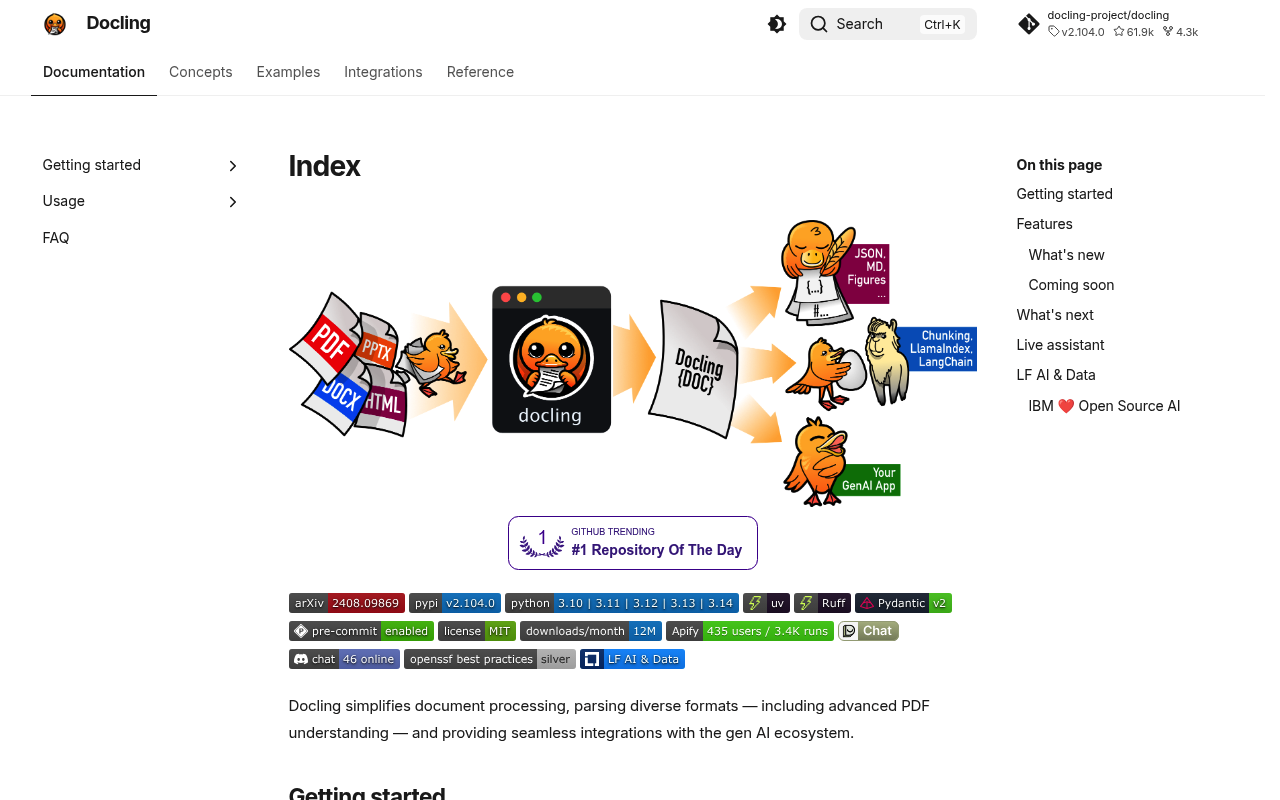
Docling is an open-source toolkit for parsing diverse document formats — PDF, DOCX, PPTX, XLSX, HTML, images, audio, LaTeX, plain text — into a unified, lossless DoclingDocument representation that downstream generative AI and RAG systems can consume directly. It pairs IBM Research's DocLayout and TableFormer models with the GraniteDocling visual language model and pluggable OCR engines, runs entirely locally for air-gapped use, and ships as a Python library and CLI, a FastAPI HTTP service (docling-serve), an MCP server (docling-mcp), and a Kubernetes operator. Originally created by IBM Research Zurich; now hosted by the LF AI and Data Foundation under the MIT license.
Docling publishes 18 API contracts indexed on the APIs.io network, including Async API, Convert API, System API, and 15 more. Tagged areas include Documents, Parsing, PDF, OCR, and Layout.
The Docling catalog on APIs.io includes 1 JSON-LD context and 2 Spectral governance rulesets.
Docling’s developer surface includes developer portal, documentation, getting-started guide, CLI, release notes, changelog, engineering blog, and 24 more developer resources.
Regulatory Posture applies to this provider. Its tags matched the
AI & Biometrics regime, so
Regulatory Posture carries 15 points of the composite.
If this regime is wrong for your business, say so on your
provider repo — the
applicability map is public and we will correct it.
Open Source Surface applies to this provider. This product is open source and we
read its repository directly, so Open Source Surface carries
10 points of the composite. It is scored from what the repository actually
publishes — a security policy, a contribution guide, a release history, a code of conduct — read live from the
provider rather than inferred from our own catalog pointers.
This facet adds; nothing was taken away to make room for it. An open-source project is not excused from
the commercial facets, because exemption would strip it of the points it does earn.
If we have the wrong repository, or this product is not open source, say so on your
provider repo and we
will drop the facet rather than have you publish against it.
Create-or-Update Ergonomics applies to this provider. This API accepts writes, so it
carries 10 points of the composite. It is scored from the published contracts
themselves: whether a caller can create-or-update in one call, whether the write accepts a key the caller already
holds, and whether the response says which branch ran. Without that, every write needs a search-and-branch in
front of it, and the first time that check is skipped a duplicate record is created.
Scored against the observed mean rather than raw — a provider at the catalog average is unchanged by this facet,
not penalised by it.
The six quality facets above are damped to 65 points between them,
because both conditional facets apply and carry
35 points together. That is why each facet's contribution is shown against a damped
maximum: raising a quality facet moves the composite by 65% of its nominal
weight, not 100%. The full arithmetic is at apis.io/rating/.
Show this score on your site.
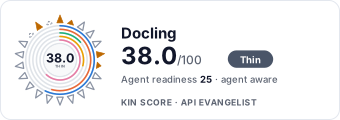
It updates itself when the score changes. Paste this where you link to your API docs:
<a href="https://apis.io/providers/docling/"><img src="https://apis.io/badge/docling/card.svg" alt="Docling on APIs.io — Kin Score by API Evangelist"></a>
Other styles, a README pill and a shields.io endpoint are on the badge page.
Raise your score.
Agent readiness — checks not met, largest first (exact, from this profile):
MCP Server+12 pts — deployment.mode + probe verdict on the mcp/ manifest, not the pointer; an unprobed slug falls back to authorship
Machine-Readable Auth+10 pts — a served openid-configuration/oauth-authorization-server carrying `issuer` (served), else the securitySchemes class in the provider OpenAPIs — bound (mutualTLS, DPoP, Signature) > negotiable (oauth2 authorizationCode/clientCredentials, openIdConnect) > bearer (http bearer, apiKey)
Idempotency+9 pts — OpenAPI mutating operations declare an idempotency key — a header, a request-body property, or a named de-duplication token whose own description says so (verified); else common[].type matches /idempoten/i (documented)
A2A Agent Card+8 pts — a2a/-a2a.yml manifest, graded on conformance.grade against A2A 1.0.0
Rate-Limit Signaling+7 pts — OpenAPI responses document X-RateLimit-* / RateLimit headers (verified), else a rate_limits artifact or RateLimits link (documented)
The Kin Score Market layer reads a provider inside its market:
its position, and how deep its integrations go. Depth is only comparable within a position. Provisional and unweighted:
not part of the Kin Score or agent readiness.
Registered MCP server and declares compatibility are report only — not weighted.
Undeclared means we found nothing we can read, so there is no number: we never infer integrations.
Standards this provider implements or carries. De facto ones are profiled and measured by the API Commons; formal ones come from the standards directory and are linked by the provider's own tags. The evidence column says how each claim was established — not that it was made.
Model Context Protocol server that exposes Docling document parsing as MCP tools so Claude, Cursor, Gemini, and other MCP-aware agents can convert PDFs, Office files, and images...
Canonical `DoclingDocument` data model and serialization primitives — text, tables, pictures, layout, hierarchy, bounding boxes, provenance — shared by the Docling library, Docl...
Native C++ PDF parsing engine used by Docling to extract text with precise coordinates from programmatic (non-scanned) PDF files. Distributed as a Python extension.
Open-weight IBM Research models that power Docling's understanding pipeline — DocLayout (layout detection and reading order), TableFormer (table structure), code- and formula-re...
End-to-end evaluation framework for document parsing models and services. Provides standard datasets and metrics for layout, tables, OCR, and reading-order quality so teams can ...
Tools for synthesizing labeled document data from real corpora — useful for fine-tuning layout, table, and reading-order models, and for stress-testing downstream RAG pipelines.
Transform unstructured documents — once normalized to `DoclingDocument` — into validated, rich, queryable knowledge graphs. Intended for GraphRAG and entity-extraction workflows...
Reference agent that reads, writes, and edits documents using Docling as the IO layer. Demonstrates how Docling output composes with tool-using LLMs to produce structured edits.
Go-based Kubernetes operator that deploys and manages Docling Serve workloads — model cache PVCs, GPU/CPU pools, RQ workers, replica sets with sticky sessions, OAuth — from a si...
A Java API for Docling that lets JVM applications call into the Docling pipeline. Complementary to `docling4j`, which targets Java-native document understanding integrations.
Calls without X-API-Key need no key. Calls with it need a paid plan — get a key.
Get an API key
Free tier, no form to fill in. Signing in shares your email address with us — we
store it to create your key and to recognise you if you sign in with another
provider. See our Privacy Policy and
Terms.
 Kin Score
How this is scored →
 It updates itself when the score changes. Paste this where you link to your API docs: