DailyPay is an on-demand pay (earned wage access) platform that lets employees access wages they have already earned before the scheduled payday. The company sells to employers across healthcare, retail, restaurants, manufacturing, hospitality and the public sector, and integrates with 180+ HCM, payroll and time-management systems. Its developer surface — the DailyPay REST API — is a json:api-shaped OAuth 2.0 / OpenID Connect API covering people, jobs, organizations, paychecks, accounts (including the EARNINGS_BALANCE account that carries available earnings), transfers and PCI-scoped debit-card tokenization, complemented by DailyPay Elements, a set of hosted drop-in iframe components for embedding on-demand pay into partner applications.
DailyPay publishes 8 API contracts indexed on the APIs.io network, including Accounts API, Card Tokenization API, Health API, and 5 more. Tagged areas include Company, Payments, Payroll, Human Resources, and Earned Wage Access.
The DailyPay catalog on APIs.io includes 1 Spectral governance ruleset.
DailyPay’s developer surface includes documentation, API reference, getting-started guide, authentication, support, engineering blog, signup flow, and 40 more developer resources.
Regulatory Posture applies to this provider. Its tags matched the
Payments regime, so
Regulatory Posture carries 15 points of the composite.
If this regime is wrong for your business, say so on your
provider repo — the
applicability map is public and we will correct it.
Create-or-Update Ergonomics applies to this provider. This API accepts writes, so it
carries 10 points of the composite. It is scored from the published contracts
themselves: whether a caller can create-or-update in one call, whether the write accepts a key the caller already
holds, and whether the response says which branch ran. Without that, every write needs a search-and-branch in
front of it, and the first time that check is skipped a duplicate record is created.
Scored against the observed mean rather than raw — a provider at the catalog average is unchanged by this facet,
not penalised by it.
The six quality facets above are damped to 75 points between them,
because the conditional facet above carries the other
25. That is why each facet's contribution is shown against a damped
maximum: raising a quality facet moves the composite by 75% of its nominal
weight, not 100%. The full arithmetic is at apis.io/rating/.
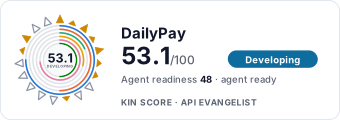
Show this score on your site.
It updates itself when the score changes. Paste this where you link to your API docs:
<a href="https://apis.io/providers/dailypay/"><img src="https://apis.io/badge/dailypay/card.svg" alt="DailyPay on APIs.io — Kin Score by API Evangelist"></a>
Other styles, a README pill and a shields.io endpoint are on the badge page.
Raise your score.
Agent readiness — checks not met, largest first (exact, from this profile):
Rate-Limit Signaling+7 pts — OpenAPI responses document X-RateLimit-* / RateLimit headers (verified), else a rate_limits artifact or RateLimits link (documented) Ask about this →
Typed Event Surface+6 pts — AsyncAPI document, OR webhooks/callbacks objects in the as-published OpenAPI, OR common[].type includes Webhooks Ask about this →
Pagination+5 pts — share of collection GETs (an array, or one wrapped in data/items/results ...) that declare a page/limit/offset/cursor parameter, a Link header or a next/cursor field; na with no collection GETs Ask about this →
4 more unmet checks in the Agent Readiness table above.
Kin Score — facets with the most composite points still available (weight × headroom):
Each check links to what satisfies it. Publish the artifact, or tell us where it already lives, and the score moves on the next scoring run.
Not sure how this applies to your stack? Ask about any one item. Kin Lane reads every question, looks at your profile and your situation, and replies with what a fix would take — scoped to that one area, priced up front, yours whether you ship it or not. Ask a question →
The Kin Score Market layer reads a provider inside its market:
its position, and how deep its integrations go. Depth is only comparable within a position. Provisional and unweighted:
not part of the Kin Score or agent readiness.
Registered MCP server and declares compatibility are report only — not weighted.
Undeclared means we found nothing we can read, so there is no number: we never infer integrations.
Standards this provider implements or carries. De facto ones are profiled and measured by the API Commons; formal ones come from the standards directory and are linked by the provider's own tags. The evidence column says how each claim was established — not that it was made.
The _accounts_ endpoint provides comprehensive information about money accounts. You can retrieve account details, including the account's unique ID, a link to the account holde...
The _health_ endpoint provides a simple health check for the API. **Functionality:** Check the status of the API to ensure it is functioning correctly.
The _jobs_ endpoint provides access to comprehensive information about a person's employment. It enables you to retrieve details about individual jobs, including information abo...
The _organizations_ endpoint provides details about a business entity, such as an employer, or a group of people, such as a division. The response includes the organization name...
The _paychecks_ endpoint provides detailed information about paychecks. You can retrieve individual paycheck details, including the person and job associated with the paycheck, ...
The _people_ endpoint allows you to see information related to who owns resources such as jobs and accounts. **Functionality:** Retrieve limited details about a person, includin...
The _transfers_ endpoint allows you to initiate and track money movement. You can access transfer details, including the transfer's unique ID, amount, currency, status, schedule...
Overlays applied on top of this provider's contracts. Each card says who wrote it: a document the provider publishes, or one API Evangelist derived or generated.
Calls without X-API-Key need no key. Calls with it need a paid plan — get a key.
Get an API key
Free tier, no form to fill in. Signing in shares your email address with us — we
store it to create your key and to recognise you if you sign in with another
provider. See our Privacy Policy and
Terms.
 Kin Score
How this is scored →
 It updates itself when the score changes. Paste this where you link to your API docs: