Chamber
Chamber is an AIOps control plane for enterprise AI infrastructure (Y Combinator W26, Seattle). Its always-on agent — Chambie — monitors, diagnoses, and automatically resolves GPU workload failures across AWS, GCP, Azure, and on-premise Kubernetes clusters, and optimizes utilization so ML teams can run more workloads on the same GPUs without manual intervention. Chamber ships a REST API, an official Python SDK (chamber-sdk), and a `chamber` CLI for submitting GPU workloads, querying capacity budgets and GPU-hour allocations, and reading GPU utilization / memory / temperature / power metrics, plus Slack and email integrations and Terraform modules for GPU-ready EKS and GKE clusters.
Chamber publishes 4 API contracts indexed on the APIs.io network, including Capacity API, Health API, Metrics API, and 1 more. Tagged areas include GPU, AIOps, Machine Learning, MLOps, and Infrastructure.
The Chamber catalog on APIs.io includes 1 Spectral governance ruleset.
Chamber’s developer surface includes documentation, API reference, getting-started guide, support, engineering blog, pricing, signup flow, and 22 more developer resources.
What this lets a business do 1
Business capabilities this provider's published APIs can perform, derived from its own contracts. Browse all capabilities →
Kin Score
 Kin Score
How this is scored →
scored 2026-11-06 · rubric v0.27.0
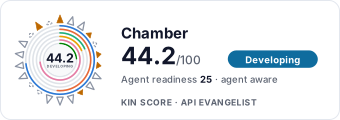 It updates itself when the score changes. Paste this where you link to your API docs:
<a href="https://apis.io/providers/chamber/"><img src="https://apis.io/badge/chamber/card.svg" alt="Chamber on APIs.io — Kin Score by API Evangelist"></a>Other styles, a README pill and a shields.io endpoint are on the badge page.
- MCP Server +12 pts — deployment.mode + probe verdict on the mcp/ manifest, not the pointer; an unprobed slug falls back to authorship
- Agentic Access Contract +10 pts — agentic_access artifact present (x-agentic-access), graded by author
- A2A Agent Card +8 pts — a2a/
-a2a.yml manifest, graded on conformance.grade against A2A 1.0.0 - Rate-Limit Signaling +7 pts — OpenAPI responses document X-RateLimit-* / RateLimit headers (verified), else a rate_limits artifact or RateLimits link (documented)
- Registration Without a Human +6 pts — a `registration_endpoint` in the served RFC 8414 / OIDC discovery document
- Delegated User Identity +6 pts — a served discovery document listing authorization_code in grant_types_supported (served), else an oauth2 authorizationCode flow or openIdConnect declared in an OpenAPI (documented)
- Access Clarity scores 23.7 — up to +15.3 composite points
- Contract Quality scores 51.4 — up to +12.2 composite points
- Operational Transparency scores 18.4 — up to +10.6 composite points
Markets this provider is in provisional
The Kin Score Market layer reads a provider inside its market: its position, and how deep its integrations go. Depth is only comparable within a position. Provisional and unweighted: not part of the Kin Score or agent readiness.
| Market | Position | Depth | Registered MCP server | Declares compatibility |
|---|---|---|---|---|
| MLOps and AI/ML Infrastructure (LF AI & Data, MLPerf, Kubeflow) | undeclared | - | - | 1 |
Registered MCP server and declares compatibility are report only — not weighted. Undeclared means we found nothing we can read, so there is no number: we never infer integrations.
Standards implemented 1
Standards this provider implements or carries. De facto ones are profiled and measured by the API Commons; formal ones come from the standards directory and are linked by the provider's own tags. The evidence column says how each claim was established — not that it was made.
APIs 4
Individual APIs this provider publishes, each with its own machine-readable definition.
Chamber Capacity API
Check budget allocations and remaining GPU hours
Chamber Health API
Service health check
Chamber Metrics API
Query GPU utilization, memory, temperature, and power metrics
Chamber Workloads API
List, retrieve, and get statistics for GPU workloads
Open Collections 4
Open, tool-agnostic API collections (OpenAPI-derived and Bruno).
Chamber Capacity API
OPEN COLLECTIONChamber Capacity Health API
OPEN COLLECTIONChamber Capacity Metrics API
OPEN COLLECTIONChamber Capacity Workloads API
OPEN COLLECTIONAgent Skills 2
Packaged agent skills for driving this provider's APIs from an AI assistant.
Monitor GPU workloads
AGENT SKILLTrack GPU capacity and spend
AGENT SKILLChamber API pricing
Pricing Plans 1
Published pricing tiers and plan structures.
FinOps 1
Cost, billing, and metering signals for API financial operations.
Chamber Finops
FINOPSSpectral Rules 1
Spectral governance rulesets for linting and validating these APIs.
Chamber API Rules
SPECTRALOpenAPI Overlays 1
Overlays applied on top of this provider's contracts. Each card says who wrote it: a document the provider publishes, or one API Evangelist derived or generated.
Chamber Openapi Overlay
DERIVEDSecurity Posture 2
Authentication, domain security, vulnerability disclosure, and trust-center signals.
Resources
Get Started 4
Portal, sign-up, and the first successful call
Documentation 2
Reference material describing how the API behaves
Agent Surfaces 4
MCP servers, agent skills, and machine-readable catalogs
Design & Contract 5
Pagination, idempotency, versioning, errors, and events
Build 4
SDKs, sample code, and the tooling you integrate with
Access & Security 2
Authentication, authorization, and security posture
Operate 2
Status, limits, changes, and where to get help
Commercial 2
Pricing, plans, and the legal terms of use
Company 2
The organization behind the API
Other 2
Properties that don't map to a standard resource type
Source (apis.yml)
Chamber API — frequently asked questions
Does Chamber have an API?
Yes. APIs.io lists 4 APIs from Chamber, including Chamber Capacity API, Chamber Health API and Chamber Metrics API, and 1 more.
Is there an OpenAPI specification for the Chamber API?
Yes. APIs.io indexes 4 OpenAPI specifications for Chamber, each linked for download from this page.
How do I authenticate with the Chamber API?
Chamber uses bearer-token authentication (http · 1 scheme). The details are profiled on APIs.io as Chamber Authentication.
Is the Chamber API ready for AI agents?
Chamber has a Kin Score of 44.2 out of 100 (developing) and an Agent Readiness score of 24.6 (agent-aware), scored by API Evangelist on 2026-11-06.
Work with this as data
Every provider here is available over the APIs.io API and to AI agents over MCP.