
Kojo Technologies
Kojo Technologies (formerly Agora Systems) builds construction materials management software for trade contractors — electrical, mechanical, plumbing, concrete and specialty trades. The Kojo platform centralizes procurement and purchasing, field requisitions from a mobile app, warehouse and inventory management, tool tracking, prefab workflows, project operations, and AI-assisted accounts payable invoice capture and matching. Kojo connects contractors to more than two hundred material suppliers and integrates with fifteen-plus construction accounting and project management systems including Procore, Autodesk, Sage, Acumatica, CMiC, Vista, Spectrum, FOUNDATION and QuickBooks. Kojo is backed by Battery Ventures. As of this profile Kojo publishes no public developer portal, API reference, or open API program — integration is delivered through its own supplier and ERP connectors rather than a self-serve developer API.
Kojo Technologies is profiled on the APIs.io network. Tagged areas include Company, Construction, Construction Technology, Procurement, and Supply Chain.
Kojo Technologies’ developer surface includes pricing, support, engineering blog, and 17 more developer resources.
Kin Score
 Kin Score
How this is scored →
scored 2026-11-02 · rubric v0.26.0
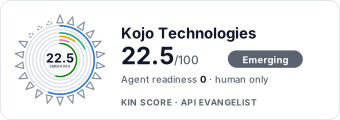 It updates itself when the score changes. Paste this where you link to your API docs:
<a href="https://apis.io/providers/kojo-technologies/"><img src="https://apis.io/badge/kojo-technologies/card.svg" alt="Kojo Technologies on APIs.io — Kin Score by API Evangelist"></a>Other styles, a README pill and a shields.io endpoint are on the badge page.
- Machine-Readable Contract +18 pts — api_specs includes an OpenAPI document
- MCP Server +12 pts — deployment.mode + probe verdict on the mcp/ manifest, not the pointer; an unprobed slug falls back to authorship
- Agentic Access Contract +10 pts — agentic_access artifact present (x-agentic-access), graded by author
- Machine-Readable Auth +10 pts — a served openid-configuration/oauth-authorization-server carrying `issuer` (served), else the securitySchemes class in the provider OpenAPIs — bound (mutualTLS, DPoP, Signature) > negotiable (oauth2 authorizationCode/clientCredentials, openIdConnect) > bearer (http bearer, apiKey)
- Idempotency +9 pts — OpenAPI mutating operations declare an idempotency key — a header, a request-body property, or a named de-duplication token whose own description says so (verified); else common[].type matches /idempoten/i (documented)
- Stable Error Semantics +8 pts — OpenAPI $refs a shared error schema across 4xx/5xx responses (verified), else common[].type includes ErrorCatalog / ErrorCodes / DeclineCodes
- Contract Quality scores 0.0 — up to +25.0 composite points
- Developer Ergonomics scores 7.1 — up to +18.6 composite points
- Operational Transparency scores 10.5 — up to +11.6 composite points
Markets this provider is in provisional
The Kin Score Market layer reads a provider inside its market: its position, and how deep its integrations go. Depth is only comparable within a position. Provisional and unweighted: not part of the Kin Score or agent readiness.
| Market | Position | Depth | Registered MCP server | Declares compatibility |
|---|---|---|---|---|
| Procurement and B2B Buying (source-to-pay suites, spend management) | standard | 17.2 (thin) | - | - |
Registered MCP server and declares compatibility are report only — not weighted. Undeclared means we found nothing we can read, so there is no number: we never infer integrations.
Security Posture 2
Authentication, domain security, vulnerability disclosure, and trust-center signals.
Resources
Get Started 1
Portal, sign-up, and the first successful call
Documentation 1
Reference material describing how the API behaves
Agent Surfaces 2
MCP servers, agent skills, and machine-readable catalogs
Design & Contract 2
Pagination, idempotency, versioning, errors, and events
Access & Security 4
Authentication, authorization, and security posture
Operate 2
Status, limits, changes, and where to get help
Commercial 3
Pricing, plans, and the legal terms of use
Company 4
The organization behind the API
Other 1
Properties that don't map to a standard resource type
Source (apis.yml)
Work with this as data
Every provider here is available over the APIs.io API and to AI agents over MCP.