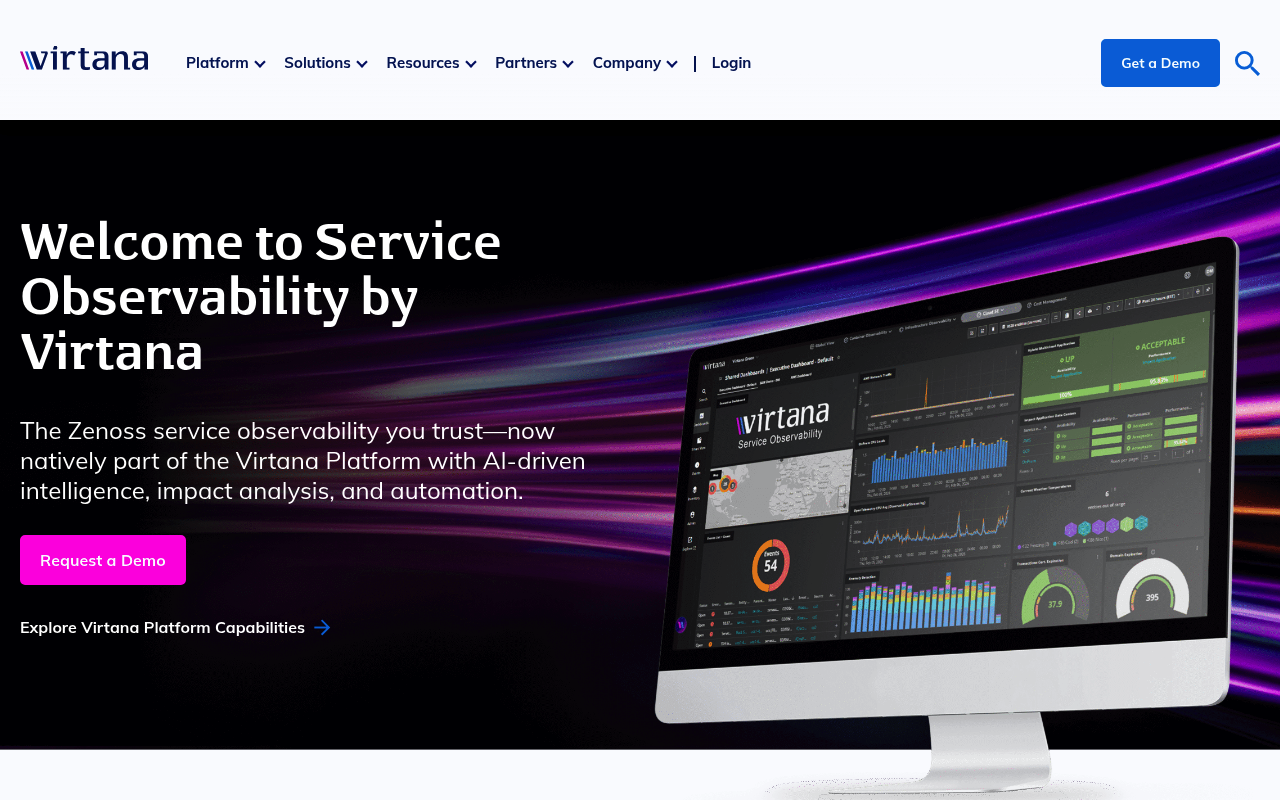
Zenoss is an AIOps and full-stack IT infrastructure monitoring platform, acquired by Virtana in May 2025 and now sold as Virtana Service Observability. It ingests metrics, events and entity models from hybrid estates — VMware, Nutanix, Kubernetes, AWS, Azure, GCP, network and storage — through on-premises Collection Zones, streaming agents and OpenTelemetry/OTLP, then applies dependency mapping, event correlation and anomaly detection to turn raw signal into service impact. The developer surface is a versioned /v1 REST API covering data ingest, event query and management, entity/model context, maintenance windows, the metric dictionary, notification Actions, credentials and user management, plus first-party proto3/gRPC contracts for the data receiver and data registry. API clients authenticate with a long-lived key in the zenoss-api-key header, issued per API Client from the console, and each tenant is assigned one of four regional endpoints.
Zenoss is listed with 3 APIs on the APIs.io network. Tagged areas include AIOps, Monitoring, Observability, Infrastructure, and Hybrid Cloud.
The Zenoss catalog on APIs.io includes 1 event-driven AsyncAPI specification.
Zenoss’ developer surface includes documentation, API reference, getting-started guide, engineering blog, support, changelog, authentication, and 29 more developer resources.
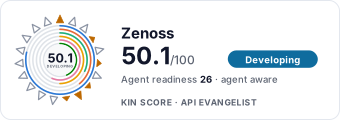
48.9/100developing▬ flatAgent26/100agent awareFront door AI6/6
dominant
Heartbeat100/100
alive
saas
Full breakdown ↓
scored 2026-11-13 · rubric v0.28.0 · Show this score on your site →
Regulatory Posture applies to this provider. Its tags matched the
Horizontal (data, software, accessibility, platform) regime, so
Regulatory Posture carries 15 points of the composite.
If this regime is wrong for your business, say so on your
provider repo — the
applicability map is public and we will correct it.
Create-or-Update Ergonomics could not be measured. We hold no machine-readable contract for
this provider to read, so there is nothing to measure a write surface against. Excluded rather than scored zero:
never-measured and measured-empty are different facts. Publishing an OpenAPI is what makes this facet — and
several others — scorable at all.
The six quality facets above are damped to 85 points between them,
because the conditional facet above carries the other
15. That is why each facet's contribution is shown against a damped
maximum: raising a quality facet moves the composite by 85% of its nominal
weight, not 100%. The full arithmetic is at apis.io/rating/.
Show this score on your site.
It updates itself when the score changes. Paste this where you link to your API docs:
<a href="https://apis.io/providers/zenoss/"><img src="https://apis.io/badge/zenoss/card.svg" alt="Zenoss on APIs.io — Kin Score by API Evangelist"></a>
Other styles, a README pill and a shields.io endpoint are on the badge page.
Raise your score.
Agent readiness — checks not met, largest first (exact, from this profile):
MCP Server+12 pts — deployment.mode + probe verdict on the mcp/ manifest, not the pointer; an unprobed slug falls back to authorship Ask about this →
Idempotency+9 pts — OpenAPI mutating operations declare an idempotency key — a header, a request-body property, or a named de-duplication token whose own description says so (verified); else common[].type matches /idempoten/i (documented) Ask about this →
Each check links to what satisfies it. Publish the artifact, or tell us where it already lives, and the score moves on the next scoring run.
Not sure how this applies to your stack? Ask about any one item. Kin Lane reads every question, looks at your profile and your situation, and replies with what a fix would take — scoped to that one area, priced up front, yours whether you ship it or not. Ask a question →
The Kin Score Market layer reads a provider inside its market:
its position, and how deep its integrations go. Depth is only comparable within a position. Provisional and unweighted:
not part of the Kin Score or agent readiness.
Registered MCP server and declares compatibility are report only — not weighted.
Undeclared means we found nothing we can read, so there is no number: we never infer integrations.
Standards this provider implements or carries. De facto ones are profiled and measured by the API Commons; formal ones come from the standards directory and are linked by the provider's own tags. The evidence column says how each claim was established — not that it was made.
Versioned /v1 REST API for the Zenoss (Virtana Service Observability) platform. Covers the data receiver (metrics, events, entity models), event query and event management, mode...
First-party proto3 service contracts published at github.com/zenoss/zenoss-protobufs and released as a Go module (v1.5.5, 2026-07-27). DataReceiverService carries unary PutEvent...
The long-standing Zenoss JSON router API, still documented and supported for Zenoss Cloud Collection Zones and on-premises Zenoss Resource Manager / Service Dynamics. Every call...
aid: zenoss
name: Zenoss
description: Zenoss is an AIOps and full-stack IT infrastructure monitoring platform, acquired by Virtana in May 2025 and
  now sold as Virtana Service Observability. It ingests metrics, events and entity models from hybrid estates — VMware, Nutanix,
  Kubernetes, AWS, Azure, GCP, network and storage — through on-premises Collection Zones, streaming agents and OpenTelemetry/OTLP,
  then applies dependency mapping, event correlation and anomaly detection to turn raw signal into service impact. The developer
  surface is a versioned /v1 REST API covering data ingest, event query and management, entity/model context, maintenance
  windows, the metric dictionary, notification Actions, credentials and user management, plus first-party proto3/gRPC contracts
  for the data receiver and data registry. API clients authenticate with a long-lived key in the zenoss-api-key header, issued
  per API Client from the console, and each tenant is assigned one of four regional endpoints.
type: Index
deliveryModel:
  model: saas
  open_source: false
  commercial: true
  callable_host: true
  label: Hosted service · you call their endpoint
  confidence: medium
  source:
  - documentation
  - grpc
  generated: '2026-08-29'
  method: derived
accessModel:
  pricing: contact-sales
  onboarding: sales-led
  trial: false
  try_now: false
  public: false
  label: Contact sales
  confidence: high
  source:
  - plans
  - url: https://www.zenoss.com
    status: 301
    note: declared website redirects to https://www.virtana.com/service-observability/ — a different registrable domain (zenoss.com
      -> virtana.com), possible rename or acquisition (probed 2026-09-03, roadmap#169)
  generated: '2026-08-29'
  method: searched
image: https://kinlane-images.s3.amazonaws.com/shared/apis-json/icons/zenoss.png
x-docs-platform: mkdocs
x-docs-platform-confidence: medium
x-docs-platform-checked: 2026-10-17
tags:
- AIOps
- Monitoring
- Observability
- Infrastructure
- Hybrid Cloud
- OpenTelemetry
- gRPC
- Metrics
url: https://raw.githubusercontent.com/api-evangelist/zenoss/refs/heads/main/apis.yml
created: '2026-03-27'
modified: '2026-08-29'
specificationVersion: '0.23'
apis:
- aid: zenoss:zenoss
  name: Virtana Service Observability API
  description: Versioned /v1 REST API for the Zenoss (Virtana Service Observability) platform. Covers the data receiver (metrics,
    events, entity models), event query and event management, model context (entity search, custom properties, maintenance
    windows), the metric/entity-field/event-field dictionary, notification Actions (triggers, rules, destinations), credentials,
    and user and group management. JSON over HTTPS, authenticated with a long-lived key in the zenoss-api-key header. Non-CRUD
    operations use Google AIP custom-method colon suffixes (:search, :count, :batchGet, :deleteBulk). Each tenant is assigned
    one of four regional endpoints — api.virtana.ai (Iowa), api2 (Las Vegas), api3 (Sydney), api4 (Frankfurt).
  humanURL: https://docs.zenoss.io/api/zenoss-api.html
  baseURL: https://api.virtana.ai
  tags:
  - AIOps
  - Monitoring
  - Observability
  - Event Management
  - Metrics
  properties:
  - type: Documentation
    url: https://docs.zenoss.io/
  - type: APIReference
    url: https://docs.zenoss.io/api/zenoss-api.html
  - type: GettingStarted
    url: https://docs.zenoss.io/start/get-started.html
  - type: Authentication
    url: authentication/zenoss-authentication.yml
  - type: Conventions
    url: conventions/zenoss-conventions.yml
  - type: ErrorCatalog
    url: errors/zenoss-problem-types.yml
  - type: DataModel
    url: data-model/zenoss-data-model.yml
  - type: Webhooks
    url: asyncapi/zenoss-webhooks.yml
- aid: zenoss:zenoss-grpc
  name: Zenoss Cloud gRPC Services
  description: First-party proto3 service contracts published at github.com/zenoss/zenoss-protobufs and released as a Go module
    (v1.5.5, 2026-07-27). DataReceiverService carries unary PutEvents, PutMetrics and PutModels plus client-streaming PutEvent,
    PutMetric and PutModel; DataRegistryService registers metric and definition metadata; CredentialManagement reads stored
    credentials; CollectionConfigService streams collection configuration to probes. RPCs carry google.api.http annotations
    binding them to the same /v1 REST paths, so the protobufs are the machine-readable contract behind the ingest surface.
  humanURL: https://docs.zenoss.io/api/receiver/data-receiver.html
  baseURL: https://api.virtana.ai
  tags:
  - gRPC
  - Metrics
  - Event Management
  - OpenTelemetry
  properties:
  - type: Protobuf
    url: grpc/zenoss-data-receiver.proto
  - type: Protobuf
    url: grpc/zenoss-data-registry.proto
  - type: Protobuf
    url: grpc/zenoss-credentials.proto
  - type: Protobuf
    url: grpc/zenoss-collection-cfg.proto
  - type: SourceCode
    url: https://github.com/zenoss/zenoss-protobufs
  - type: Documentation
    url: https://docs.zenoss.io/api/receiver/data-receiver.html
- aid: zenoss:zenoss-router-api
  name: Zenoss API for Collection Zone and Resource Manager
  description: 'The long-standing Zenoss JSON router API, still documented and supported for Zenoss Cloud Collection Zones
    and on-premises Zenoss Resource Manager / Service Dynamics. Every call is an HTTP POST of a JSON envelope — {"action":
    "<Router>", "method": "<method>", "data": [...], "tid": <n>} — to a router path under /zport/dmd (for example device_router,
    events_router, triggers_router). 61 routers are documented, covering devices, events, event classes, triggers, templates,
    reports, jobs, users, LDAP, SAML IdP, licensing, ZenPacks, impact and vendor-specific surfaces (AWS, Azure, vSphere, Hyper-V,
    OpenStack, Cisco UCS, EMC Isilon, SMI-S). Collection Zones authenticate with a z-api-key header; Resource Manager uses
    HTTP Basic. Zenoss states that some of this functionality will be replaced by the newer /v1 API services over time.'
  humanURL: https://docs.zenoss.com/api/background.html
  baseURL: https://{collection-zone-host}/cz0/zport/dmd
  tags:
  - Monitoring
  - Event Management
  - Infrastructure
  properties:
  - type: Documentation
    url: https://docs.zenoss.com/api/background.html
  - type: APIReference
    url: https://docs.zenoss.com/api/reference/devicerouter.html
  - type: GettingStarted
    url: https://docs.zenoss.com/api/how-to/use-curl.html
  - type: Authentication
    url: authentication/zenoss-authentication.yml
  - type: Conventions
    url: conventions/zenoss-conventions.yml
common:
- type: License
  name: Apache-2.0
  url: https://github.com/zenoss/zenoss-protobufs/blob/master/LICENSE
- type: Website
  url: https://www.zenoss.com
- type: Documentation
  url: https://docs.zenoss.io/
- type: APIReference
  url: https://docs.zenoss.io/api/zenoss-api.html
- type: GettingStarted
  url: https://docs.zenoss.io/start/get-started.html
- type: GitHubOrganization
  url: https://github.com/zenoss
- type: LinkedIn
  url: https://www.linkedin.com/company/zenoss-inc-
- type: Blog
  url: https://www.virtana.com/blog/
- type: BlogRSS
  url: https://www.virtana.com/feed/
- type: Support
  url: https://www.virtana.com/support/
- type: Login
  url: https://app.cloud.virtana.com/ui/new-signin
- type: TermsOfService
  url: https://www.virtana.com/legal-notices/
- type: PrivacyPolicy
  url: https://www.virtana.com/privacy/
- type: StatusPage
  url: https://status.zenoss.io/
- type: Deprecation
  url: https://docs.zenoss.io/admin/updates/deprecation.html
- type: ChangeLog
  url: https://docs.zenoss.io/admin/updates/cloud-updates.html
- type: ChangeLog
  url: changelog/zenoss-changelog.yml
- type: Lifecycle
  url: lifecycle/zenoss-lifecycle.yml
- type: Vocabulary
  url: https://docs.zenoss.io/glossary/glossary.html
- type: TrustCenter
  url: https://www.virtana.com/trust/
- type: Compliance
  url: security/zenoss-trust-center.yml
- type: Conformance
  url: conformance/zenoss-conformance.yml
- type: Packages
  url: packages/zenoss-packages.yml
- type: SDKs
  url: packages/zenoss-packages.yml
- type: Authentication
  url: authentication/zenoss-authentication.yml
- type: Conventions
  url: conventions/zenoss-conventions.yml
- type: ErrorCatalog
  url: errors/zenoss-problem-types.yml
- type: DataModel
  url: data-model/zenoss-data-model.yml
- type: Webhooks
  url: asyncapi/zenoss-webhooks.yml
- type: Plans
  url: plans/zenoss-plans-pricing.yml
- type: RateLimits
  url: rate-limits/zenoss-rate-limits.yml
- type: FinOps
  url: finops/zenoss-finops.yml
- type: DomainSecurity
  url: security/zenoss-domain-security.yml
- type: AgentSkill
  url: skills/_index.yml
- type: LLMsTxt
  url: llms/zenoss-llms.txt
- type: DeprecationSchedule
  url: deprecation/zenoss-deprecation-policy.yml
maintainers:
- FN: Kin Lane
  email: kin@apievangelist.com
x-enrichment:
  date: '2026-08-29'
  status: enriched
  artifacts_added: 22
  pass: local-v1
x-tags-removed:
- Event Management
Zenoss API — frequently asked questions
Does Zenoss have an API?
Yes. APIs.io lists 3 APIs from Zenoss, including Virtana Service Observability API, Zenoss Cloud gRPC Services and Zenoss API for Collection Zone and Resource Manager.
How do I authenticate with the Zenoss API?
Zenoss uses bearer-token authentication (3 schemes). The details are profiled on APIs.io as Zenoss Authentication.
Is the Zenoss API ready for AI agents?
Zenoss has a Kin Score of 48.9 out of 100 (developing) and an Agent Readiness score of 26.1 (agent-aware), scored by API Evangelist on 2026-11-13.
Calls without X-API-Key need no key. Calls with it need a paid plan — get a key.
Get an API key
Free tier, no form to fill in. Signing in shares your email address with us — we
store it to create your key and to recognise you if you sign in with another
provider. See our Privacy Policy and
Terms.
 Kin Score
How this is scored →
 It updates itself when the score changes. Paste this where you link to your API docs: