Zenlytic
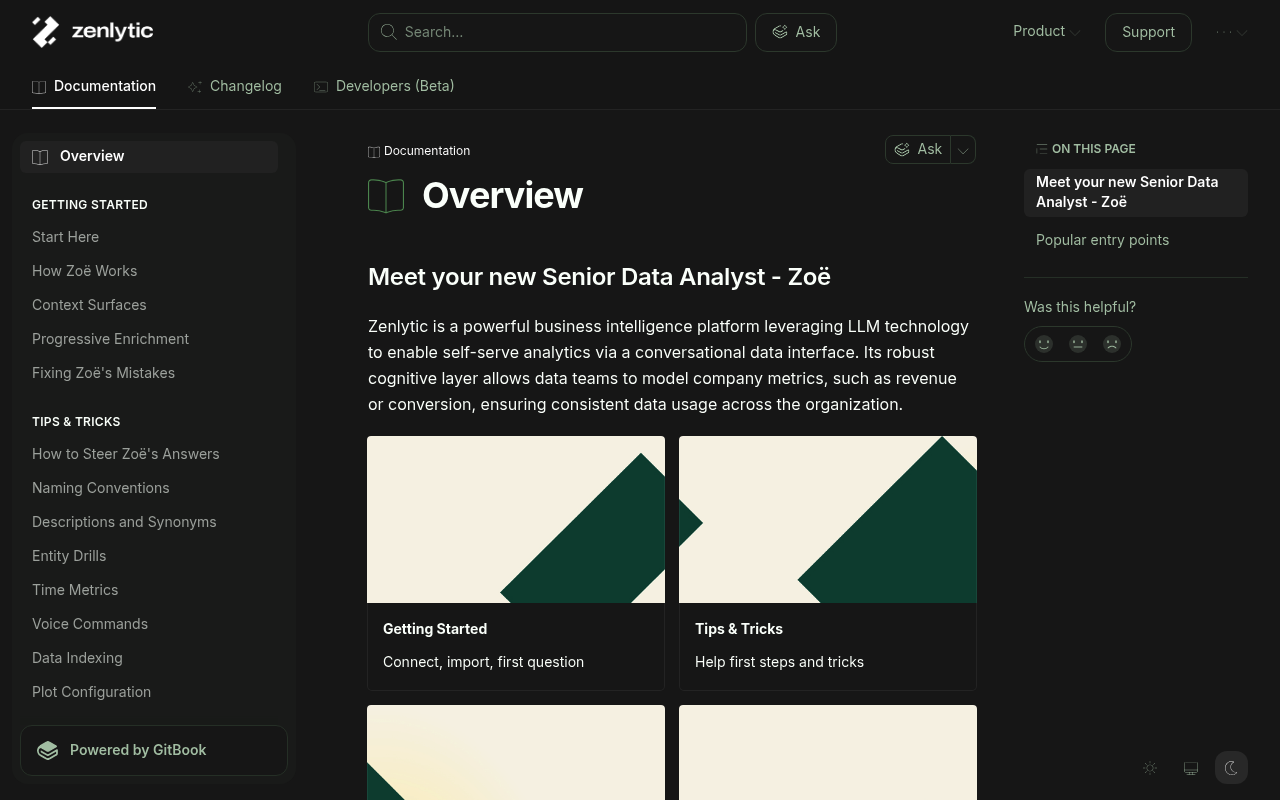
Zenlytic is an AI-powered business intelligence platform built around Zoë, an autonomous AI data analyst that turns natural-language questions into verified, governed insights and business-ready artifacts (dashboards, decks, models, and reports). It connects to cloud warehouses (Snowflake, BigQuery, Redshift, Databricks, Azure Synapse), builds a semantic context layer from schemas and query history, and answers with full lineage so every result is traceable to its source tables, filters, and metrics. Developers integrate Zenlytic through its open-source metrics-layer Python library, an iframe embedding surface with a signed-URL REST endpoint for external users, SSO (Microsoft Entra, Okta), and experimental MCP connectors that let Zoë call tools in the surrounding data stack. Zenlytic is backed by Bain Capital Ventures.
Zenlytic publishes 1 API contract indexed on the APIs.io network: Embedding API. Tagged areas include Company, Commerce, Business Intelligence, Analytics, and Artificial Intelligence.
Zenlytic’s developer surface includes documentation, API reference, getting-started guide, support, engineering blog, signup flow, changelog, and 14 more developer resources.
Kin Score
 Kin Score
How this is scored →
Kin Score
How this is scored →scored 2026-10-17 · rubric v0.24.0
Markets this provider is in provisional
The Kin Score Market layer reads a provider inside its market: its position, and how deep its integrations go. Depth is only comparable within a position. Provisional and unweighted: not part of the Kin Score or agent readiness.
| Market | Position | Depth | Registered MCP server | Declares compatibility |
|---|---|---|---|---|
| Business Intelligence, Analytics and Visualization | builds-on | 17.2 (thin) | - | - |
Registered MCP server and declares compatibility are report only — not weighted. Undeclared means we found nothing we can read, so there is no number: we never infer integrations.
APIs 1
Individual APIs this provider publishes, each with its own machine-readable definition.
Zenlytic Embedding API
Generate signed URLs for embedding Zenlytic content in host apps.
Open Collections 2
Open, tool-agnostic API collections (OpenAPI-derived and Bruno).
API Collection
OPEN COLLECTIONZenlytic Signed Embedding API
OPEN COLLECTIONMCP Servers 1
Model Context Protocol servers that expose these APIs to AI agents.
Security Posture 2
Authentication, domain security, vulnerability disclosure, and trust-center signals.
Resources
Get Started 4
Portal, sign-up, and the first successful call
Documentation 2
Reference material describing how the API behaves
Agent Surfaces 2
MCP servers, agent skills, and machine-readable catalogs
Design & Contract 2
Pagination, idempotency, versioning, errors, and events
Build 3
SDKs, sample code, and the tooling you integrate with
Access & Security 2
Authentication, authorization, and security posture
Operate 2
Status, limits, changes, and where to get help
Commercial 2
Pricing, plans, and the legal terms of use
Company 2
The organization behind the API
Source (apis.yml)
Work with this as data
Every provider here is available over the APIs.io API and to AI agents over MCP.