Tuva Health
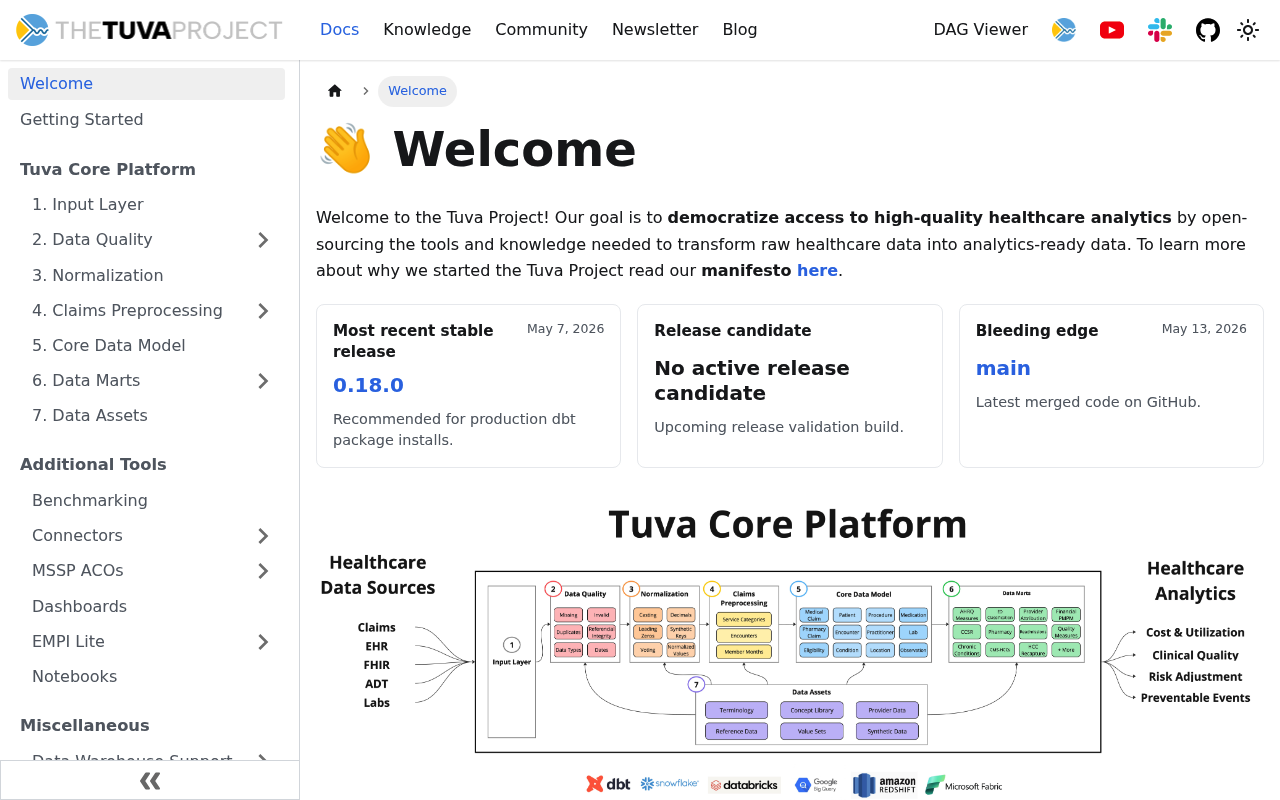
Tuva Health, Inc. is a United States healthcare data company behind The Tuva Project, an open-source, warehouse-native data-transformation platform that harmonizes, validates, normalizes, and enriches raw healthcare data - medical and pharmacy claims, EHR clinical data, ADT feeds, and HL7 FHIR sources - into an analytics-ready Core Data Model and a library of Data Marts (AHRQ measures, readmissions, quality measures, chronic conditions, CCSR, pharmacy). It is delivered primarily as a dbt package plus Python utilities (FHIR Inferno) and a family of source connectors that run inside the customer's own cloud data warehouse - Snowflake, Databricks, Google BigQuery, Amazon Redshift, or Microsoft Fabric - rather than as a hosted service. Tuva is not a FHIR API vendor: FHIR R4 is a supported input format that Tuva flattens and maps into its Input Layer, not a live FHIR server it operates. It does ship one HTTP API - Tuva EMPI, an Apache-2.0 enterprise master patient index with a documented OpenAPI 3.0.3 contract - but that too is customer-deployed from OCI images, so there is no Tuva-operated API host. The company pairs the open-source project with a commercial Core Platform and named services. Home market is the United States.
Tuva Health publishes 11 API contracts indexed on the APIs.io network, including Config API, Data Sources API, Check API, and 8 more. Tagged areas include Healthcare, United States, Health Data, FHIR, and Interoperability.
Tuva Health’s developer surface includes engineering blog, documentation, getting-started guide, changelog, support, API reference, authentication, and 28 more developer resources.
What this lets a business do 1
Business capabilities this provider's published APIs can perform, derived from its own contracts. Browse all capabilities →
Kin Score
 Kin Score
How this is scored →
Kin Score
How this is scored →scored 2026-10-17 · rubric v0.24.0
Standards implemented 1
Standards this provider implements or carries. De facto ones are profiled and measured by the API Commons; formal ones come from the standards directory and are linked by the provider's own tags. The evidence column says how each claim was established — not that it was made.
APIs 11
Individual APIs this provider publishes, each with its own machine-readable definition.
The Tuva Project (dbt package)
The core open-source Tuva dbt package that transforms healthcare data from the Tuva Input Layer into the Tuva Core Data Model and Data Marts, including data-quality tests, norma...
FHIR Inferno
An open-source Python utility that flattens nested HL7 FHIR JSON (bundles / resources) into tabular CSV files so FHIR-sourced data can be loaded and mapped into the Tuva Input L...
Tuva Connectors
A family of open-source dbt connector projects (Medicare CCLF, BCDA, CMS synthetic, Aetna, BCBS, and a connector template, plus a FHIR preprocessing connector) that map raw clai...
Tuva Health Config API
The config API from Tuva Health — 1 operation(s) for config.
Tuva Health Data Sources API
The data-sources API from Tuva Health — 1 operation(s) for data-sources.
Tuva Health Check API
The health-check API from Tuva Health — 1 operation(s) for health-check.
Tuva Health Matches API
The matches API from Tuva Health — 1 operation(s) for matches.
Tuva Health Person Records API
The person-records API from Tuva Health — 2 operation(s) for person-records.
Tuva Health Persons API
The persons API from Tuva Health — 2 operation(s) for persons.
Tuva Health Potential Matches API
The potential-matches API from Tuva Health — 2 operation(s) for potential-matches.
Tuva Health Users API
The users API from Tuva Health — 2 operation(s) for users.
Scroll for all 11
Pricing Plans 1
Published pricing tiers and plan structures.
Rate Limits 1
Documented rate limits and quota policies.
Tuva Health Rate Limits
RATE LIMITSOpenAPI Overlays 1
Overlays applied on top of this provider's contracts. Each card says who wrote it: a document the provider publishes, or one API Evangelist derived or generated.
Tuva Health Empi Overlay
GENERATEDSecurity Posture 2
Authentication, domain security, vulnerability disclosure, and trust-center signals.
Resources
Get Started 3
Portal, sign-up, and the first successful call
Documentation 2
Reference material describing how the API behaves
Agent Surfaces 2
MCP servers, agent skills, and machine-readable catalogs
Design & Contract 4
Pagination, idempotency, versioning, errors, and events
Build 5
SDKs, sample code, and the tooling you integrate with
Access & Security 2
Authentication, authorization, and security posture
Operate 7
Status, limits, changes, and where to get help
Scroll for all 7
Commercial 4
Pricing, plans, and the legal terms of use
Company 4
The organization behind the API
Other 2
Properties that don't map to a standard resource type
Source (apis.yml)
Work with this as data
Every provider here is available over the APIs.io API and to AI agents over MCP.