Topk
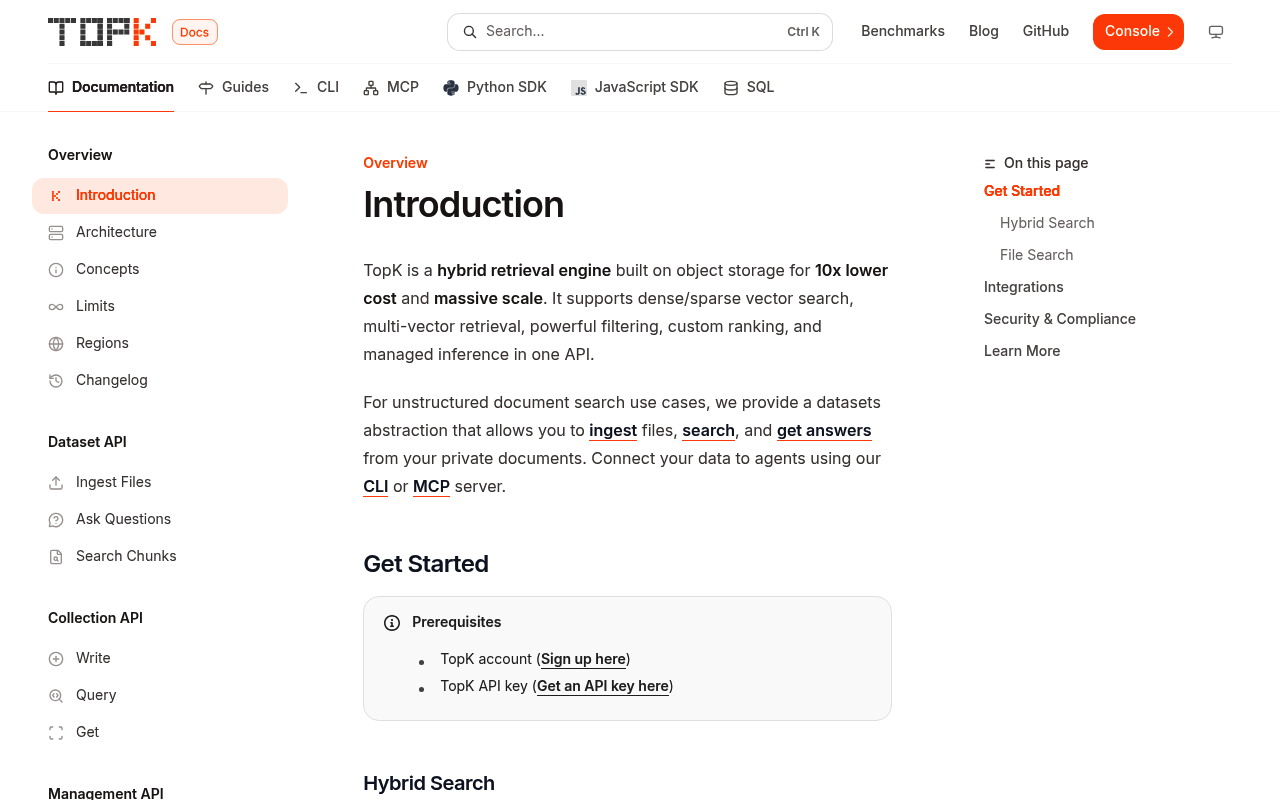
TopK is a search engine for accuracy-critical AI applications, delivering hybrid search, multi-vector (late-interaction) retrieval, dense and sparse vector search, BM25 keyword search, custom ranking, document parsing, and grounded question answering through a single API. Built on object storage for roughly 10x lower cost and effectively unlimited scale, TopK exposes a Collection API for structured document storage and querying, a Dataset API for unstructured document ingestion, semantic search, and evidence-backed answers, and a Management API for datasets and collections. It ships official Python, JavaScript, Rust, and SQL (PostgreSQL-wire) SDKs, a Homebrew-installable CLI, and a hosted MCP server so AI agents can query private data with natural language. TopK is developed by topk-io and is a portfolio company of Earlybird.
Topk is listed with 3 APIs on the APIs.io network. Tagged areas include Company, Search, Vector Search, Hybrid Search, and Multi-Vector Retrieval.
Topk’s developer surface includes documentation, API reference, getting-started guide, engineering blog, pricing, signup flow, CLI, and 25 more developer resources.
Kin Score
 Kin Score
How this is scored →
Kin Score
How this is scored →scored 2026-10-17 · rubric v0.24.0
APIs 3
Individual APIs this provider publishes, each with its own machine-readable definition.
TopK Collection API
Structured document store and query surface. Create collections with typed, indexed fields (keyword_index, semantic_index, vector index), upsert/update/delete documents by `_id`...
TopK Dataset API
Unstructured document ingestion, semantic search, and grounded question answering. Upload document files (PDF, Markdown, HTML, and more) to a dataset, retrieve the most relevant...
TopK Management API
Create, list, get, update, and delete datasets and collections that back TopK search and retrieval.
MCP Servers 1
Model Context Protocol servers that expose these APIs to AI agents.
Topk MCP Server
TopK ships an official hosted, remote MCP server that lets any MCP-compatible AI agent query private datasets using natural language. It is region-scoped (one HTTP endpoint per ...
MCP SERVERSecurity Posture 4
Authentication, domain security, vulnerability disclosure, and trust-center signals.
Resources
Get Started 4
Portal, sign-up, and the first successful call
Documentation 2
Reference material describing how the API behaves
Agent Surfaces 4
MCP servers, agent skills, and machine-readable catalogs
Design & Contract 4
Pagination, idempotency, versioning, errors, and events
Build 4
SDKs, sample code, and the tooling you integrate with
Access & Security 7
Authentication, authorization, and security posture
Scroll for all 7
Operate 2
Status, limits, changes, and where to get help
Commercial 3
Pricing, plans, and the legal terms of use
Company 2
The organization behind the API
Source (apis.yml)
Work with this as data
Every provider here is available over the APIs.io API and to AI agents over MCP.