Threat Stack
Threat Stack was a Boston-based cloud security company providing full-stack cloud security observability, intrusion detection, and compliance monitoring for infrastructure and applications across cloud-native workloads including virtual machines, containers, and Kubernetes. Its platform combined rules and supervised machine learning to detect threats, vulnerabilities, and attacks in real time. Threat Stack exposed a RESTful V2 API (HAWK/HMAC authenticated) and trigger-based webhook alerts, along with first-party SDKs, a Go CLI, and configuration-management modules (Chef, Ansible, Puppet, Terraform, CloudFormation, Helm). The company was acquired by F5 in 2021 and the product is now F5 Distributed Cloud App Infrastructure Protection (AIP); the original threatstack.com and api.threatstack.com domains have been decommissioned.
Threat Stack is profiled on the APIs.io network. Tagged areas include Company, Security, Cloud Security, Cloud Monitoring, and Intrusion Detection.
Threat Stack’s developer surface includes documentation, API reference, authentication, CLI, and 5 more developer resources.
Kin Score
 Kin Score
How this is scored →
scored 2026-11-06 · rubric v0.27.0
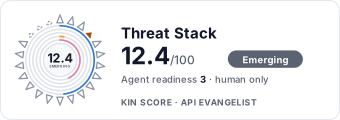 It updates itself when the score changes. Paste this where you link to your API docs:
<a href="https://apis.io/providers/threat-stack/"><img src="https://apis.io/badge/threat-stack/card.svg" alt="Threat Stack on APIs.io — Kin Score by API Evangelist"></a>Other styles, a README pill and a shields.io endpoint are on the badge page.
- Machine-Readable Contract +18 pts — api_specs includes an OpenAPI document
- MCP Server +12 pts — deployment.mode + probe verdict on the mcp/ manifest, not the pointer; an unprobed slug falls back to authorship
- Agentic Access Contract +10 pts — agentic_access artifact present (x-agentic-access), graded by author
- Idempotency +9 pts — OpenAPI mutating operations declare an idempotency key — a header, a request-body property, or a named de-duplication token whose own description says so (verified); else common[].type matches /idempoten/i (documented)
- Stable Error Semantics +8 pts — OpenAPI $refs a shared error schema across 4xx/5xx responses (verified), else common[].type includes ErrorCatalog / ErrorCodes / DeclineCodes
- A2A Agent Card +8 pts — a2a/
-a2a.yml manifest, graded on conformance.grade against A2A 1.0.0
- Contract Quality scores 0.0 — up to +25.0 composite points
- Access Clarity scores 0.0 — up to +20.0 composite points
- Operational Transparency scores 2.6 — up to +12.7 composite points
Markets this provider is in provisional
The Kin Score Market layer reads a provider inside its market: its position, and how deep its integrations go. Depth is only comparable within a position. Provisional and unweighted: not part of the Kin Score or agent readiness.
| Market | Position | Depth | Registered MCP server | Declares compatibility |
|---|---|---|---|---|
| Configuration-Management Content Registries (Ansible Galaxy, Chef Supermarket) | builds-on | 17.2 (thin) | - | - |
Registered MCP server and declares compatibility are report only — not weighted. Undeclared means we found nothing we can read, so there is no number: we never infer integrations.
Standards implemented 1
Standards this provider implements or carries. De facto ones are profiled and measured by the API Commons; formal ones come from the standards directory and are linked by the provider's own tags. The evidence column says how each claim was established — not that it was made.
Security Posture 1
Authentication, domain security, vulnerability disclosure, and trust-center signals.
Resources
Documentation 2
Reference material describing how the API behaves
Build 4
SDKs, sample code, and the tooling you integrate with
Access & Security 1
Authentication, authorization, and security posture
Company 1
The organization behind the API
Other 1
Properties that don't map to a standard resource type
Source (apis.yml)
Threat Stack API — frequently asked questions
How do I authenticate with the Threat Stack API?
Threat Stack uses bearer-token authentication (hawk · 1 scheme). The details are profiled on APIs.io as Threat Stack Authentication.
Is the Threat Stack API ready for AI agents?
Threat Stack has a Kin Score of 12.4 out of 100 (emerging) and an Agent Readiness score of 2.5 (human-only), scored by API Evangelist on 2026-11-06.
Work with this as data
Every provider here is available over the APIs.io API and to AI agents over MCP.