The Guild is an open-source software group building much of the GraphQL ecosystem's tooling, published together at the-guild.dev. Its portfolio spans GraphQL Hive (schema registry, usage observability and breaking-change detection), GraphQL Mesh (composing many APIs into one graph), GraphQL Yoga (server), Envelop (plugin runtime), GraphQL Tools and Schema Stitching (schema composition), GraphQL Code Generator (typed clients and servers), GraphQL Inspector (schema diffing and CI checks) and GraphQL Scalars. Every product listed here shares the-guild.dev as its home, which is why they are profiled as one provider with many APIs rather than as separate companies.
The Guild is listed with 10 APIs on the APIs.io network, including GraphQL Hive Console GraphQL API, and 9 more. Tagged areas include API Composition, API Gateway, API Observability, Breaking Changes, and CI/CD.
The The Guild catalog on APIs.io includes 2 JSON-LD contexts and 3 Spectral governance rulesets.
The Guild’s developer surface includes documentation, engineering blog, pricing, getting-started guide, GitHub presence, code examples, and 80 more developer resources.
Regulatory Posture applies to this provider. Its tags matched the
Horizontal (data, software, accessibility, platform) regime, so
Regulatory Posture carries 15 points of the composite.
If this regime is wrong for your business, say so on your
provider repo — the
applicability map is public and we will correct it.
Open Source Surface applies to this provider. This product is open source and we
read its repository directly, so Open Source Surface carries
10 points of the composite. It is scored from what the repository actually
publishes — a security policy, a contribution guide, a release history, a code of conduct — read live from the
provider rather than inferred from our own catalog pointers.
This facet adds; nothing was taken away to make room for it. An open-source project is not excused from
the commercial facets, because exemption would strip it of the points it does earn.
If we have the wrong repository, or this product is not open source, say so on your
provider repo and we
will drop the facet rather than have you publish against it.
Create-or-Update Ergonomics could not be measured. We hold no machine-readable contract for
this provider to read, so there is nothing to measure a write surface against. Excluded rather than scored zero:
never-measured and measured-empty are different facts. Publishing an OpenAPI is what makes this facet — and
several others — scorable at all.
The six quality facets above are damped to 75 points between them,
because both conditional facets apply and carry
25 points together. That is why each facet's contribution is shown against a damped
maximum: raising a quality facet moves the composite by 75% of its nominal
weight, not 100%. The full arithmetic is at apis.io/rating/.
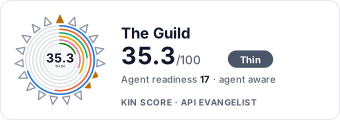
Show this score on your site.
It updates itself when the score changes. Paste this where you link to your API docs:
<a href="https://apis.io/providers/the-guild-dev/"><img src="https://apis.io/badge/the-guild-dev/card.svg" alt="The Guild on APIs.io — Kin Score by API Evangelist"></a>
Other styles, a README pill and a shields.io endpoint are on the badge page.
The Kin Score Market layer reads a provider inside its market:
its position, and how deep its integrations go. Depth is only comparable within a position. Provisional and unweighted:
not part of the Kin Score or agent readiness.
Registered MCP server and declares compatibility are report only — not weighted.
Undeclared means we found nothing we can read, so there is no number: we never infer integrations.
Standards this provider implements or carries. De facto ones are profiled and measured by the API Commons; formal ones come from the standards directory and are linked by the provider's own tags. The evidence column says how each claim was established — not that it was made.
The @envelop/core package exposes the envelop() function and a set of built-in plugins (useSchema, useEngine, useLogger, useMaskedErrors, useExtendContext) that wrap the GraphQL...
GraphQL Code Generator generates typed code from GraphQL schemas and operations, supporting TypeScript, React Query, Apollo Client, and many other frameworks through its plugin ...
The public GraphQL API for Hive Console allows developers to build custom workflows, administer users and access tokens, retrieve usage metrics, manage schema registries, publis...
Command-line tool for comparing two GraphQL schemas and generating a detailed list of breaking, non-breaking, and dangerous changes. Also validates documents and fragments, meas...
GraphQL federation framework that composes any API service — REST, OpenAPI, gRPC, SOAP, OData, JSON Schema, GraphQL, and databases — into a unified, type-safe GraphQL schema wit...
A set of utilities for faster GraphQL development, enabling SDL-first schema building, type-safe resolver composition, schema stitching across multiple services, fine-grained mo...
GraphQL Yoga is a self-hosted GraphQL server library — each deployment exposes its own GraphQL endpoint (default: /graphql). The library handles request parsing, execution, subs...
Hive Gateway is a federated GraphQL routing engine from The Guild that supports both Apollo Federation and Schema Stitching approaches to compose distributed GraphQL services.
Schema Stitching is a GraphQL technique for combining multiple GraphQL schemas into a single unified API gateway. The @graphql-tools/stitch package creates a combined proxy laye...
Discovery needs no key. Ratings and market analysis are Pro.
Get an API key
Free tier, no form to fill in. Signing in shares your email address with us — we
store it to create your key and to recognise you if you sign in with another
provider. See our Privacy Policy and
Terms.
 Kin Score
How this is scored →
 It updates itself when the score changes. Paste this where you link to your API docs: