Sailthru
Sailthru is a cross-channel relationship-marketing and personalization platform built for media, publishing, retail and e-commerce brands, unifying email, SMS, mobile push, in-app and on-site messaging around a single customer profile with predictive segmentation and 1:1 content personalization. Founded in New York in 2008, it was acquired by CM Group (later Marigold) in 2018 and became part of Zeta Global in November 2025 when Zeta bought Marigold's enterprise software business; the product is now documented as Sailthru by Zeta. Its public HTTPS API lives at api.sailthru.com and covers users, lists, content, templates, blasts (campaigns), transactional sends, triggers, purchases, events, includes, ad plans and stats, authenticated with an api_key plus an MD5 signature computed over the request parameters. It is complemented by the Zephyr template language, a JavaScript on-site personalization tag, mobile SDKs, and API postbacks (webhooks) for opt-out, hardbounce, verify and profile-update events.
Sailthru is listed with 2 APIs on the APIs.io network. Tagged areas include Company, Email Marketing, Marketing Automation, Personalization, and Customer Data Platform.
The Sailthru catalog on APIs.io includes 1 event-driven AsyncAPI specification.
Sailthru’s developer surface includes documentation, API reference, getting-started guide, support, engineering blog, signup flow, changelog, and 24 more developer resources.
Kin Score
 Kin Score
How this is scored →
scored 2026-11-06 · rubric v0.27.0
 It updates itself when the score changes. Paste this where you link to your API docs:
<a href="https://apis.io/providers/sailthru/"><img src="https://apis.io/badge/sailthru/card.svg" alt="Sailthru on APIs.io — Kin Score by API Evangelist"></a>Other styles, a README pill and a shields.io endpoint are on the badge page.
- Agentic Access Contract +10 pts — agentic_access artifact present (x-agentic-access), graded by author
- Idempotency +9 pts — OpenAPI mutating operations declare an idempotency key — a header, a request-body property, or a named de-duplication token whose own description says so (verified); else common[].type matches /idempoten/i (documented)
- A2A Agent Card +8 pts — a2a/
-a2a.yml manifest, graded on conformance.grade against A2A 1.0.0 - Request/Response Examples +7 pts — share of operations carrying request/response examples; else an Examples / Code Samples link
- Registration Without a Human +6 pts — a `registration_endpoint` in the served RFC 8414 / OIDC discovery document
- Delegated User Identity +6 pts — a served discovery document listing authorization_code in grant_types_supported (served), else an oauth2 authorizationCode flow or openIdConnect declared in an OpenAPI (documented)
- Contract Quality scores 39.0 — up to +15.3 composite points
- Contract Governance scores 4.5 — up to +11.5 composite points
- Access Clarity scores 43.4 — up to +11.3 composite points
Markets this provider is in provisional
The Kin Score Market layer reads a provider inside its market: its position, and how deep its integrations go. Depth is only comparable within a position. Provisional and unweighted: not part of the Kin Score or agent readiness.
| Market | Position | Depth | Registered MCP server | Declares compatibility |
|---|---|---|---|---|
| Commerce Platform Ecosystems (Shopify, WooCommerce, Stripe Apps) | builds-on | 42.9 | - | - |
| Reviews, Ratings and UGC (review platforms and who integrates with them) | builds-on | 42.9 | - | - |
| Mobile SDK Publishers (Play SDK Index, CocoaPods, ADA certification) | builds-on | 42.9 | - | - |
| Official SDKs on Packagist, pub.dev and Hex | builds-on | 42.9 | - | - |
Registered MCP server and declares compatibility are report only — not weighted. Undeclared means we found nothing we can read, so there is no number: we never infer integrations.
Standards implemented 1
Standards this provider implements or carries. De facto ones are profiled and measured by the API Commons; formal ones come from the standards directory and are linked by the provider's own tags. The evidence column says how each claim was established — not that it was made.
APIs 2
Individual APIs this provider publishes, each with its own machine-readable definition.
Sailthru API
The core Sailthru HTTPS API. All requests are GET, POST or DELETE calls to https://api.sailthru.com/, authenticated with api_key, an MD5 sig over the sorted parameter values, an...
Sailthru JavaScript API (Personalization Engine)
The client-side Sailthru JavaScript tag (spm.v1.min.js, served from ak.sail-horizon.com) used for on-site behavior tracking, content-library sync, userSignUp/userSignUpConfirm c...
MCP Servers 1
Model Context Protocol servers that expose these APIs to AI agents.
Sailthru API pricing
Rate limits
- : 200 1s
- : 300 1s
- : 40 1s
Pricing Plans 1
Published pricing tiers and plan structures.
Rate Limits 1
Documented rate limits and quota policies.
Sailthru Rate Limits
RATE LIMITSFinOps 1
Cost, billing, and metering signals for API financial operations.
Sailthru Finops
FINOPSEvent Specifications 1
AsyncAPI definitions for this provider's event-driven and streaming APIs.
Sailthru Postbacks Webhooks
ASYNCAPISecurity Posture 4
Authentication, domain security, vulnerability disclosure, and trust-center signals.
Sailthru Trust Center
SOC 2 Type 2, ISO/IEC 27001, ISO/IEC 27018:2019, ISO/IEC 27701, HDS, Privacy Mark, SOX, GDPR, CCPA, HITRUST, SIG Core, CAIQ, SOC 1 Type 2
SECURITYResources
Get Started 3
Portal, sign-up, and the first successful call
Documentation 2
Reference material describing how the API behaves
Agent Surfaces 1
MCP servers, agent skills, and machine-readable catalogs
Design & Contract 6
Pagination, idempotency, versioning, errors, and events
Build 4
SDKs, sample code, and the tooling you integrate with
Access & Security 6
Authentication, authorization, and security posture
Operate 4
Status, limits, changes, and where to get help
Commercial 3
Pricing, plans, and the legal terms of use
Company 2
The organization behind the API
Source (apis.yml)
Sailthru API — frequently asked questions
Does Sailthru have an API?
Yes. APIs.io lists 2 APIs from Sailthru, including Sailthru API and Sailthru JavaScript API (Personalization Engine).
How do I authenticate with the Sailthru API?
Sailthru uses bearer-token authentication (apiKey/requestSignature · 3 schemes). The details are profiled on APIs.io as Sailthru Authentication.
Does Sailthru have an MCP server?
Yes. APIs.io lists 1 MCP server for Sailthru: Remote MCP server at docs.zetaglobal.com over HTTP.
Is the Sailthru API ready for AI agents?
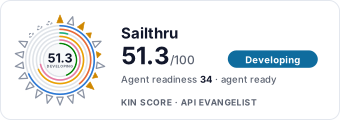
Sailthru has a Kin Score of 51.3 out of 100 (developing) and an Agent Readiness score of 33.8 (agent-ready), scored by API Evangelist on 2026-11-06.
Work with this as data
Every provider here is available over the APIs.io API and to AI agents over MCP.