Rivet
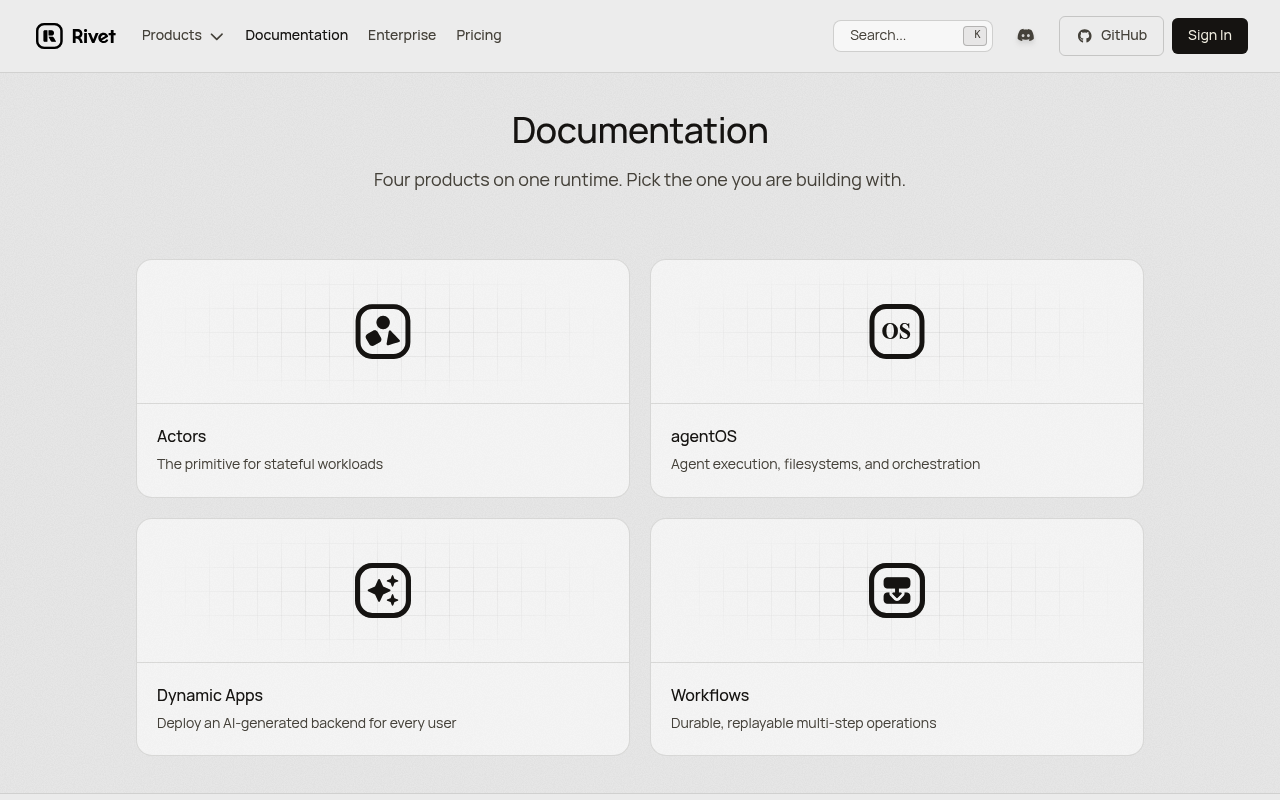
Rivet is infrastructure for the agentic era, providing durable, stateful compute for AI agents and realtime applications. Its core primitive, Rivet Actors (RivetKit), is a runtime for long-lived processes that co-locate in-memory state with compute, support built-in WebSockets, workflows, queues, scheduling and cron, hibernate when idle, and scale from zero to thousands of instances across a global edge network. Rivet also ships agentOS, a lightweight WebAssembly-powered alternative to sandboxes for running coding agents, and Rivet Cloud, a managed serverless platform. RivetKit is open source (Apache-2.0), self-hostable on Postgres, the file system, or FoundationDB, with client SDKs for JavaScript, React, Rust, Swift and SwiftUI, a CLI, an OpenAPI-described gateway/inspector HTTP API and an AsyncAPI WebSocket protocol. Rivet is backed by Y Combinator and a16z Speedrun.
Rivet publishes 2 API contracts indexed on the APIs.io network: Actors API and Gateway API. Tagged areas include Company, Infrastructure, Actors, Stateful Compute, and AI Agents.
Rivet’s developer surface includes engineering blog, documentation, API reference, getting-started guide, changelog, pricing, signup flow, and 23 more developer resources.
Kin Score
 Kin Score
How this is scored →
Kin Score
How this is scored →scored 2026-10-17 · rubric v0.24.0
Standards implemented 1
Standards this provider implements or carries. De facto ones are profiled and measured by the API Commons; formal ones come from the standards directory and are linked by the provider's own tags. The evidence column says how each claim was established — not that it was made.
APIs 2
Individual APIs this provider publishes, each with its own machine-readable definition.
Rivet Actors API
The Actors API from Rivet — 3 operation(s) for actors.
Rivet Gateway API
The Gateway API from Rivet — 12 operation(s) for gateway.
Open Collections 3
Open, tool-agnostic API collections (OpenAPI-derived and Bruno).
API Collection
OPEN COLLECTIONRivetKit Actors API
OPEN COLLECTIONRivetKit Actors Gateway API
OPEN COLLECTIONOpenAPI Overlays 1
Overlays applied on top of this provider's contracts. Each card says who wrote it: a document the provider publishes, or one API Evangelist derived or generated.
Rivet Rivetkit Overlay
UNRECORDEDSecurity Posture 2
Authentication, domain security, vulnerability disclosure, and trust-center signals.
Agentic Access 1
Recommended x-agentic-access execution contracts for AI agents.
Resources
Get Started 3
Portal, sign-up, and the first successful call
Documentation 3
Reference material describing how the API behaves
Agent Surfaces 4
MCP servers, agent skills, and machine-readable catalogs
Design & Contract 4
Pagination, idempotency, versioning, errors, and events
Build 4
SDKs, sample code, and the tooling you integrate with
Access & Security 2
Authentication, authorization, and security posture
Operate 4
Status, limits, changes, and where to get help
Commercial 1
Pricing, plans, and the legal terms of use
Company 4
The organization behind the API
Other 1
Properties that don't map to a standard resource type
Source (apis.yml)
Work with this as data
Every provider here is available over the APIs.io API and to AI agents over MCP.