
Remitly
Remitly is a Seattle-based digital financial services provider for immigrants and their families, operating a global cross-border remittance and money-movement network across more than 170 countries. Beyond its consumer money-transfer app, Remitly runs "Remitly for Developers" (Remitly Access), a gated enterprise partner API that lets businesses embed international payouts, cross-border payments, and locally relevant disbursement options into their own products, along with open-source "Connected Experiences" mobile/web SDK components. Remitly is a regulated money services business: FinCEN-registered, licensed as a money transmitter across all 50 U.S. states, and registered with FINTRAC in Canada. Added to the API Evangelist network as a fintech company profile and enriched with identity, domain-security, and compliance artifacts.
Remitly is profiled on the APIs.io network. Tagged areas include Company, Fintech, Money Transfer, Remittances, and Cross-Border Payments.
Remitly’s developer surface includes engineering blog, documentation, support, and 10 more developer resources.
Kin Score
 Kin Score
How this is scored →
scored 2026-10-23 · rubric v0.25.0
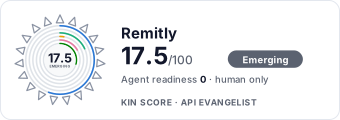 It updates itself when the score changes. Paste this where you link to your API docs:
<a href="https://apis.io/providers/remitly/"><img src="https://apis.io/badge/remitly/card.svg" alt="Remitly on APIs.io — Kin Score by API Evangelist"></a>Other styles, a README pill and a shields.io endpoint are on the badge page.
Markets this provider is in provisional
The Kin Score Market layer reads a provider inside its market: its position, and how deep its integrations go. Depth is only comparable within a position. Provisional and unweighted: not part of the Kin Score or agent readiness.
| Market | Position | Depth | Registered MCP server | Declares compatibility |
|---|---|---|---|---|
| RegTech, AML/KYC and Money Transmission | undeclared | - | - | - |
| African Payments (Nigeria, Kenya, South Africa, Ghana, WAEMU) | undeclared | - | - | - |
| EU/EEA Payment and E-Money Institutions (PSD2 passports) | undeclared | - | - | - |
| Canada RPAA Payment Service Providers (Bank of Canada registry + Payments Canada) | undeclared | - | - | - |
Registered MCP server and declares compatibility are report only — not weighted. Undeclared means we found nothing we can read, so there is no number: we never infer integrations.
Security Posture 1
Authentication, domain security, vulnerability disclosure, and trust-center signals.
Resources
Get Started 1
Portal, sign-up, and the first successful call
Documentation 1
Reference material describing how the API behaves
Design & Contract 1
Pagination, idempotency, versioning, errors, and events
Build 1
SDKs, sample code, and the tooling you integrate with
Access & Security 2
Authentication, authorization, and security posture
Operate 1
Status, limits, changes, and where to get help
Commercial 2
Pricing, plans, and the legal terms of use
Company 4
The organization behind the API
Source (apis.yml)
Work with this as data
Every provider here is available over the APIs.io API and to AI agents over MCP.