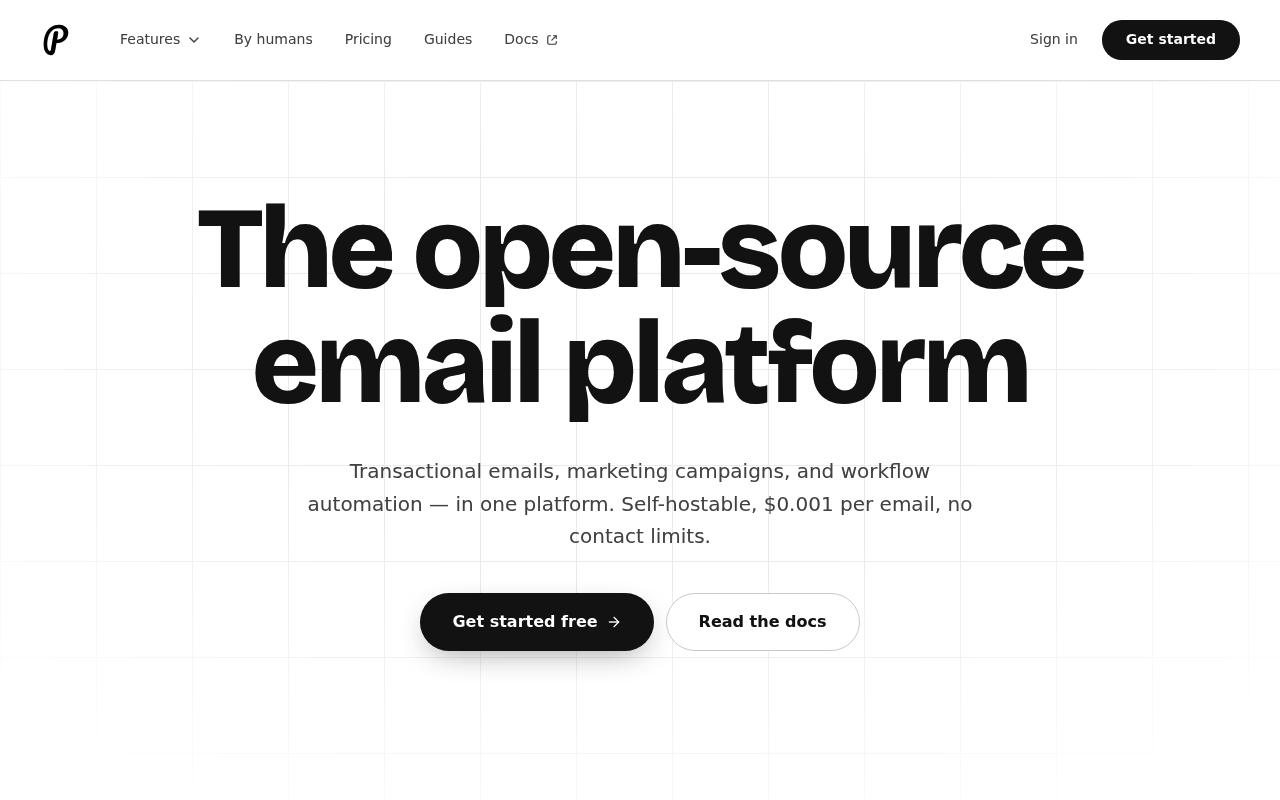
Plunk website screenshot

Plunk

Plunk is an open-source (AGPL-3.0) email platform for developers that unifies transactional email, marketing campaigns, contact segmentation and event-driven workflow automation behind a single REST API. It publishes its own OpenAPI 3.1.0 at docs.useplunk.com/openapi.json, declaring next-api.useplunk.com as the production base URL, and authenticates with a two-class Bearer API key where the prefix decides capability — sk_ for every endpoint and pk_ for the client-safe /v1/track tracking call. The API supports Idempotency-Key on both public write endpoints, cursor pagination, a structured error envelope carrying machine codes plus remediation hints, and a documented webhook event catalogue delivered as workflow steps. Every documentation page is also served as Markdown. The entire stack self-hosts with Docker Compose for full data ownership and no per-email costs.

Plunk publishes 5 APIs on the APIs.io network, including Campaigns API, Contacts API, and 3 more. Tagged areas include Email, Transactional Email, Marketing, Automation, and Open-Source.

The Plunk catalog on APIs.io includes 1 event-driven AsyncAPI specification.

Plunk’s developer surface includes authentication, documentation, changelog, API reference, getting-started guide, support, pricing, and 28 more developer resources.

70.6/100 exemplar ▬ flat Agent 36/100 agent ready Full breakdown ↓
scored 2026-08-25 · rubric v0.14.0
AccessFreemiumOpen⚡ Free to try
5 APIs
EmailTransactional EmailMarketingAutomationOpen-SourceSoftware-as-a-ServiceEmail APIWebhookSegmentationWorkflow-AutomationSelf-HostedDeveloper Tools

Kin Score

Kin Score Kin Score How this is scored →
scored 2026-08-25 · rubric v0.14.0
Composite quality — 70.6/100 · exemplar
Contract Quality 18.1 / 25
Developer Ergonomics 12.7 / 20
Access Clarity 18.4 / 20
Operational Transparency 9.6 / 13
Contract Governance 3.6 / 12
Discoverability 8.2 / 10
Agent readiness — 36/100 · agent ready
Machine-Readable Contract 18 / 18
Agentic Access Contract 10 / 10
Documented Reversibility 0 / 6
MCP Server 0 / 12
Machine-Readable Auth 10 / 10
Idempotency 9 / 9
Stable Error Semantics 8 / 8
Request/Response Examples 7 / 7
Rate-Limit Signaling 7 / 7
Typed Event Surface 6 / 6
Agent Skills 5 / 5
Well-Known Catalog 0 / 4
Consent & Bot Identity 0 / 3
A2A Agent Card 0 / 8
Dry-Run / Simulate Mode 0 / 4
Delegated User Identity 0 / 6
Protected Resource Metadata 0 / 5
Registration Without a Human 0 / 6
Agentic Commerce Surface 0 / 5
Improve this rating by publishing the missing artifacts — every area above can be raised, and the full rubric is at apis.io/rating/. This rating is computed from github.com/api-evangelist/plunk: open an issue to ask a question, or submit a pull request to add artifacts. Want it done for you? Prioritized profiling — $2,500 →

APIs 5

Individual APIs this provider publishes, each with its own machine-readable definition.

Plunk API

Plunk's own published OpenAPI 3.1.0, served at https://docs.useplunk.com/openapi.json and declaring https://next-api.useplunk.com as the production base URL. Covers the public A...

Plunk Campaigns API

Create and send marketing campaigns.

Plunk Contacts API

Manage contacts and their subscription state.

Plunk Events API

Track contact events that drive automations.

Plunk Transactional API

Send transactional email.

Open Collections 6

Open, tool-agnostic API collections (OpenAPI-derived and Bruno).

API Collection

OPEN COLLECTION

Plunk Campaigns API

OPEN COLLECTION

Plunk API

OPEN COLLECTION

Pricing Plans 1

Published pricing tiers and plan structures.

Plunk Plans Pricing

3 plans

PLANS

Rate Limits 1

Documented rate limits and quota policies.

Plunk Rate Limits

3 limits

RATE LIMITS

FinOps 1

Cost, billing, and metering signals for API financial operations.

Plunk Finops

FINOPS

Event Specifications 1

AsyncAPI definitions for this provider's event-driven and streaming APIs.

Plunk Webhooks

ASYNCAPI

Security Posture 2

Authentication, domain security, vulnerability disclosure, and trust-center signals.

Plunk Authentication

http · 1 scheme

SECURITY

Plunk Domain Security

TLSv1.3 · DMARC

SECURITY

Agentic Access 1

Recommended x-agentic-access execution contracts for AI agents.

Plunk Agentic Access

14 operations · 11 acting

14 operations · 11 acting

AGENTIC

Resources

Get Started 4

Portal, sign-up, and the first successful call

Documentation 2

Reference material describing how the API behaves

Agent Surfaces 3

MCP servers, agent skills, and machine-readable catalogs

Design & Contract 7

Pagination, idempotency, versioning, errors, and events

Scroll for all 7

Build 4

SDKs, sample code, and the tooling you integrate with

Access & Security 3

Authentication, authorization, and security posture

Operate 4

Status, limits, changes, and where to get help

Commercial 5

Pricing, plans, and the legal terms of use

Company 2

The organization behind the API

Other 1

Properties that don't map to a standard resource type

Source (apis.yml)

apis.yml Raw ↑
aid: plunk
url: https://raw.githubusercontent.com/api-evangelist/plunk/refs/heads/main/apis.yml
name: Plunk
kind: company
description: Plunk is an open-source (AGPL-3.0) email platform for developers that unifies transactional email, marketing
  campaigns, contact segmentation and event-driven workflow automation behind a single REST API. It publishes its own OpenAPI
  3.1.0 at docs.useplunk.com/openapi.json, declaring next-api.useplunk.com as the production base URL, and authenticates with
  a two-class Bearer API key where the prefix decides capability — sk_ for every endpoint and pk_ for the client-safe /v1/track
  tracking call. The API supports Idempotency-Key on both public write endpoints, cursor pagination, a structured error envelope
  carrying machine codes plus remediation hints, and a documented webhook event catalogue delivered as workflow steps. Every
  documentation page is also served as Markdown. The entire stack self-hosts with Docker Compose for full data ownership and
  no per-email costs.
accessModel:
  pricing: freemium
  onboarding: open
  trial: false
  try_now: true
  public: true
  label: Freemium · Open access
  confidence: high
  source:
  - plans
  - authentication
  generated: '2026-07-22'
  method: derived
image: https://kinlane-images.s3.amazonaws.com/shared/apis-json/icons/plunk.png
tags:
- Email
- Transactional Email
- Marketing
- Automation
- Open-Source
- Software-as-a-Service
- Email API
- Webhook
- Segmentation
- Workflow-Automation
- Self-Hosted
- Developer Tools
tags_raw:
- Email
- Transactional Email
- Marketing
- Automation
- Open Source
- SaaS
- Email API
- Webhooks
- Segmentation
- Workflow Automation
- Self-Hosted
- Developer Tools
created: '2026-06-20'
modified: '2026-08-13'
specificationVersion: '0.23'
apis:
- aid: plunk:plunk-api
  name: Plunk API
  description: Plunk's own published OpenAPI 3.1.0, served at https://docs.useplunk.com/openapi.json and declaring https://next-api.useplunk.com
    as the production base URL. Covers the public API (transactional send, event tracking, email verification) plus the contacts,
    templates, campaigns and segments resources. Authenticated with a Bearer API key whose prefix decides its capability —
    sk_ for every endpoint except POST /v1/track, which requires pk_. POST /v1/send and POST /v1/track accept an Idempotency-Key
    header. Lists are cursor paginated. This is the first-party contract; the four hand-authored specs below predate it and
    cover the older api.useplunk.com surface.
  humanURL: https://docs.useplunk.com/api-reference/overview
  baseURL: https://next-api.useplunk.com
  tags:
  - Email
  - Transactional
  - Contacts
  - Campaigns
  - Segments
  - Templates
  properties:
  - type: OpenAPI
    url: openapi/_original/plunk-api-openapi.json
  - type: Overlay
    url: overlays/plunk-api-overlay.yaml
  - type: Documentation
    url: https://docs.useplunk.com/api-reference/overview
  - type: APIReference
    url: https://docs.useplunk.com/api-reference/overview
  - type: Authentication
    url: https://docs.useplunk.com/guides/api-keys
  - type: Idempotency
    url: https://docs.useplunk.com/guides/idempotency
  - type: ErrorCatalog
    url: https://docs.useplunk.com/api-reference/errors
  - type: Webhooks
    url: https://docs.useplunk.com/guides/webhooks
  - type: DataModel
    url: data-model/plunk-data-model.yml
  - type: AgentSkill
    url: skills/_index.yml
  - type: GitHub
    url: https://github.com/useplunk/plunk
- aid: plunk:plunk-campaigns-api
  name: Plunk Campaigns API
  description: Create and send marketing campaigns.
  humanURL: https://docs.useplunk.com/api-reference/transactional/send
  baseURL: https://api.useplunk.com/v1
  tags:
  - Campaigns
  properties:
  - type: OpenAPI
    url: openapi/plunk-campaigns-api-openapi.yml
  - type: Documentation
    url: https://docs.useplunk.com/api-reference/transactional/send
  - type: APIReference
    url: https://docs.useplunk.com/api-reference/overview
  - type: PostmanCollection
    url: collections/plunk.postman_collection.json
  - type: OpenCollection
    url: collections/plunk.opencollection.json
  - type: GitHub
    url: https://github.com/useplunk/plunk
  - type: Documentation
    url: https://docs.useplunk.com/api-reference/transactional/track
  - type: Documentation
    url: https://docs.useplunk.com/api-reference/contacts/create
  - type: Documentation
    url: https://docs.useplunk.com/api-reference/campaigns/create
- aid: plunk:plunk-contacts-api
  name: Plunk Contacts API
  description: Manage contacts and their subscription state.
  humanURL: https://docs.useplunk.com/api-reference/transactional/send
  baseURL: https://api.useplunk.com/v1
  tags:
  - Contacts
  properties:
  - type: OpenAPI
    url: openapi/plunk-contacts-api-openapi.yml
  - type: Documentation
    url: https://docs.useplunk.com/api-reference/transactional/send
  - type: APIReference
    url: https://docs.useplunk.com/api-reference/overview
  - type: PostmanCollection
    url: collections/plunk.postman_collection.json
  - type: OpenCollection
    url: collections/plunk.opencollection.json
  - type: GitHub
    url: https://github.com/useplunk/plunk
  - type: Documentation
    url: https://docs.useplunk.com/api-reference/transactional/track
  - type: Documentation
    url: https://docs.useplunk.com/api-reference/contacts/create
  - type: Documentation
    url: https://docs.useplunk.com/api-reference/campaigns/create
- aid: plunk:plunk-events-api
  name: Plunk Events API
  description: Track contact events that drive automations.
  humanURL: https://docs.useplunk.com/api-reference/transactional/send
  baseURL: https://api.useplunk.com/v1
  tags:
  - Event
  tags_raw:
  - Events
  properties:
  - type: OpenAPI
    url: openapi/plunk-events-api-openapi.yml
  - type: Documentation
    url: https://docs.useplunk.com/api-reference/transactional/send
  - type: APIReference
    url: https://docs.useplunk.com/api-reference/overview
  - type: PostmanCollection
    url: collections/plunk.postman_collection.json
  - type: OpenCollection
    url: collections/plunk.opencollection.json
  - type: GitHub
    url: https://github.com/useplunk/plunk
  - type: Documentation
    url: https://docs.useplunk.com/api-reference/transactional/track
  - type: Documentation
    url: https://docs.useplunk.com/api-reference/contacts/create
  - type: Documentation
    url: https://docs.useplunk.com/api-reference/campaigns/create
- aid: plunk:plunk-transactional-api
  name: Plunk Transactional API
  description: Send transactional email.
  humanURL: https://docs.useplunk.com/api-reference/transactional/send
  baseURL: https://api.useplunk.com/v1
  tags:
  - Transactional
  properties:
  - type: OpenAPI
    url: openapi/plunk-transactional-api-openapi.yml
  - type: Documentation
    url: https://docs.useplunk.com/api-reference/transactional/send
  - type: APIReference
    url: https://docs.useplunk.com/api-reference/overview
  - type: PostmanCollection
    url: collections/plunk.postman_collection.json
  - type: OpenCollection
    url: collections/plunk.opencollection.json
  - type: GitHub
    url: https://github.com/useplunk/plunk
  - type: Documentation
    url: https://docs.useplunk.com/api-reference/transactional/track
  - type: Documentation
    url: https://docs.useplunk.com/api-reference/contacts/create
  - type: Documentation
    url: https://docs.useplunk.com/api-reference/campaigns/create
common:
- type: AgenticAccess
  url: agentic-access/plunk-agentic-access.yml
- type: DomainSecurity
  url: security/plunk-domain-security.yml
- type: Authentication
  url: authentication/plunk-authentication.yml
- type: GitHubOrganization
  url: https://github.com/useplunk
- type: LinkedIn
  url: https://www.linkedin.com/company/useplunk
- type: Website
  url: https://www.useplunk.com
- type: Documentation
  url: https://docs.useplunk.com
- type: Plans
  url: plans/plunk-plans-pricing.yml
- type: RateLimits
  url: rate-limits/plunk-rate-limits.yml
- type: FinOps
  url: finops/plunk-finops.yml
- type: Packages
  url: packages/plunk-packages.yml
- type: SDKs
  url: packages/plunk-packages.yml
- type: LLMsTxt
  url: llms/plunk-llms.txt
- type: Overlay
  url: overlays/plunk-api-overlay.yaml
- type: Conventions
  url: conventions/plunk-conventions.yml
- type: Idempotency
  url: conventions/plunk-conventions.yml
- type: ErrorCatalog
  url: errors/plunk-problem-types.yml
- type: Lifecycle
  url: lifecycle/plunk-lifecycle.yml
- type: StatusPage
  url: https://status.useplunk.com
- type: ChangeLog
  url: changelog/plunk-changelog.yml
- type: DataModel
  url: data-model/plunk-data-model.yml
- type: Webhooks
  url: asyncapi/plunk-webhooks.yml
- type: AgentSkill
  url: skills/_index.yml
- type: Conformance
  url: conformance/plunk-conformance.yml
- type: Compliance
  url: https://www.useplunk.com/dpa
- type: DeveloperPortal
  url: https://docs.useplunk.com
- type: APIReference
  url: https://docs.useplunk.com/api-reference/overview
- type: GettingStarted
  url: https://docs.useplunk.com
- type: Support
  url: https://www.useplunk.com/discord
- type: Pricing
  url: https://www.useplunk.com/pricing
- type: SignUp
  url: https://next-app.useplunk.com/auth/signup
- type: Login
  url: https://next-app.useplunk.com/auth/login
- type: TermsOfService
  url: https://www.useplunk.com/terms
- type: PrivacyPolicy
  url: https://www.useplunk.com/privacy
- type: SourceCode
  url: https://github.com/useplunk/plunk
maintainers:
- FN: Kin Lane
  email: kin@apievangelist.com
x-enrichment:
  date: '2026-08-13'
  status: enriched
  artifacts_added: 19
  pass: local-v1

Work with this as data

Every provider here is available over the APIs.io API and to AI agents over MCP.

MCP server

One button, every client — Claude, Cursor, VS Code and the rest.

https://apis.io/mcp

Tools for providers

9 MCP tools reach this
  • find_providersBrowse and filter every provider in the catalog.
  • get_provider_artifactsEvery artifact this provider publishes, grouped by type.
  • get_provider_operationsEvery operation across all of their OpenAPIs — one call instead of parsing every spec.
  • get_provider_toolsEvery MCP tool they ship, with the operation each wraps.
  • get_provider_evidenceHow each part of their score was established. Free — the basis for a claim should not sit behind it.
  • get_provider_ratingPRO — composite, band, trend and facet scores.
  • apis_io_searchSTART HERE — APIs, providers and tags for one query, each with its total.
  • resolveTurn a domain, URL or GitHub org into the provider it belongs to.
  • find_cohortsEvery scored population of providers in the catalog.
All 92 tools

Call it yourself

curl for this page
This provider
curl "https://apis.io/api/v1/providers/plunk"
All providers
curl "https://apis.io/api/v1/providers?limit=25"
Every operation they expose
curl "https://apis.io/api/v1/providers/plunk/operations?limit=25"
How their score was established
curl "https://apis.io/api/v1/providers/plunk/evidence"

Discovery needs no key. Ratings and market analysis are Pro.

Get an API key

Free tier, no email required.

A second provider on the same verified email joins the account you already have.