Plain
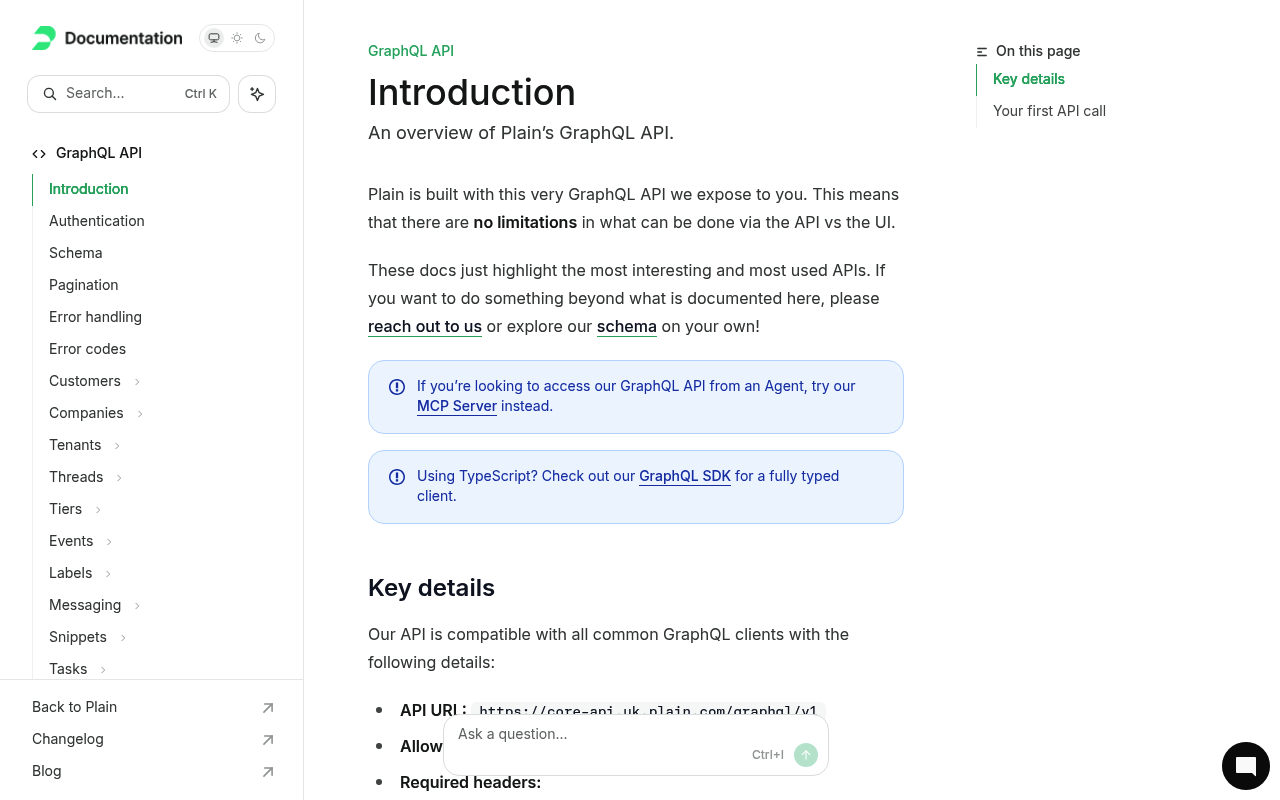
Plain is a customer support platform for B2B and technical SaaS companies, built entirely on its own public GraphQL API so there is full parity between what the product UI and the API can do. It unifies support across email, chat, Slack, and API-created threads, with customers, companies, tenants, tiers and SLAs, labels, help center articles, snippets, tasks, and events as first-class entities. Developers integrate via a Relay-style GraphQL API (bearer API keys with fine-grained permissions), typed TypeScript and Go SDKs, a CLI, customer-card UI components, HMAC-signed webhooks, a hosted MCP server, and an official agent skill. This profile was enriched from Plain's public developer surface.
Plain is listed with 1 API on the APIs.io network. Tagged areas include Company, Customer Service, Help Desk, Support, and Software-as-a-Service.
The Plain catalog on APIs.io includes 1 event-driven AsyncAPI specification.
Plain’s developer surface includes documentation, API reference, getting-started guide, engineering blog, support, pricing, changelog, and 25 more developer resources.
Kin Score
 Kin Score
How this is scored →
Kin Score
How this is scored →scored 2026-10-17 · rubric v0.24.0
Standards implemented 1
Standards this provider implements or carries. De facto ones are profiled and measured by the API Commons; formal ones come from the standards directory and are linked by the provider's own tags. The evidence column says how each claim was established — not that it was made.
APIs 1
Individual APIs this provider publishes, each with its own machine-readable definition.
Plain Core GraphQL API
Plain's Core GraphQL API — the same API the Plain product is built on. Manage customers, companies, tenants, threads, messaging, help center, labels, tiers/SLAs, snippets, tasks...
MCP Servers 1
Model Context Protocol servers that expose these APIs to AI agents.
Event Specifications 1
AsyncAPI definitions for this provider's event-driven and streaming APIs.
Plain Webhooks
ASYNCAPISecurity Posture 3
Authentication, domain security, vulnerability disclosure, and trust-center signals.
Resources
Get Started 3
Portal, sign-up, and the first successful call
Documentation 3
Reference material describing how the API behaves
Agent Surfaces 3
MCP servers, agent skills, and machine-readable catalogs
Design & Contract 7
Pagination, idempotency, versioning, errors, and events
Scroll for all 7
Build 4
SDKs, sample code, and the tooling you integrate with
Access & Security 3
Authentication, authorization, and security posture
Operate 4
Status, limits, changes, and where to get help
Commercial 3
Pricing, plans, and the legal terms of use
Company 2
The organization behind the API
Source (apis.yml)
Work with this as data
Every provider here is available over the APIs.io API and to AI agents over MCP.