mParticle
mParticle is a customer data platform (CDP) that helps brands collect, unify, and activate customer data across mobile, web, OTT, and server sources, then forward it in real time to hundreds of analytics, marketing, and warehouse destinations. The mParticle developer platform exposes server Events, IDSync, Profile, Warehouse Sync, Calculated Attributes, Data Planning and Platform APIs that let teams ingest events, resolve identity, manage configurations, and orchestrate audiences using HTTP Basic, an HMAC request digest, and OAuth 2.0 client-credentials bearer tokens. mParticle was acquired by Rokt.
mParticle publishes 10 API contracts indexed on the APIs.io network, including Data Plan API, Data Plan Version API, Events API, and 7 more. Tagged areas include Customer Data Platform, CDP, Analytics, Identity Resolution, and Audiences.
The mParticle catalog on APIs.io includes 1 event-driven AsyncAPI specification.
mParticle’s developer surface includes authentication, changelog, sandbox, CLI, documentation, API reference, getting-started guide, and 39 more developer resources.
What this lets a business do 2
Business capabilities this provider's published APIs can perform, derived from its own contracts. Browse all capabilities →
Kin Score
 Kin Score
How this is scored →
Kin Score
How this is scored →scored 2026-10-23 · rubric v0.25.0
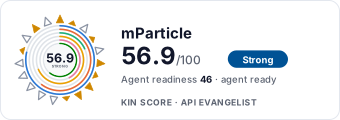 It updates itself when the score changes. Paste this where you link to your API docs:
<a href="https://apis.io/providers/mparticle/"><img src="https://apis.io/badge/mparticle/card.svg" alt="mParticle on APIs.io — Kin Score by API Evangelist"></a>Other styles, a README pill and a shields.io endpoint are on the badge page.
Markets this provider is in provisional
The Kin Score Market layer reads a provider inside its market: its position, and how deep its integrations go. Depth is only comparable within a position. Provisional and unweighted: not part of the Kin Score or agent readiness.
| Market | Position | Depth | Registered MCP server | Declares compatibility |
|---|---|---|---|---|
| Martech and Customer Data Platforms | undeclared | - | - | - |
| Data Marketplaces (data providers on cloud data platforms) | undeclared | - | - | - |
| Mobile SDK Publishers (Play SDK Index, CocoaPods, ADA certification) | undeclared | - | - | - |
| Official SDKs on Packagist, pub.dev and Hex | undeclared | - | - | - |
Registered MCP server and declares compatibility are report only — not weighted. Undeclared means we found nothing we can read, so there is no number: we never infer integrations.
APIs 10
Individual APIs this provider publishes, each with its own machine-readable definition.
mParticle Profile API
REST API for retrieving unified user profiles, identities, attributes, and audience memberships at scale to personalize downstream applications.
mParticle Platform API
Management REST API used to programmatically configure mParticle inputs, outputs, filters, audiences, data plans, and workspace settings as part of a fully versioned CDP-as-code...
mParticle Warehouse Sync API
REST API for building reverse-ETL pipelines that pull data out of a customer data warehouse (connections, data models, field transformations and pipelines) and load it into mPar...
mParticle Data Plan API
Endpoints for managing Data Plans
mParticle Data Plan Version API
Endpoints for versioning Data Plans
mParticle Events API
Send your data to the mParticle platform.
mParticle Identify API
The Identify API from mParticle — 1 operation(s) for identify.
mParticle Login API
The Login API from mParticle — 1 operation(s) for login.
mParticle Logout API
The Logout API from mParticle — 1 operation(s) for logout.
mParticle Modify API
The Modify API from mParticle — 1 operation(s) for modify.
Scroll for all 10
Open Collections 3
Open, tool-agnostic API collections (OpenAPI-derived and Bruno).
mParticle Events Bulkevents API
OPEN COLLECTIONmParticle Bulkevents Events API
OPEN COLLECTIONmParticle Events API
OPEN COLLECTIONPricing Plans 1
Published pricing tiers and plan structures.
Rate Limits 1
Documented rate limits and quota policies.
Mparticle Rate Limits
RATE LIMITSEvent Specifications 1
AsyncAPI definitions for this provider's event-driven and streaming APIs.
Mparticle Webhooks
ASYNCAPIOpenAPI Overlays 3
Overlays applied on top of this provider's contracts. Each card says who wrote it: a document the provider publishes, or one API Evangelist derived or generated.
Mparticle Dataplanning Overlay
DERIVEDMparticle Events Overlay
DERIVEDMparticle Identity Overlay
DERIVEDJSON Schema 3
Standalone JSON Schema definitions for this provider's data models.
Mparticle Eventsapi Bulk
JSON SCHEMAMparticle Eventsapi Sample
JSON SCHEMAMparticle Eventsapi
JSON SCHEMASecurity Posture 4
Authentication, domain security, vulnerability disclosure, and trust-center signals.
Agentic Access 1
Recommended x-agentic-access execution contracts for AI agents.
Resources
Get Started 5
Portal, sign-up, and the first successful call
Documentation 3
Reference material describing how the API behaves
Agent Surfaces 5
MCP servers, agent skills, and machine-readable catalogs
Design & Contract 7
Pagination, idempotency, versioning, errors, and events
Scroll for all 7
Build 5
SDKs, sample code, and the tooling you integrate with
Access & Security 7
Authentication, authorization, and security posture
Scroll for all 7
Operate 2
Status, limits, changes, and where to get help
Commercial 4
Pricing, plans, and the legal terms of use
Company 3
The organization behind the API
Other 5
Properties that don't map to a standard resource type
Source (apis.yml)
Work with this as data
Every provider here is available over the APIs.io API and to AI agents over MCP.