Hamsa
Hamsa (formerly HamsaPay) is a San Francisco-based financial infrastructure company "powering the Finternet." It builds the Hamsa Unified Confidential Ledger (UCL), a privacy-enabled, EVM-compatible, permissioned Layer-2 blockchain for banks and financial institutions, plus the Hamsa Privacy module that uses zero-knowledge-proof (ZKP) rollups on Hyperledger Besu to run confidential Delivery-versus-Payment (DvP) and Payment-versus-Payment (PvP) settlement, tokenized deposits, stablecoins, and CBDCs. The developer platform exposes an EVM-standard JSON-RPC API (eth_* methods) and DvP escrow smart contracts, authenticated with Ethereum message signatures and role-based access control. Hamsa has tokenized over $3.2B for Tier-1/Tier-2 banks (including Banco Safra's Safra Dolar stablecoin) and participates in the Brazilian Drex CBDC pilot.
Hamsa is profiled on the APIs.io network. Tagged areas include Company, Financial Services, Blockchain, Payments, and Tokenization.
Hamsa’s developer surface includes documentation, API reference, engineering blog, authentication, and 12 more developer resources.
Kin Score
 Kin Score
How this is scored →
scored 2026-11-06 · rubric v0.27.0
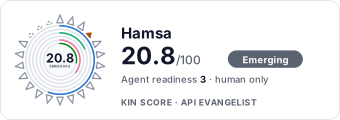 It updates itself when the score changes. Paste this where you link to your API docs:
<a href="https://apis.io/providers/hamsa/"><img src="https://apis.io/badge/hamsa/card.svg" alt="Hamsa on APIs.io — Kin Score by API Evangelist"></a>Other styles, a README pill and a shields.io endpoint are on the badge page.
- Machine-Readable Contract +18 pts — api_specs includes an OpenAPI document
- MCP Server +12 pts — deployment.mode + probe verdict on the mcp/ manifest, not the pointer; an unprobed slug falls back to authorship
- Agentic Access Contract +10 pts — agentic_access artifact present (x-agentic-access), graded by author
- Idempotency +9 pts — OpenAPI mutating operations declare an idempotency key — a header, a request-body property, or a named de-duplication token whose own description says so (verified); else common[].type matches /idempoten/i (documented)
- Stable Error Semantics +8 pts — OpenAPI $refs a shared error schema across 4xx/5xx responses (verified), else common[].type includes ErrorCatalog / ErrorCodes / DeclineCodes
- A2A Agent Card +8 pts — a2a/
-a2a.yml manifest, graded on conformance.grade against A2A 1.0.0
- Contract Quality scores 0.0 — up to +25.0 composite points
- Access Clarity scores 27.6 — up to +14.5 composite points
- Operational Transparency scores 0.0 — up to +13.0 composite points
Markets this provider is in provisional
The Kin Score Market layer reads a provider inside its market: its position, and how deep its integrations go. Depth is only comparable within a position. Provisional and unweighted: not part of the Kin Score or agent readiness.
| Market | Position | Depth | Registered MCP server | Declares compatibility |
|---|---|---|---|---|
| Stablecoins and Tokenization (stablecoin issuers, tokenized assets) | undeclared | - | - | - |
| LF Decentralized Trust (Hyperledger) Members and Projects (enterprise blockchain, digital identity, CBDC) | undeclared | - | - | - |
Registered MCP server and declares compatibility are report only — not weighted. Undeclared means we found nothing we can read, so there is no number: we never infer integrations.
Standards implemented 1
Standards this provider implements or carries. De facto ones are profiled and measured by the API Commons; formal ones come from the standards directory and are linked by the provider's own tags. The evidence column says how each claim was established — not that it was made.
Security Posture 2
Authentication, domain security, vulnerability disclosure, and trust-center signals.
Resources
Get Started 2
Portal, sign-up, and the first successful call
Documentation 2
Reference material describing how the API behaves
Agent Surfaces 2
MCP servers, agent skills, and machine-readable catalogs
Design & Contract 2
Pagination, idempotency, versioning, errors, and events
Access & Security 2
Authentication, authorization, and security posture
Commercial 2
Pricing, plans, and the legal terms of use
Company 4
The organization behind the API
Source (apis.yml)
Hamsa API — frequently asked questions
How do I authenticate with the Hamsa API?
Hamsa uses bearer-token authentication (signature · 1 scheme). The details are profiled on APIs.io as Hamsa Authentication.
Is the Hamsa API ready for AI agents?
Hamsa has a Kin Score of 20.8 out of 100 (emerging) and an Agent Readiness score of 2.5 (human-only), scored by API Evangelist on 2026-11-06.
Work with this as data
Every provider here is available over the APIs.io API and to AI agents over MCP.