Globant is a NYSE-listed digital and cognitive transformation company that, through two distinct platforms, publishes a genuinely agent-facing API surface. Globant Enterprise AI (Glob.AI OS) — the platform that began life as GeneXus' SAIA and was renamed after Globant acquired GeneXus — documents 26 API groups covering agents, agentic processes, RAG, corpora, tools, embeddings, guardrails and usage limits at api.saia.ai, with a Python SDK (PyGEAI), a geai CLI, a full numeric error registry and a dated one-year support window per release. Separately, Glob.AI, the AI-native delivery platform launched in August 2026, publishes an OpenAPI 3.1 description, an RFC 9727 api-catalog, an llms.txt, digest-pinned Agent Skills and an MCP server card at glob.ai. Globant also ships the CODA agentic coding CLI.
Globant publishes 3 API contracts indexed on the APIs.io network, including Catalog API, Health API, and 1 more. Tagged areas include Software, Digital Transformation, Artificial Intelligence, Agents, and MCP.
Globant’s developer surface includes documentation, API reference, getting-started guide, support, engineering blog, pricing, signup flow, and 30 more developer resources.
Regulatory Posture applies to this provider. Its tags matched the
Horizontal (data, software, accessibility, platform) regime, so
Regulatory Posture carries 15 points of the composite.
If this regime is wrong for your business, say so on your
provider repo — the
applicability map is public and we will correct it.
Create-or-Update Ergonomics does not apply to this provider. The published contracts declare
no write operations, and a read-only API cannot create-or-update. The facet is excluded from this provider's
denominator entirely — not scored zero. A reference or data API is not deficient for being unable to
upsert.
The six quality facets above are damped to 85 points between them,
because the conditional facet above carries the other
15. That is why each facet's contribution is shown against a damped
maximum: raising a quality facet moves the composite by 85% of its nominal
weight, not 100%. The full arithmetic is at apis.io/rating/.
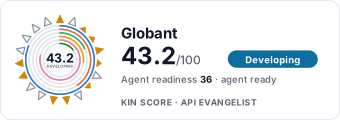
Show this score on your site.
It updates itself when the score changes. Paste this where you link to your API docs:
<a href="https://apis.io/providers/globant/"><img src="https://apis.io/badge/globant/card.svg" alt="Globant on APIs.io — Kin Score by API Evangelist"></a>
Other styles, a README pill and a shields.io endpoint are on the badge page.
Improve this rating by publishing the missing artifacts — every area above can be raised, and the full rubric is at apis.io/rating/. Every facet and dimension name above is a link: it opens that measurement's own page — what it means, the exact checks that feed it, how the whole catalog distributes on it, and the providers at the top of it. This rating is computed from github.com/api-evangelist/globant: open an issue to ask a question, or submit a pull request to add artifacts.
Submit an artifact on GitHub — free →Manage your own listing — the Influence plan, $499/mo →
Markets this provider is in provisional
The Kin Score Market layer reads a provider inside its market:
its position, and how deep its integrations go. Depth is only comparable within a position. Provisional and unweighted:
not part of the Kin Score or agent readiness.
Registered MCP server and declares compatibility are report only — not weighted.
Undeclared means we found nothing we can read, so there is no number: we never infer integrations.
The Globant Enterprise AI platform API. Twenty-six documented API groups — Access Control, Agents, Agentic Processes, Analytics, Assistant, Chat, Corpus, Corpus Semantic Similar...
Globant publishes an MCP server card at https://glob.ai/.well-known/mcp/server-card.json describing an MCP server named "orchestrator" that exposes the Glob.AI Hubs Orchestrator...
Overlays applied on top of this provider's contracts. Each card says who wrote it: a document the provider publishes, or one API Evangelist derived or generated.
Discovery needs no key. Ratings and market analysis are Pro.
Get an API key
Free tier, no form to fill in. Signing in shares your email address with us — we
store it to create your key and to recognise you if you sign in with another
provider. See our Privacy Policy and
Terms.

 Kin Score
How this is scored →
 It updates itself when the score changes. Paste this where you link to your API docs: