FundGuard is an AI-powered, cloud-native investment accounting operating system for asset managers, asset owners, custodian banks and fund administrators. A single real-time accounting engine acts as the core system of record across Fund Accounting/ABOR, Investment Accounting/IBOR and Private Markets portfolio accounting, supporting mutual funds, ETFs, hedge funds, insurance products and pension funds with multi-book views (ABOR, IBOR, GAAP, tax, performance, currency and custom), shadow and contingent NAV, reconciliation, Report Studio and AI-driven anomaly detection with suggested resolutions. Founded 2018, headquartered in New York with offices in Dedham MA, Tel Aviv and London; backed by Citi, State Street, Key1 Capital, Blumberg Capital, Euclidean Capital, Hamilton Lane, LionBird and Team8, and running on AWS and Microsoft Azure. The platform is marketed as API-first for front- and middle-office integration with portfolio management systems, custodians, administrators and data providers, but as of this pass FundGuard publishes no public developer portal, API reference or machine-readable API contract — the customer knowledge base at kb.fundguard.com is behind a login and the product runs on per-tenant hosts.
FundGuard is listed with 1 API on the APIs.io network. Tagged areas include investment-accounting, Fund Accounting, ibor, abor, and NAV.
FundGuard’s developer surface includes documentation, support, engineering blog, signup flow, YouTube channel, authentication, and 19 more developer resources.
Regulatory Posture applies to this provider. Its tags matched the
Horizontal (data, software, accessibility, platform) regime, so
Regulatory Posture carries 15 points of the composite.
If this regime is wrong for your business, say so on your
provider repo — the
applicability map is public and we will correct it.
Create-or-Update Ergonomics could not be measured. We hold no machine-readable contract for
this provider to read, so there is nothing to measure a write surface against. Excluded rather than scored zero:
never-measured and measured-empty are different facts. Publishing an OpenAPI is what makes this facet — and
several others — scorable at all.
The six quality facets above are damped to 85 points between them,
because the conditional facet above carries the other
15. That is why each facet's contribution is shown against a damped
maximum: raising a quality facet moves the composite by 85% of its nominal
weight, not 100%. The full arithmetic is at apis.io/rating/.
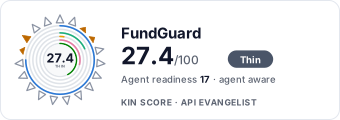
Show this score on your site.
It updates itself when the score changes. Paste this where you link to your API docs:
<a href="https://apis.io/providers/fundguard/"><img src="https://apis.io/badge/fundguard/card.svg" alt="FundGuard on APIs.io — Kin Score by API Evangelist"></a>
Other styles, a README pill and a shields.io endpoint are on the badge page.
Raise your score.
Agent readiness — checks not met, largest first (exact, from this profile):
Idempotency+9 pts — OpenAPI mutating operations declare an idempotency key — a header, a request-body property, or a named de-duplication token whose own description says so (verified); else common[].type matches /idempoten/i (documented) Ask about this →
Stable Error Semantics+8 pts — OpenAPI $refs a shared error schema across 4xx/5xx responses (verified), else common[].type includes ErrorCatalog / ErrorCodes / DeclineCodes Ask about this →
Rate-Limit Signaling+7 pts — OpenAPI responses document X-RateLimit-* / RateLimit headers (verified), else a rate_limits artifact or RateLimits link (documented) Ask about this →
8 more unmet checks in the Agent Readiness table above.
Kin Score — facets with the most composite points still available (weight × headroom):
Each check links to what satisfies it. Publish the artifact, or tell us where it already lives, and the score moves on the next scoring run.
Not sure how this applies to your stack? Ask about any one item. Kin Lane reads every question, looks at your profile and your situation, and replies with what a fix would take — scoped to that one area, priced up front, yours whether you ship it or not. Ask a question →
Standards this provider implements or carries. De facto ones are profiled and measured by the API Commons; formal ones come from the standards directory and are linked by the provider's own tags. The evidence column says how each claim was established — not that it was made.
A Model Context Protocol server served from FundGuard's own corporate web host via the WordPress MCP adapter, advertised through RFC 8414 OAuth authorization-server metadata and...
Calls without X-API-Key need no key. Calls with it need a paid plan — get a key.
Get an API key
Free tier, no form to fill in. Signing in shares your email address with us — we
store it to create your key and to recognise you if you sign in with another
provider. See our Privacy Policy and
Terms.
 Kin Score
How this is scored →
 It updates itself when the score changes. Paste this where you link to your API docs: