Flow AI
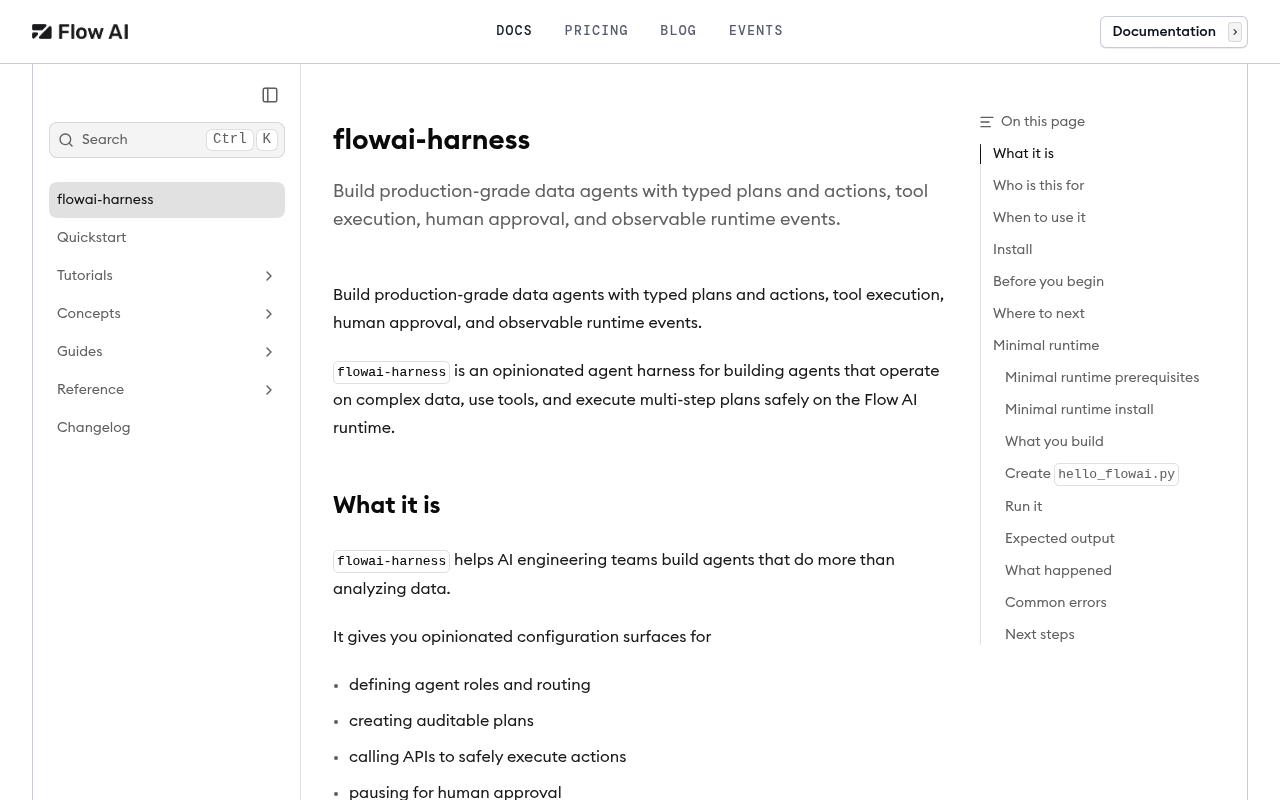
Flow AI builds infrastructure for embedding schema-aware, deterministic AI agents directly inside analytical SaaS products. Its flagship flowai-harness is a Rust-native runtime with a Python SDK for building production-grade data agents on top of your own data product, organized around five primitives - a data catalog agents use to resolve intent, typed plans and actions executed as auditable state machines with human approval gates, an embedded runtime, Studio (a local UI to run, debug, and evaluate agents), and self-improvement. It runs inside your infrastructure with your own model keys (OpenAI, Anthropic, Gemini, Llama, Mistral, Qwen) and warehouse (Postgres, Snowflake, BigQuery, Databricks, DuckDB). The team also publishes the open Flow Judge LLM-as-a-judge evaluation model and the flow-eval evaluation engine.
Flow AI is profiled on the APIs.io network. Tagged areas include Company, Artificial Intelligence, AI Agents, Agent Infrastructure, and LLM Evaluation.
Flow AI’s developer surface includes documentation, API reference, getting-started guide, pricing, engineering blog, support, YouTube channel, and 20 more developer resources.
Kin Score
 Kin Score
How this is scored →
Kin Score
How this is scored →scored 2026-10-17 · rubric v0.24.0
MCP Servers 1
Model Context Protocol servers that expose these APIs to AI agents.
Flow AI MCP Server
flowai-harness can expose its runtime tools as Model Context Protocol (MCP) servers, so an MCP-aware client (Claude, IDEs, agents) can call the data-agent tools defined in a Flo...
MCP SERVERPricing Plans 1
Published pricing tiers and plan structures.
Security Posture 2
Authentication, domain security, vulnerability disclosure, and trust-center signals.
Resources
Get Started 3
Portal, sign-up, and the first successful call
Documentation 2
Reference material describing how the API behaves
Agent Surfaces 3
MCP servers, agent skills, and machine-readable catalogs
Design & Contract 2
Pagination, idempotency, versioning, errors, and events
Build 4
SDKs, sample code, and the tooling you integrate with
Access & Security 3
Authentication, authorization, and security posture
Learn 1
Tutorials, courses, talks, and written guidance
Operate 2
Status, limits, changes, and where to get help
Commercial 3
Pricing, plans, and the legal terms of use
Company 4
The organization behind the API
Source (apis.yml)
Work with this as data
Every provider here is available over the APIs.io API and to AI agents over MCP.