Eldorado
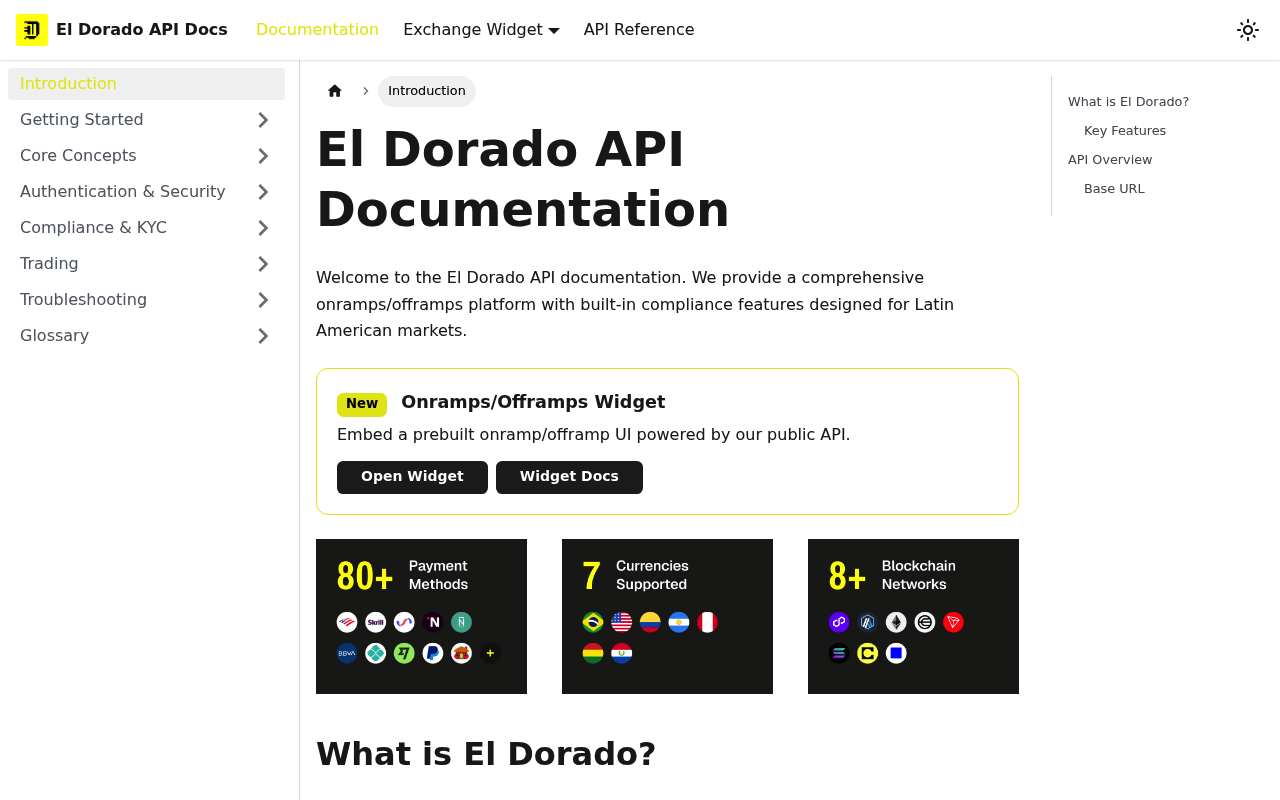
El Dorado is a stablecoin-powered payments SuperApp for Latin America whose public API provides crypto onramp/offramp (buy and sell) infrastructure across Argentina, Brazil, Colombia, Peru, Bolivia, Panama, Paraguay, the Dominican Republic and more. The API lets partners create buy and sell quotes and orders that convert between local fiat currencies (USD, ARS, BRL, COP, PEN and others) and crypto (settled in USDT on Arbitrum), with built-in KYC verification, 80+ local payment methods, and an embeddable Exchange Widget for no-code or low-code integration. Authentication uses per-partner ClientID and ReferralID headers plus a JWT bearer token obtained via an OTP login flow. El Dorado is backed by Multicoin Capital, Coinbase Ventures and Berkeley SkyDeck and has surpassed 500,000 users.
Eldorado is listed with 1 API on the APIs.io network. Tagged areas include Company, Web3, Stablecoins, Payments, and On-Ramp.
The Eldorado catalog on APIs.io includes 1 event-driven AsyncAPI specification.
Eldorado’s developer surface includes documentation, API reference, getting-started guide, sandbox, engineering blog, signup flow, support, and 15 more developer resources.
Kin Score
 Kin Score
How this is scored →
Kin Score
How this is scored →scored 2026-10-17 · rubric v0.24.0
APIs 1
Individual APIs this provider publishes, each with its own machine-readable definition.
El Dorado API
The El Dorado onramp/offramp trading API for converting between Latin American fiat currencies and crypto (USDT on Arbitrum). Create buy/sell quotes and orders, manage KYC, and ...
Event Specifications 1
AsyncAPI definitions for this provider's event-driven and streaming APIs.
Eldorado Webhooks
ASYNCAPISecurity Posture 2
Authentication, domain security, vulnerability disclosure, and trust-center signals.
Resources
Get Started 5
Portal, sign-up, and the first successful call
Documentation 2
Reference material describing how the API behaves
Agent Surfaces 3
MCP servers, agent skills, and machine-readable catalogs
Design & Contract 7
Pagination, idempotency, versioning, errors, and events
Scroll for all 7
Access & Security 2
Authentication, authorization, and security posture
Operate 1
Status, limits, changes, and where to get help
Company 2
The organization behind the API
Source (apis.yml)
Work with this as data
Every provider here is available over the APIs.io API and to AI agents over MCP.