Eco
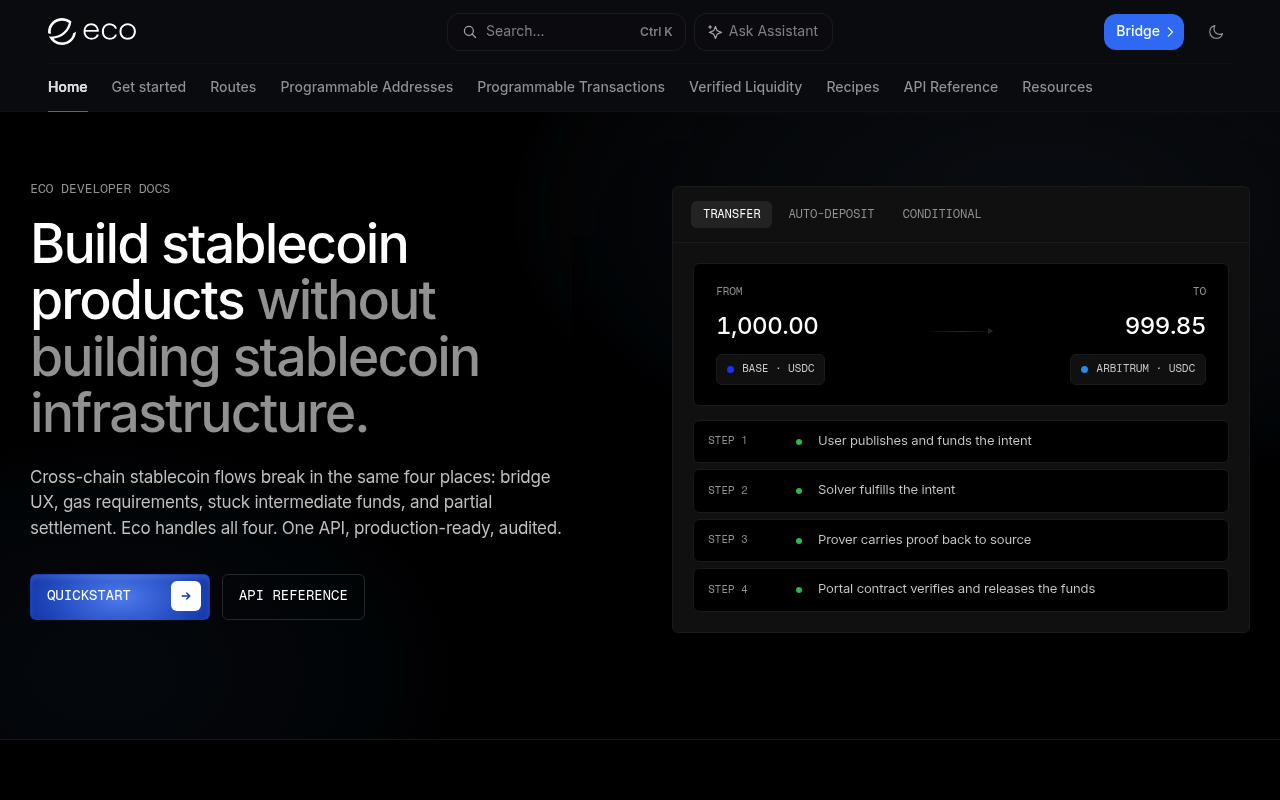
Eco is a developer platform for programmable stablecoin infrastructure — "The Stablecoin Network That Makes Money Programmable." It provides real-time, non-custodial cross-chain stablecoin routing, liquidity, and orchestration across onchain markets through four products: Routes (intent-based cross-chain transfers and swaps fulfilled by competing solvers in 20-40 seconds), Programmable Addresses (deterministic CREATE2 deposit/withdrawal addresses with pre-programmed routing, via Solana Deposit Addresses and Circle Gateway), Programmable Transactions (single-transaction multi-contract "Sauce" execution, beta), and Orchestration (a composition layer over Routes, transactions, and compliance, beta). The Routes REST API exposes quote, intent, and solver operations across V1/V2/V3, requiring no authentication (a dAppID is passed in the request body for attribution). Eco supports 16+ chains and 240+ directional pairs and is used by stablecoin issuers, wallets, exchanges, payment platforms, DeFi protocols, treasury managers, and AI agents.
Eco publishes 3 API contracts indexed on the APIs.io network: Quotes V1 API, Quotes V2 API, and Quotes V3 API. Tagged areas include Company, Stablecoins, Cryptocurrency, Payments, and Blockchain.
Eco’s developer surface includes engineering blog, documentation, API reference, getting-started guide, support, CLI, authentication, and 20 more developer resources.
Kin Score
 Kin Score
How this is scored →
Kin Score
How this is scored →scored 2026-10-09 · rubric v0.23.0
APIs 3
Individual APIs this provider publishes, each with its own machine-readable definition.
Eco Quotes V1 API
The Quotes V1 API from Eco — 2 operation(s) for quotes v1.
Eco Quotes V2 API
The Quotes V2 API from Eco — 4 operation(s) for quotes v2.
Eco Quotes V3 API
The Quotes V3 API from Eco — 9 operation(s) for quotes v3.
Open Collections 4
Open, tool-agnostic API collections (OpenAPI-derived and Bruno).
API Collection
OPEN COLLECTIONEco Routes Quotes V1 API
OPEN COLLECTIONEco Routes Quotes V1 Quotes V2 API
OPEN COLLECTIONEco Routes Quotes V1 Quotes V3 API
OPEN COLLECTIONOpenAPI Overlays 1
Overlays applied on top of this provider's contracts. Each card says who wrote it: a document the provider publishes, or one API Evangelist derived or generated.
Eco Routes Overlay
UNRECORDEDSecurity Posture 2
Authentication, domain security, vulnerability disclosure, and trust-center signals.
Resources
Get Started 3
Portal, sign-up, and the first successful call
Documentation 2
Reference material describing how the API behaves
Agent Surfaces 3
MCP servers, agent skills, and machine-readable catalogs
Design & Contract 5
Pagination, idempotency, versioning, errors, and events
Build 4
SDKs, sample code, and the tooling you integrate with
Access & Security 2
Authentication, authorization, and security posture
Operate 1
Status, limits, changes, and where to get help
Commercial 2
Pricing, plans, and the legal terms of use
Company 4
The organization behind the API
Other 1
Properties that don't map to a standard resource type
Source (apis.yml)
Work with this as data
Every provider here is available over the APIs.io API and to AI agents over MCP.