BrightEdge
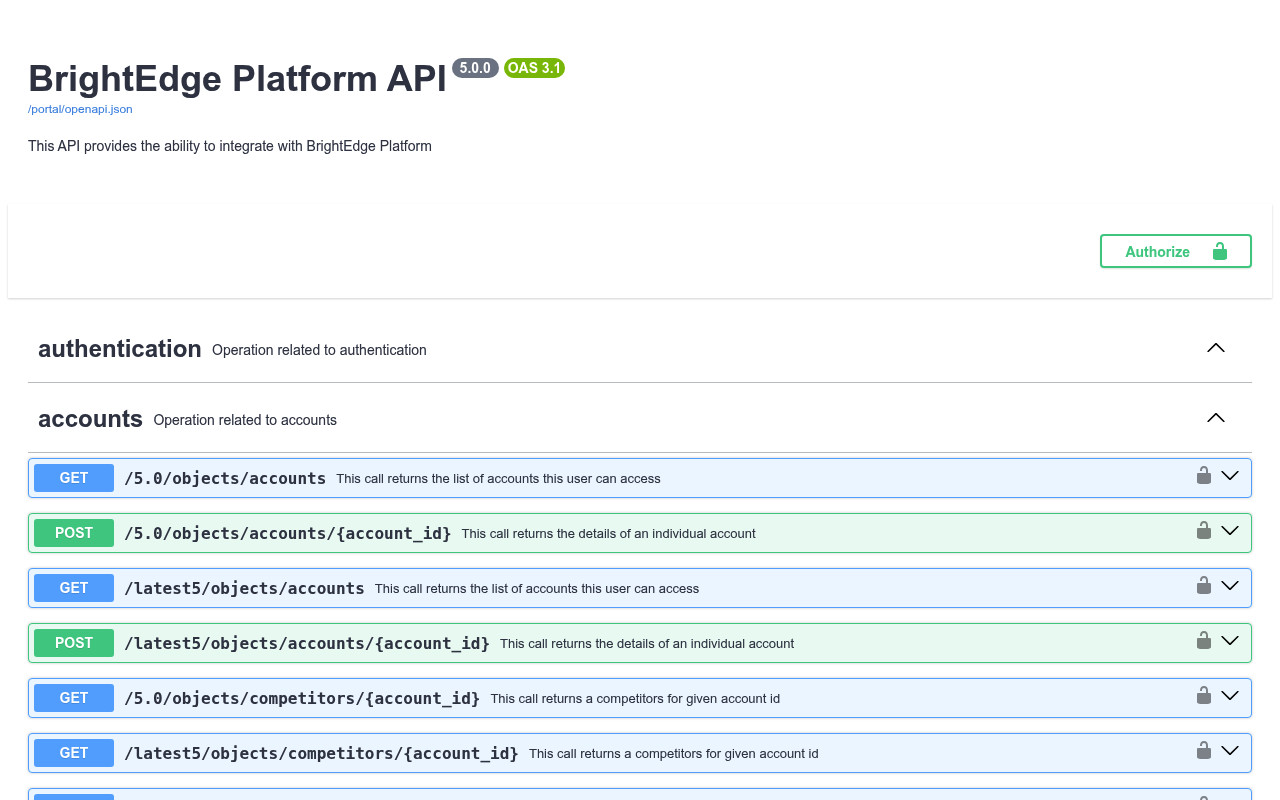
BrightEdge is an enterprise SEO and content performance platform, founded in 2007 and headquartered in Silicon Valley, used by thousands of brands and a majority of the Fortune 100. Its products include the DataCube keyword and content data repository, ContentIQ site auditing, Autopilot, Copilot, and the DataMind AI engine plus AI Catalyst for generative-search visibility. The BrightEdge Platform API (v5.0) is a REST API published at api.brightedge.com that exposes accounts, keywords, keyword groups, competitors, domains, pages, backlinks, the DataCube dataset, recommendations, People-Also-Ask, SERP features, Core Web Vitals, bulk export, and user/organization management, so teams can integrate BrightEdge search and content intelligence into their own reporting, analytics, and data-warehouse workflows.
BrightEdge publishes 10 API contracts indexed on the APIs.io network, including Auth API, Authorize API, Feedback API, and 7 more. Tagged areas include Company, SEO, Search, Content, and Marketing.
The BrightEdge catalog on APIs.io includes 1 Spectral governance ruleset.
BrightEdge’s developer surface includes documentation, API reference, getting-started guide, signup flow, pricing, support, engineering blog, and 41 more developer resources.
What this lets a business do 1
Business capabilities this provider's published APIs can perform, derived from its own contracts. Browse all capabilities →
Kin Score
 Kin Score
How this is scored →
scored 2026-11-21 · rubric v0.28.1
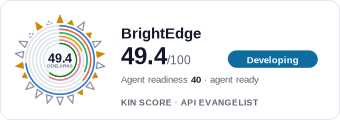 It updates itself when the score changes. Paste this where you link to your API docs:
<a href="https://apis.io/providers/brightedge/"><img src="https://apis.io/badge/brightedge/card.svg" alt="BrightEdge on APIs.io — Kin Score by API Evangelist"></a>Other styles, a README pill and a shields.io endpoint are on the badge page.
- MCP Server +12 pts — deployment.mode + probe verdict on the mcp/ manifest, not the pointer; an unprobed slug falls back to authorship Ask about this →
- Idempotency +9 pts — OpenAPI mutating operations declare an idempotency key — a header, a request-body property, or a named de-duplication token whose own description says so (verified); else common[].type matches /idempoten/i (documented) Ask about this →
- A2A Agent Card +8 pts — a2a/
-a2a.yml manifest, graded on conformance.grade against A2A 1.0.0 Ask about this → - Request/Response Examples +7 pts — share of operations carrying request/response examples; else an Examples / Code Samples link Ask about this →
- Registration Without a Human +6 pts — a `registration_endpoint` in the served RFC 8414 / OIDC discovery document Ask about this →
- Documented Reversibility +6 pts — a reversal operation in the contract, graded up when a window is documented too Ask about this →
- Contract Quality scores 37.2 — up to +15.7 composite points Ask about this →
- Operational Transparency scores 19.0 — up to +10.5 composite points Ask about this →
- Developer Ergonomics scores 58.9 — up to +8.2 composite points Ask about this →
Standards implemented 3
Standards this provider implements or carries. De facto ones are profiled and measured by the API Commons; formal ones come from the standards directory and are linked by the provider's own tags. The evidence column says how each claim was established — not that it was made.
APIs 10
Individual APIs this provider publishes, each with its own machine-readable definition.
BrightEdge MCP Server
BrightEdge's hosted, remote Model Context Protocol server. An MCP client POSTs to https://mcp2.brightedge.com/mcp (or the SSE endpoint https://mcp2-sse.brightedge.com/sse) and, ...
BrightEdge Auth API
The Auth API from BrightEdge — 3 operation(s) for auth.
BrightEdge Authorize API
The Authorize API from BrightEdge — 2 operation(s) for authorize.
BrightEdge Feedback API
The Feedback API from BrightEdge — 4 operation(s) for feedback.
BrightEdge OAuth API
The Oauth API from BrightEdge — 3 operation(s) for oauth.
BrightEdge Ping API
The Ping API from BrightEdge — 1 operation(s) for ping.
BrightEdge SAML API
The Saml API from BrightEdge — 2 operation(s) for saml.
BrightEdge SSO API
The Sso API from BrightEdge — 2 operation(s) for sso.
BrightEdge Token API
The Token API from BrightEdge — 2 operation(s) for token.
BrightEdge .well Known API
The .well Known API from BrightEdge — 7 operation(s) for .well known.
Scroll for all 10
Open Collections 44
Open, tool-agnostic API collections (OpenAPI-derived and Bruno).
BrightEdge Platform accounts API
OPEN COLLECTIONBrightEdge Platform accounts ai_catalyst API
OPEN COLLECTIONBrightEdge Platform accounts autopilot API
OPEN COLLECTIONBrightEdge Platform accounts backlinks API
OPEN COLLECTIONBrightEdge Platform accounts be_local API
OPEN COLLECTIONBrightEdge Platform accounts budd API
OPEN COLLECTIONBrightEdge Platform accounts bulk_export API
OPEN COLLECTIONBrightEdge Platform accounts chrome_extension API
OPEN COLLECTIONBrightEdge Platform accounts Chrome Extension Keywords API
OPEN COLLECTIONBrightEdge Platform accounts Chrome Extension Overview API
OPEN COLLECTIONBrightEdge Platform accounts chromeextension API
OPEN COLLECTIONBrightEdge Platform accounts competitors API
OPEN COLLECTIONBrightEdge Platform accounts core API
OPEN COLLECTIONBrightEdge Platform accounts datacube_searchengines API
OPEN COLLECTIONBrightEdge Platform accounts dataset API
OPEN COLLECTIONBrightEdge Platform accounts domains API
OPEN COLLECTIONBrightEdge Platform accounts instant API
OPEN COLLECTIONBrightEdge Platform accounts keywordgroups API
OPEN COLLECTIONBrightEdge Platform accounts keywords API
OPEN COLLECTIONBrightEdge Platform accounts Latest5 API
OPEN COLLECTIONBrightEdge Platform accounts legacy API
OPEN COLLECTIONBrightEdge Platform accounts marketinsights API
OPEN COLLECTIONBrightEdge Platform accounts marketo API
OPEN COLLECTIONBrightEdge Platform accounts organizations API
OPEN COLLECTIONBrightEdge Platform accounts paa per keyword API
OPEN COLLECTIONBrightEdge Platform accounts page cache API
OPEN COLLECTIONBrightEdge Platform accounts page crawl API
OPEN COLLECTIONBrightEdge Platform accounts Pages API
OPEN COLLECTIONBrightEdge Platform accounts people_also_ask API
OPEN COLLECTIONBrightEdge Platform accounts ping API
OPEN COLLECTIONBrightEdge Platform accounts product_grid API
OPEN COLLECTIONBrightEdge Platform accounts qa API
OPEN COLLECTIONBrightEdge Platform accounts query API
OPEN COLLECTIONBrightEdge Platform accounts recommendations API
OPEN COLLECTIONBrightEdge Platform accounts searchengines API
OPEN COLLECTIONBrightEdge Platform accounts Serp Features API
OPEN COLLECTIONBrightEdge Platform accounts time API
OPEN COLLECTIONBrightEdge Platform accounts top keywords for a domain API
OPEN COLLECTIONBrightEdge Platform accounts top keywords per page API
OPEN COLLECTIONBrightEdge Platform accounts top pages API
OPEN COLLECTIONBrightEdge Platform accounts user_settings API
OPEN COLLECTIONBrightEdge Platform accounts users API
OPEN COLLECTIONBrightEdge Platform accounts web_vitals API
OPEN COLLECTIONBrightEdge Platform accounts webhook API
OPEN COLLECTIONScroll for all 44
MCP Servers 2
Model Context Protocol servers that expose these APIs to AI agents.
BrightEdge MCP product page
MCP SERVERAgent Skills 4
Packaged agent skills for driving this provider's APIs from an AI assistant.
Create and retrieve a bulk export job
AGENT SKILLPull keyword rankings for an account
AGENT SKILLBrightEdge API pricing
Pricing Plans 1
Published pricing tiers and plan structures.
Rate Limits 1
Documented rate limits and quota policies.
BrightEdge Rate Limits
RATE LIMITSTerms of Service 1
What its API terms permit and prohibit, quoted from its own page.
Privacy & Data 1
Its role, the data it processes, retention and transfers, quoted from its own privacy page.
Compliance 1
Attestations the provider states (SOC 2, ISO 27001 and others), quoted from its own trust page. APIs.io verifies none of them.
Eligibility 1
Who may sign up and where, quoted from its own terms.
FinOps 1
Cost, billing, and metering signals for API financial operations.
BrightEdge Finops
FINOPSSpectral Rules 1
Spectral governance rulesets for linting and validating these APIs. Counts are the severity each rule declares, not results of running them.
BrightEdge API Rules
SPECTRALOpenAPI Overlays 1
Overlays applied on top of this provider's contracts. Each card says who wrote it: a document the provider publishes, or one API Evangelist derived or generated.
BrightEdge Platform Overlay
DERIVEDSecurity Posture 3
Authentication, domain security, vulnerability disclosure, and trust-center signals.
BrightEdge Trust Center
SOC 2, ISO/IEC 27001:2022, ISO/IEC 27701:2019, ISO/IEC 42001:2023, GDPR, CCPA, EU-U.S. Data Privacy Framework
SECURITYScopes 1
OAuth scopes governing access to this provider's APIs.
Agentic Access (API Evangelist recommendations) 1
Recommended x-agentic-access execution contracts for AI agents.
Resources
Get Started 4
Portal, sign-up, and the first successful call
Documentation 2
Reference material describing how the API behaves
Agent Surfaces 11
MCP servers, agent skills, and machine-readable catalogs
Scroll for all 11
Design & Contract 5
Pagination, idempotency, versioning, errors, and events
Build 3
SDKs, sample code, and the tooling you integrate with
Access & Security 5
Authentication, authorization, and security posture
Operate 5
Status, limits, changes, and where to get help
Commercial 5
Pricing, plans, and the legal terms of use
Company 3
The organization behind the API
Other 5
Properties that don't map to a standard resource type
Source (apis.yml)
BrightEdge API — frequently asked questions
Does BrightEdge have an API?
Yes. APIs.io lists 10 APIs from BrightEdge, including BrightEdge MCP Server, BrightEdge Auth API and BrightEdge Authorize API, and 7 more.
Is there an OpenAPI specification for the BrightEdge API?
Yes. APIs.io indexes 9 OpenAPI specifications for BrightEdge, each linked for download from this page.
How do I authenticate with the BrightEdge API?
BrightEdge documents its authentication (apiKey/http/oauth2 · 7 schemes). The details are profiled on APIs.io as BrightEdge Authentication.
Does BrightEdge have an MCP server?
Yes. APIs.io lists 2 MCP servers for BrightEdge: Remote MCP server at mcp2.brightedge.com over HTTP.
Is the BrightEdge API ready for AI agents?
BrightEdge has a Kin Score of 49.5 out of 100 (developing) and an Agent Readiness score of 38.8 (agent-ready), scored by API Evangelist on 2026-11-21.
Work with this as data
Every provider here is available over the APIs.io API and to AI agents over MCP.