Trino
Trino is an open-source, distributed SQL query engine built for lightning-fast analytics over large, heterogeneous data sets. Originally forked from Presto (which emerged at Facebook), it supports ANSI-compliant SQL across a wide range of storage systems from data lakes (S3, HDFS, Iceberg) to relational and NoSQL databases (MySQL, PostgreSQL, Cassandra, MongoDB, Elasticsearch, Kafka, and more).
Trino publishes 2 API contracts indexed on the APIs.io network: Cluster API and Queries API. Tagged areas include Analytics, Big Data, Distributed SQL, MySQL, and NoSQL.
The Trino catalog on APIs.io includes 1 JSON-LD context and 2 Spectral governance rulesets.
Trino’s developer surface includes CLI, documentation, changelog, getting-started guide, engineering blog, and 20 more developer resources.
What this lets a business do 1
Business capabilities this provider's published APIs can perform, derived from its own contracts. Browse all capabilities →
Kin Score
 Kin Score
How this is scored →
Kin Score
How this is scored →scored 2026-10-23 · rubric v0.25.0
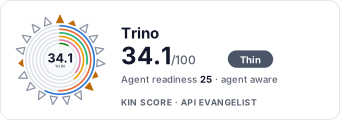 It updates itself when the score changes. Paste this where you link to your API docs:
<a href="https://apis.io/providers/trino/"><img src="https://apis.io/badge/trino/card.svg" alt="Trino on APIs.io — Kin Score by API Evangelist"></a>Other styles, a README pill and a shields.io endpoint are on the badge page.
Standards implemented 1
Standards this provider implements or carries. De facto ones are profiled and measured by the API Commons; formal ones come from the standards directory and are linked by the provider's own tags. The evidence column says how each claim was established — not that it was made.
APIs 2
Individual APIs this provider publishes, each with its own machine-readable definition.
Trino Cluster API
Cluster status and node information
Trino Queries API
Submit and manage SQL queries
Open Collections 3
Open, tool-agnostic API collections (OpenAPI-derived and Bruno).
Trino Client REST API
OPEN COLLECTIONTrino Client REST Cluster API
OPEN COLLECTIONTrino Client REST Cluster Queries API
OPEN COLLECTIONPricing Plans 1
Published pricing tiers and plan structures.
Trino Plans Pricing
PLANSRate Limits 1
Documented rate limits and quota policies.
Trino Rate Limits
RATE LIMITSFinOps 1
Cost, billing, and metering signals for API financial operations.
Trino Finops
FINOPSFeatures 126
Notable capabilities this provider offers.
C# Client Driver
Go Client Driver
JDBC
ODBC
Python Client Driver
Elixir Client Driver
Simba JDBC Client Driver
R Client Driver
Ruby Client Driver
Rust Client Driver
Command Line Interface
Grafana
Apache Airflow
Apache DolphinScheduler
Coginiti
Cube
DBeaver
dbt
DbVisualizer
Emacs
FugueSQL
Great Expectations
Harlequin
Hue
Ibis
IBM Cognos Analytics
JetBrains Datagrip
Jupy SQL
Logi Symphony
Looker
Metabase
Microstrategy
Mitzu
Mode
PopSQL
Power BI
Querybook
Quix
Redash
SQuirrel SQL
Tableau
VSCode
waii
Wren AI
yanagishima
Zing Data
Spill to disk
Resource groups
Session property managers
Distributed sort
Dynamic filtering
Graceful shutdown
Fault-tolerant execution
HTTP event listener
Kafka event listener
MySQL event listener
OpenLineage event listener
Client protocol
HTTP server
Resource management
Query management
Catalog management
SQL environment
Spilling
Exchange
Task
Write partitioning
Writer scaling
Node scheduler
Optimizer
Logging
Web UI
Regular expression function
HTTP client
Table statistics
Cost in EXPLAIN
Cost-based optimizations
Pushdown
Adaptive plan optimizations
Amazon Redshift
Apache Cassandra
Apache Druid
Apache Ignite
Apache Kafka
Apache Pinot
Clickhouse
Datafaker
Elasticsearch
Exasol
Google BigQuery
Google Sheets
MariaDB
Microsoft SQL Server
MongoDB
MySQL
OpenSearch
Oracle
PostgreSQL
Prometheus
Redis
SingleStore
Snowflake
TPC
Vertica
Amazon Kinesis
Apache Accumulo
Apache Kudu
Apache Phoenix
Git
OpenAPI
VAST
JMX
Kubernetes
OpenLineage
Open Policy Agent
OpenTelemetry
Trino Gateway
Datadog
Gurubase
jOOQ
Minitrino
RudderStack
SQL Formatter
Testcontainers
Trino-lb
Workload Analyzer
Scroll for all 126
Semantic Vocabularies 1
JSON-LD contexts and semantic vocabularies used across these APIs.
Trino Context
JSON-LDSpectral Rules 2
Spectral governance rulesets for linting and validating these APIs.
Trino — jsonschema rules
SPECTRALTrino API Rules
SPECTRALJSON Schema 1
Standalone JSON Schema definitions for this provider's data models.
Trino Query Results
JSON SCHEMAJSON Structure 1
JSON Structure definitions describing this provider's data shapes.
Trino Query Results Structure
JSON STRUCTUREExamples 3
Example request and response payloads for these APIs.
Trino Cancel Query Example
EXAMPLESecurity Posture 1
Authentication, domain security, vulnerability disclosure, and trust-center signals.
Agentic Access 1
Recommended x-agentic-access execution contracts for AI agents.
Integrations 37
Pre-built integrations with other platforms and tools.
BigQuery
Black Hole
Cassandra
ClickHouse
Delta Lake
Druid
DuckDB
Elasticsearch
Exasol
Faker
Google Sheets
Hive
Hudi
Iceberg
Ignite
JMX
Kafka
Loki
MariaDB
Memory
MongoDB
MySQL
OpenSearch
Oracle
Pinot
PostgreSQL
Prometheus
Redis
Redshift
SingleStore
Snowflake
SQL Server
System
Thrift
TPC-DS
TPC-H
Vertica
Scroll for all 37
Resources
Get Started 1
Portal, sign-up, and the first successful call
Documentation 2
Reference material describing how the API behaves
Agent Surfaces 1
MCP servers, agent skills, and machine-readable catalogs
Design & Contract 3
Pagination, idempotency, versioning, errors, and events
Build 5
SDKs, sample code, and the tooling you integrate with
Access & Security 2
Authentication, authorization, and security posture
Operate 3
Status, limits, changes, and where to get help
Commercial 2
Pricing, plans, and the legal terms of use
Company 2
The organization behind the API
Other 4
Properties that don't map to a standard resource type
Source (apis.yml)
Work with this as data
Every provider here is available over the APIs.io API and to AI agents over MCP.