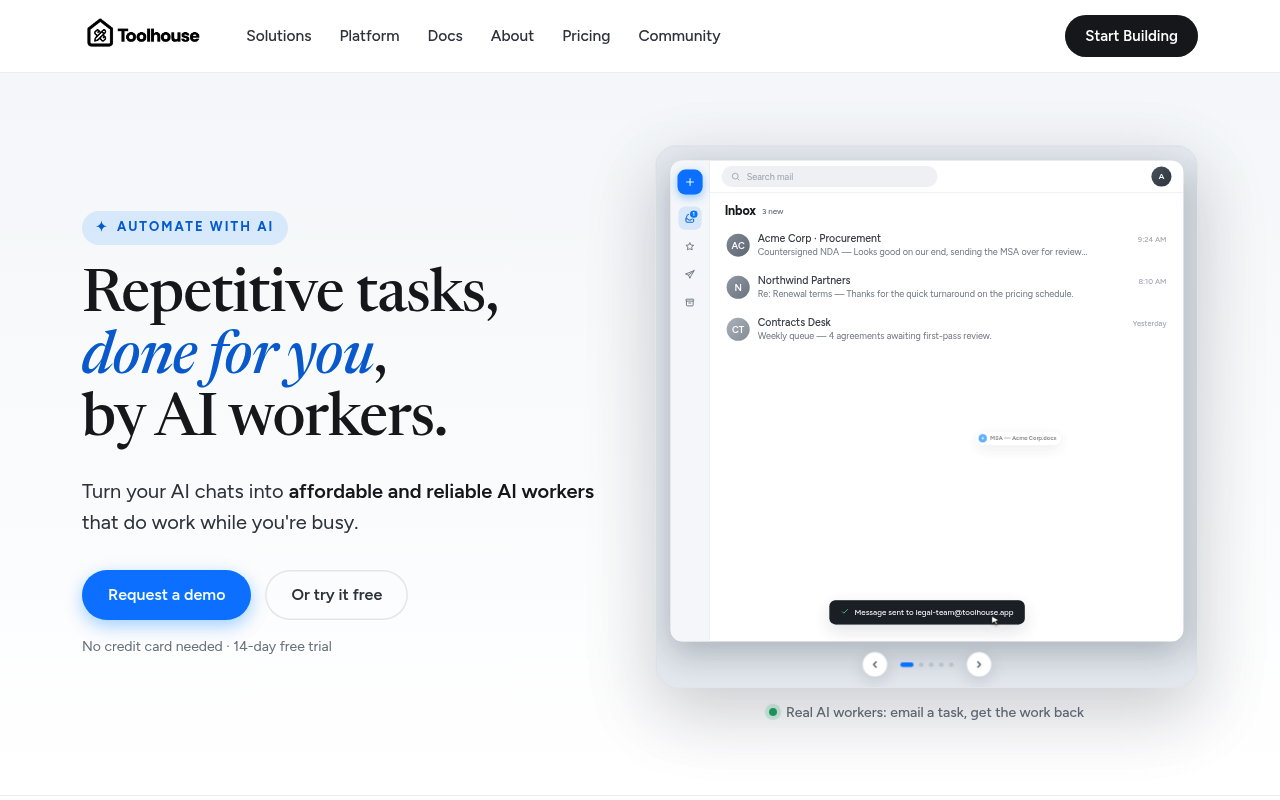
Toolhouse is a Backend-as-a-Service platform for building, deploying, and managing "AI workers" (Toolhouse's current product noun, used interchangeably with "AI agents"). The homepage frames the value proposition as "Turn your AI chats into affordable and reliable AI workers that do work while you're busy," and the docs define a worker as "a system that carries out a task with three components: a trigger, a process that may include specialized skills, and tools or systems it can connect to." Builders describe a task in plain language in the Agent Editor and ship a worker to production; developers can do the same programmatically via SDKs. Every worker is automatically wired into Toolhouse's pre-integrated capabilities, including web and social media search, scraping, Toolhouse RAG, persistent memory, the Virtual Computer code-execution sandbox, image generation/editing and vision, document parsing, file download, and MCP Discovery for connecting to thousands of MCP servers at runtime. The platform exposes a Workers API (agents.toolhouse.ai) for invoking deployed workers over REST with text and NDJSON streaming and stateful conversation continuity (X-Toolhouse-Run-ID), a Platform API for full worker and run lifecycle management, scheduling (10-minute minimum cadence), metrics, monetization, and integrations, plus no-code workflow integration through Zapier and Toolhouse n8n Nodes. Toolhouse runs on a broad model substrate including OpenAI, Anthropic, Together AI, Groq, and NVIDIA model offerings. The current public pricing surface is Business ($500/mo, 25,000 credits, 50 workers), Business Max ($1,200/mo, 80,000 credits, 500 workers), and custom Enterprise — all plans include "free unlimited tokens" and a 14-day free trial. Toolhouse reports 7,000+ teams on the platform and 40+ integrations and is backed by NextGenerationEU funding.
Toolhouse publishes 8 API contracts indexed on the APIs.io network, including Agent Runs API, API Keys API, Backoffice API, and 5 more. Tagged areas include Agent Infrastructure, AI Agents, AI Workers, Backend-as-a-Service, and MCP.
The Toolhouse catalog on APIs.io includes 1 JSON-LD context and 2 Spectral governance rulesets.
Toolhouse’s developer surface includes authentication, documentation, engineering blog, pricing, YouTube channel, support, tooling, and 41 more developer resources.
Regulatory Posture applies to this provider. Its tags matched the
Horizontal (data, software, accessibility, platform) regime, so
Regulatory Posture carries 15 points of the composite.
If this regime is wrong for your business, say so on your
provider repo — the
applicability map is public and we will correct it.
Create-or-Update Ergonomics applies to this provider. This API accepts writes, so it
carries 10 points of the composite. It is scored from the published contracts
themselves: whether a caller can create-or-update in one call, whether the write accepts a key the caller already
holds, and whether the response says which branch ran. Without that, every write needs a search-and-branch in
front of it, and the first time that check is skipped a duplicate record is created.
Scored against the observed mean rather than raw — a provider at the catalog average is unchanged by this facet,
not penalised by it.
The six quality facets above are damped to 75 points between them,
because the conditional facet above carries the other
25. That is why each facet's contribution is shown against a damped
maximum: raising a quality facet moves the composite by 75% of its nominal
weight, not 100%. The full arithmetic is at apis.io/rating/.
Improve this rating by publishing the missing artifacts — every area above can be raised, and the full rubric is at apis.io/rating/. Every facet and dimension name above is a link: it opens that measurement's own page — what it means, the exact checks that feed it, how the whole catalog distributes on it, and the providers at the top of it. This rating is computed from github.com/api-evangelist/toolhouse: open an issue to ask a question, or submit a pull request to add artifacts.
Submit an artifact on GitHub — free →Manage your own listing — the Influence plan, $499/mo →
Toolhouse is an area vendor: providers adopt it to run part of their developer surface. This is the Kin Score checks its features can move for a provider that adopts it, what each one really earns, and what it earns nothing for.
mcp hostingcapability map5 features checked 2026-09-25 · rubric v0.22.0
Toolhouse no longer fits mcp-hosting from a provider’s point of view: its current product is AI workers that consume integrations and connect out to MCP servers other people host (its “official partner” Tavily is wired in via Tavily’s own mcp.tavily.com). A provider gains Kin Score only from its own MCP server, which Toolhouse neither builds nor hosts; a Toolhouse integration for your API earns nothing. The one qualified row is a provider-run MCP server that Toolhouse can consume — the credit is the provider’s, not Toolhouse’s.
Nothing the Kin Score reads. Toolhouse's features serve the provider's operations, not the published surface the score measures.
Across 8977 providers that publish a contract, adopting Toolhouse would move 0. Median lift: composite +0.0 (90th percentile +0.0), agent readiness +0.0 (+0.0). Conditional rows excluded.
What Toolhouse ships that earns nothing (4)
Built-in and connection-required integrations — A Toolhouse-built integration for a provider’s API runs inside Toolhouse workers; it is not an MCP server the provider publishes.
Skills and knowledge files — Skill files are uploaded by the Toolhouse user into a private worker; they are not provider-authored, published skills.
Workers API — Worker endpoints on agents.toolhouse.ai carry no A2A agent card, and they belong to the Toolhouse user, not the provider.
Connect workers to external MCP servers — Toolhouse is an OAuth client of MCP servers; it serves no protected-resource metadata for anyone.
A model, not a score. Adopting this vendor changes a provider's Kin Score only when the provider publishes the resulting artifacts on its own surface; nothing here writes a score, and no sponsorship or partnership can. The rating is not for sale → · Full vendor facets artifact
The Toolhouse Workers API (historically the "Agents API") enables HTTP execution of any deployed Toolhouse worker. Workers defined via the Agent Editor or as code are reachable ...
Discovery needs no key. Ratings and market analysis are Pro.
Get an API key
Free tier, no form to fill in. Signing in shares your email address with us — we
store it to create your key and to recognise you if you sign in with another
provider. See our Privacy Policy and
Terms.
 Kin Score
How this is scored →
Kin Score
How this is scored →