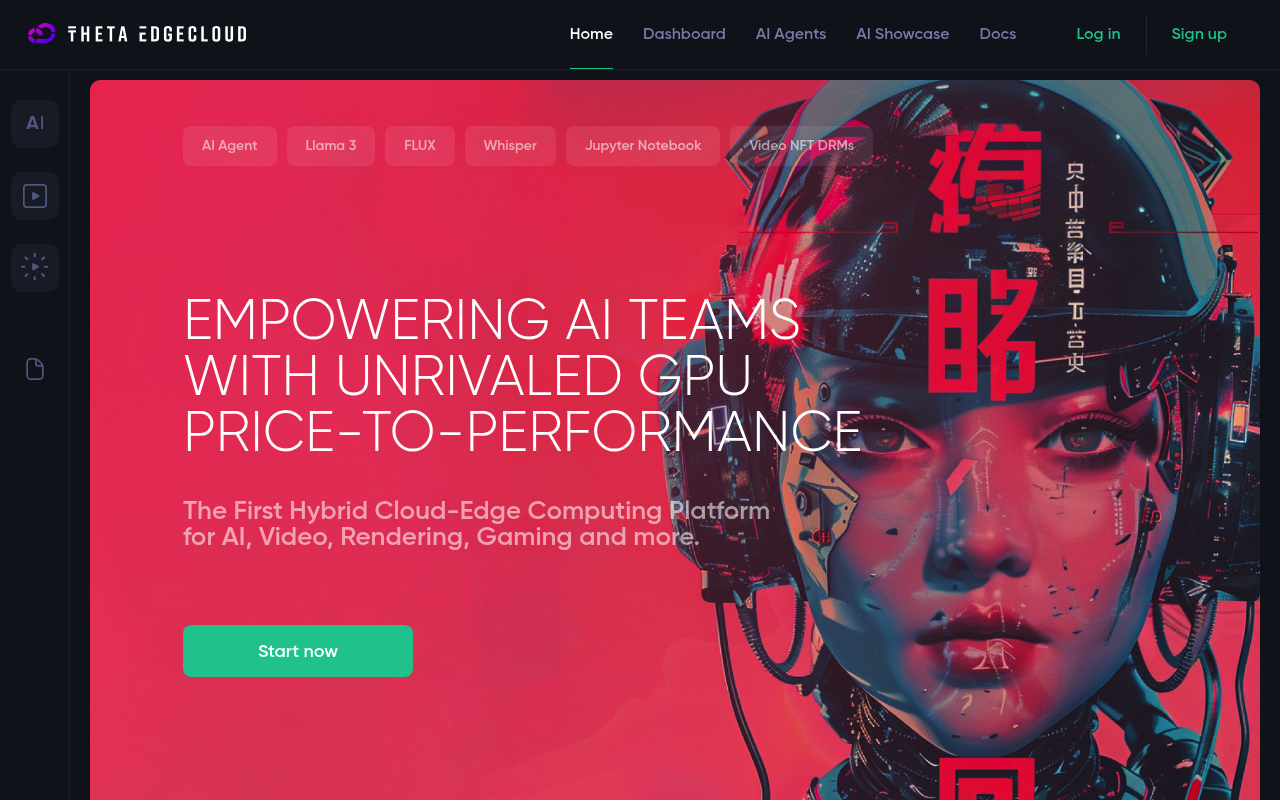
Theta EdgeCloud
Theta EdgeCloud is a distributed, hybrid AI and video cloud built on the Theta Network blockchain, offering on-demand GPU compute for AI model training, fine-tuning, inference, video transcoding, and live streaming. EdgeCloud aggregates GPU capacity from data-center hyperscaler partners and a global community of Edge Nodes (consumer and enterprise GPUs) into a single dispatchable compute layer addressable via REST, JSON-RPC, and SDK clients. Core services include EdgeCloud AI Services (on-demand model inference APIs for LLMs, image, audio, and multimodal models such as Llama, Stable Diffusion, FLUX, and Whisper; agentic RAG chatbots; GPU-backed Jupyter notebooks; dedicated GPU pod deployments; and AI training with GPU clusters), EdgeCloud Video Services (the Theta Video API for upload, transcoding, livestream ingestion, DRM, NFT-gated playback, and webhooks), EdgeStore (decentralized object storage), and the EdgeCloud Client (an installable node that earns TFUEL for contributing GPU and bandwidth). Developers authenticate with x-api-key tokens issued from the EdgeCloud dashboard, manage deployments programmatically through api.thetaedgecloud.com and the Node.js SDK @thetalabs/theta-edgecloud, and access on-demand model endpoints (also distributed through RapidAPI). The Theta blockchain layer is EVM-compatible with an Ethereum RPC adaptor, supports TNT-20 tokens and NFTs, and underwrites EdgeCloud's payment, rewards, and staking economy through the THETA governance token and TFUEL gas token. Theta operates as Theta Labs, headquartered in San Jose, California.
Theta EdgeCloud is profiled on the APIs.io network. Tagged areas include Distributed Computing, GPU Compute, AI Compute, Inference, and AI Training.
Theta EdgeCloud’s developer surface includes documentation, GitHub presence, engineering blog, YouTube channel, and 43 more developer resources.
Kin Score
 Kin Score
How this is scored →
Kin Score
How this is scored →scored 2026-10-17 · rubric v0.24.0
Security Posture 1
Authentication, domain security, vulnerability disclosure, and trust-center signals.
Resources
Get Started 3
Portal, sign-up, and the first successful call
Documentation 3
Reference material describing how the API behaves
Agent Surfaces 2
MCP servers, agent skills, and machine-readable catalogs
Design & Contract 1
Pagination, idempotency, versioning, errors, and events
Build 7
SDKs, sample code, and the tooling you integrate with
Scroll for all 7
Access & Security 2
Authentication, authorization, and security posture
Learn 7
Tutorials, courses, talks, and written guidance
Scroll for all 7
Operate 2
Status, limits, changes, and where to get help
Company 4
The organization behind the API
Other 16
Properties that don't map to a standard resource type
Scroll for all 16
Source (apis.yml)
Work with this as data
Every provider here is available over the APIs.io API and to AI agents over MCP.