Tether
Tether Operations Limited is the issuer of USD₮ (USDT), the largest stablecoin by circulating supply, along with XAU₮ (gold-backed), USA₮ and EUR₮ tokens issued across Ethereum, Tron, TON, Solana, Bitcoin/Liquid, Avalanche, Polygon, Arbitrum, Plasma and other chains. Beyond token issuance, Tether ships a developer surface centred on the open-source Wallet Development Kit (WDK) — a modular, self-custodial multi-chain wallet framework distributed as @tetherto/* npm packages, a WDK CLI, a React Native UI kit, an MCP Toolkit that exposes 35 wallet, pricing, indexer, swap, bridge, lending and fiat tools to AI agents, a published Agent Skill, and the hosted WDK Indexer REST API (wdk-api.tether.io) for token balances and transfer history. Tether also operates the QVAC local-AI SDK, the Tether Wallet app, and a public bug-bounty program.
Tether publishes 5 API contracts indexed on the APIs.io network, including API Keys API, Chains API, Health API, and 2 more. Tagged areas include Company, Stablecoins, Cryptocurrency, Blockchain, and Wallets.
The Tether catalog on APIs.io includes 1 Spectral governance ruleset.
Tether’s developer surface includes documentation, API reference, getting-started guide, support, engineering blog, signup flow, CLI, and 28 more developer resources.
Kin Score
 Kin Score
How this is scored →
scored 2026-11-06 · rubric v0.27.0
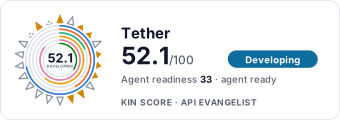 It updates itself when the score changes. Paste this where you link to your API docs:
<a href="https://apis.io/providers/tether/"><img src="https://apis.io/badge/tether/card.svg" alt="Tether on APIs.io — Kin Score by API Evangelist"></a>Other styles, a README pill and a shields.io endpoint are on the badge page.
- Agentic Access Contract +10 pts — agentic_access artifact present (x-agentic-access), graded by author
- Idempotency +9 pts — OpenAPI mutating operations declare an idempotency key — a header, a request-body property, or a named de-duplication token whose own description says so (verified); else common[].type matches /idempoten/i (documented)
- A2A Agent Card +8 pts — a2a/
-a2a.yml manifest, graded on conformance.grade against A2A 1.0.0 - Registration Without a Human +6 pts — a `registration_endpoint` in the served RFC 8414 / OIDC discovery document
- Delegated User Identity +6 pts — a served discovery document listing authorization_code in grant_types_supported (served), else an oauth2 authorizationCode flow or openIdConnect declared in an OpenAPI (documented)
- Typed Event Surface +6 pts — AsyncAPI document, OR webhooks/callbacks objects in the as-published OpenAPI, OR common[].type includes Webhooks
- Contract Quality scores 41.6 — up to +14.6 composite points
- Access Clarity scores 34.2 — up to +13.2 composite points
- Contract Governance scores 18.2 — up to +9.8 composite points
Markets this provider is in provisional
The Kin Score Market layer reads a provider inside its market: its position, and how deep its integrations go. Depth is only comparable within a position. Provisional and unweighted: not part of the Kin Score or agent readiness.
| Market | Position | Depth | Registered MCP server | Declares compatibility |
|---|---|---|---|---|
| Agent Skills (SKILL.md packages) | builds-on | 26.8 (thin) | - | 1 |
| Stablecoins and Tokenization (stablecoin issuers, tokenized assets) | builds-on | 26.8 (thin) | - | 1 |
| Flathub Linux App Publishers (company-published, domain-verified Linux desktop apps) | builds-on | 26.8 (thin) | - | 1 |
Registered MCP server and declares compatibility are report only — not weighted. Undeclared means we found nothing we can read, so there is no number: we never infer integrations.
Standards implemented 3
Standards this provider implements or carries. De facto ones are profiled and measured by the API Commons; formal ones come from the standards directory and are linked by the provider's own tags. The evidence column says how each claim was established — not that it was made.
APIs 5
Individual APIs this provider publishes, each with its own machine-readable definition.
Tether API Keys API
The API Keys API from Tether — 2 operation(s) for api keys.
Tether Chains API
Supported blockchains and token discovery
Tether Health API
Server health and status checks
Tether Token Balances API
Query current token balances for addresses
Tether Token Transfers API
Query token transfer history for addresses
Open Collections 5
Open, tool-agnostic API collections (OpenAPI-derived and Bruno).
WDK Indexer API Keys API
OPEN COLLECTIONWDK Indexer Chains API
OPEN COLLECTIONWDK Indexer Health API
OPEN COLLECTIONWDK Indexer Token Balances API
OPEN COLLECTIONWDK Indexer Token Transfers API
OPEN COLLECTIONMCP Servers 1
Model Context Protocol servers that expose these APIs to AI agents.
Agent Skills 3
Packaged agent skills for driving this provider's APIs from an AI assistant.
Rate Limits 1
Documented rate limits and quota policies.
Tether Rate Limits
RATE LIMITSSpectral Rules 1
Spectral governance rulesets for linting and validating these APIs.
Tether API Rules
SPECTRALOpenAPI Overlays 1
Overlays applied on top of this provider's contracts. Each card says who wrote it: a document the provider publishes, or one API Evangelist derived or generated.
Tether Wdk Indexer Overlay
DERIVEDSecurity Posture 3
Authentication, domain security, vulnerability disclosure, and trust-center signals.
Resources
Get Started 4
Portal, sign-up, and the first successful call
Documentation 3
Reference material describing how the API behaves
Agent Surfaces 4
MCP servers, agent skills, and machine-readable catalogs
Design & Contract 6
Pagination, idempotency, versioning, errors, and events
Build 5
SDKs, sample code, and the tooling you integrate with
Access & Security 4
Authentication, authorization, and security posture
Operate 3
Status, limits, changes, and where to get help
Commercial 2
Pricing, plans, and the legal terms of use
Company 3
The organization behind the API
Other 1
Properties that don't map to a standard resource type
Source (apis.yml)
Tether API — frequently asked questions
Does Tether have an API?
Yes. APIs.io lists 5 APIs from Tether, including Tether API Keys API, Tether Chains API and Tether Health API, and 2 more.
Is there an OpenAPI specification for the Tether API?
Yes. APIs.io indexes 5 OpenAPI specifications for Tether, each linked for download from this page.
How do I authenticate with the Tether API?
Tether uses bearer-token authentication (apiKey · 1 scheme). The details are profiled on APIs.io as Tether Authentication.
Does Tether have an MCP server?
Yes. APIs.io lists 1 MCP server for Tether: Local (stdio) MCP server; 35 tools listed.
Is the Tether API ready for AI agents?
Tether has a Kin Score of 52.1 out of 100 (developing) and an Agent Readiness score of 32.6 (agent-ready), scored by API Evangelist on 2026-11-06.
Work with this as data
Every provider here is available over the APIs.io API and to AI agents over MCP.