Tenstorrent
Tenstorrent is an AI hardware company designing Tensix and Tensix++ based AI accelerators on the open RISC-V architecture, including the Wormhole and Blackhole generations of cards, the TT-QuietBox workstation, and the Galaxy Blackhole 6U server housing 32 Blackhole chips. The company is unusual in the AI silicon space for shipping a fully open-source software stack including TT-Metal (the low-level kernel and operator library), TT-Forge (an MLIR-based compiler for PyTorch, JAX, and ONNX), TT-MLIR, TT-XLA, the TT-Inference-Server, and RISC-V cores and toolchains. Pricing is published from 999 dollars for an entry card up to 440,000 dollars for a base Galaxy supercluster. Tenstorrent does not currently offer a public hosted-inference API, so this profile catalogs hardware, SDKs, compilers, and open-source repositories rather than an HTTP API surface.
Tenstorrent is profiled on the APIs.io network. Tagged areas include AI Hardware, RISC-V, Accelerator, Open Source, and Compilers.
Tenstorrent’s developer surface includes documentation, engineering blog, and 20 more developer resources.
Kin Score
 Kin Score
How this is scored →
scored 2026-11-06 · rubric v0.27.0
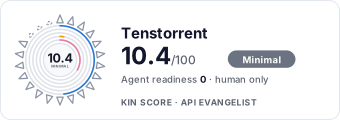 It updates itself when the score changes. Paste this where you link to your API docs:
<a href="https://apis.io/providers/tenstorrent/"><img src="https://apis.io/badge/tenstorrent/card.svg" alt="Tenstorrent on APIs.io — Kin Score by API Evangelist"></a>Other styles, a README pill and a shields.io endpoint are on the badge page.
- Machine-Readable Contract +18 pts — api_specs includes an OpenAPI document
- MCP Server +12 pts — deployment.mode + probe verdict on the mcp/ manifest, not the pointer; an unprobed slug falls back to authorship
- Agentic Access Contract +10 pts — agentic_access artifact present (x-agentic-access), graded by author
- Machine-Readable Auth +10 pts — a served openid-configuration/oauth-authorization-server carrying `issuer` (served), else the securitySchemes class in the provider OpenAPIs — bound (mutualTLS, DPoP, Signature) > negotiable (oauth2 authorizationCode/clientCredentials, openIdConnect) > bearer (http bearer, apiKey)
- Idempotency +9 pts — OpenAPI mutating operations declare an idempotency key — a header, a request-body property, or a named de-duplication token whose own description says so (verified); else common[].type matches /idempoten/i (documented)
- Stable Error Semantics +8 pts — OpenAPI $refs a shared error schema across 4xx/5xx responses (verified), else common[].type includes ErrorCatalog / ErrorCodes / DeclineCodes
- Contract Quality scores 0.0 — up to +25.0 composite points
- Access Clarity scores 0.0 — up to +20.0 composite points
- Developer Ergonomics scores 33.3 — up to +13.3 composite points
Markets this provider is in provisional
The Kin Score Market layer reads a provider inside its market: its position, and how deep its integrations go. Depth is only comparable within a position. Provisional and unweighted: not part of the Kin Score or agent readiness.
| Market | Position | Depth | Registered MCP server | Declares compatibility |
|---|---|---|---|---|
| IDE Extension Marketplaces (JetBrains, VS Code, Open VSX, Docker Verified Publishers, PyPI orgs) | mixed | 46.0 | - | 1 |
| Semiconductor Consortia (RISC-V, OCP hardware, CHIPS awards) | mixed | 46.0 | - | 1 |
| Vendor CLIs in the Arch User Repository | mixed | 46.0 | - | 1 |
Registered MCP server and declares compatibility are report only — not weighted. Undeclared means we found nothing we can read, so there is no number: we never infer integrations.
Standards implemented 1
Standards this provider implements or carries. De facto ones are profiled and measured by the API Commons; formal ones come from the standards directory and are linked by the provider's own tags. The evidence column says how each claim was established — not that it was made.
Security Posture 1
Authentication, domain security, vulnerability disclosure, and trust-center signals.
Resources
Get Started 1
Portal, sign-up, and the first successful call
Documentation 1
Reference material describing how the API behaves
Build 2
SDKs, sample code, and the tooling you integrate with
Access & Security 2
Authentication, authorization, and security posture
Operate 1
Status, limits, changes, and where to get help
Company 4
The organization behind the API
Other 11
Properties that don't map to a standard resource type
Scroll for all 11
Source (apis.yml)
Work with this as data
Every provider here is available over the APIs.io API and to AI agents over MCP.