Substructure
Substructure provides a cloud‑native agent harness called subs that enables developers to run unprivileged agents locally or as a client‑server system. It offers a hosted deployment, integrates with MCP servers for tool access, and supports a variety of LLM back‑ends. The platform includes extensive documentation, pricing details, llms.txt configuration, and open‑source tooling on GitHub. Substructure aims to simplify building AI‑driven workflows with secure, sandboxed execution.
Substructure is listed with 1 API on the APIs.io network. Tagged areas include Company, Artificial Intelligence, Agents, Cloud-Native, and Automation.
The Substructure catalog on APIs.io includes 1 event-driven AsyncAPI specification, 1 JSON-LD context, and 1 Spectral governance ruleset.
Substructure’s developer surface includes authentication, documentation, getting-started guide, pricing, engineering blog, support, and 16 more developer resources.
Kin Score
 Kin Score
How this is scored →
scored 2026-10-23 · rubric v0.25.0
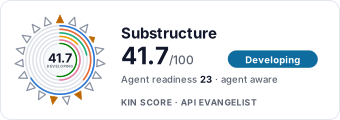 It updates itself when the score changes. Paste this where you link to your API docs:
<a href="https://apis.io/providers/substructure/"><img src="https://apis.io/badge/substructure/card.svg" alt="Substructure on APIs.io — Kin Score by API Evangelist"></a>Other styles, a README pill and a shields.io endpoint are on the badge page.
APIs 1
Individual APIs this provider publishes, each with its own machine-readable definition.
Substructure API
Substructure API as documented publicly: 40 operations. Contract generated from the documentation by API Evangelist (2026-10-19); not the provider's own document.
Pricing Plans 1
Published pricing tiers and plan structures.
Event Specifications 1
AsyncAPI definitions for this provider's event-driven and streaming APIs.
Substructure Webhooks
ASYNCAPISemantic Vocabularies 1
JSON-LD contexts and semantic vocabularies used across these APIs.
Substructure Context
JSON-LDSpectral Rules 1
Spectral governance rulesets for linting and validating these APIs.
Substructure API Rules
SPECTRALJSON Schema 6
Standalone JSON Schema definitions for this provider's data models.
GetApiV1ProjectsProjectApiKeysResponse
JSON SCHEMAGetApiV1ProjectsProjectLlmResponse
JSON SCHEMAGetResponse
JSON SCHEMAPostApiChannelsAgUiAgentsAgentidRunRequest
JSON SCHEMAPostApiMachineSessionsSubmitRequest
JSON SCHEMASecurity Posture 2
Authentication, domain security, vulnerability disclosure, and trust-center signals.
Resources
Get Started 2
Portal, sign-up, and the first successful call
Documentation 1
Reference material describing how the API behaves
Agent Surfaces 1
MCP servers, agent skills, and machine-readable catalogs
Design & Contract 6
Pagination, idempotency, versioning, errors, and events
Build 1
SDKs, sample code, and the tooling you integrate with
Access & Security 2
Authentication, authorization, and security posture
Operate 1
Status, limits, changes, and where to get help
Commercial 4
Pricing, plans, and the legal terms of use
Company 2
The organization behind the API
Other 2
Properties that don't map to a standard resource type
Source (apis.yml)
Work with this as data
Every provider here is available over the APIs.io API and to AI agents over MCP.