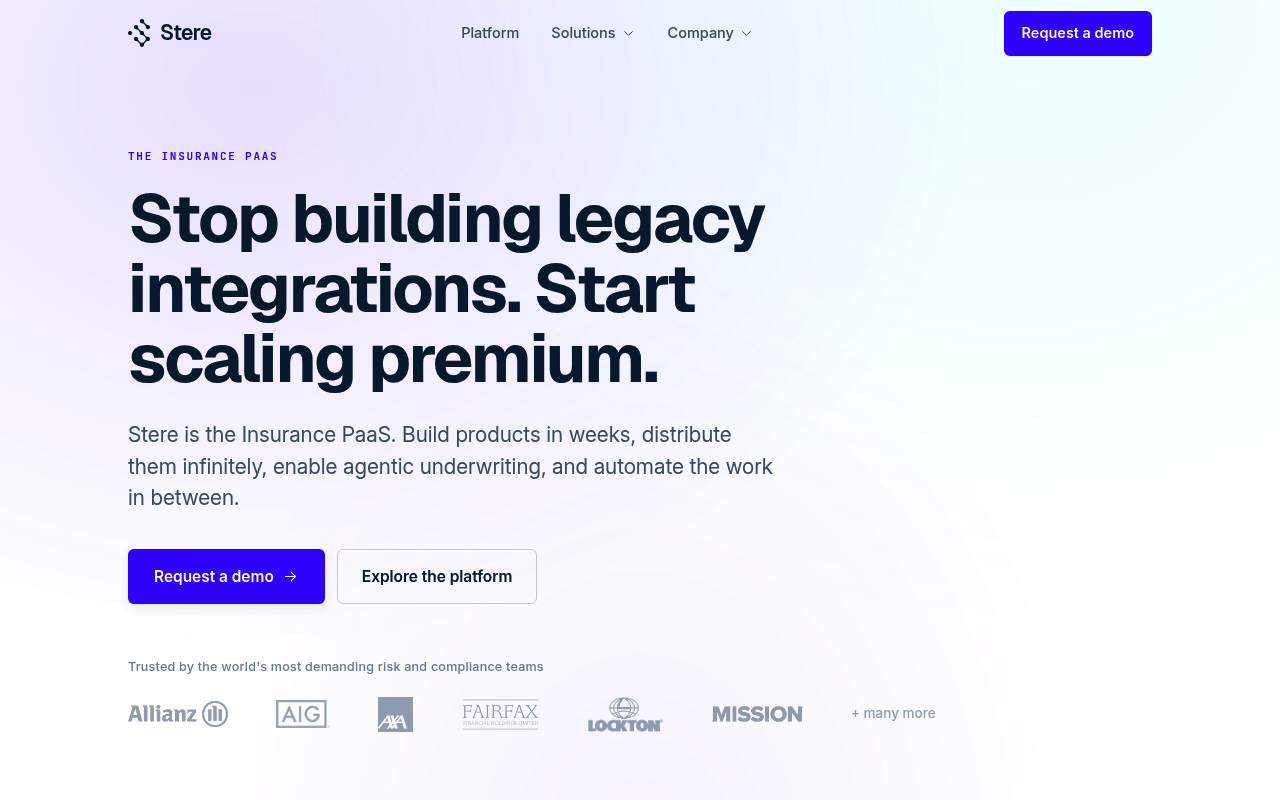
Stere is a New York-based insurance infrastructure company (founded 2021) that lets insurers, MGAs, and distribution partners build and launch digital insurance products - rating, quoting, binding, policy issuance, claims, and premium payments - in weeks rather than years. Its core offering is a "Stere API-as-a-Service" underwriting API (insurers can bring their own API or have Stere build one) plus a separate Stere Unified API and Stere Distribution layer that let brokers, wholesalers, fintechs, and embedded partners reach multiple carriers/products through a single connection (API, SDK, and webhooks). Stere Claims handles FNOL and claims workflow (portions of claims assessment and resolution are marketed as in-development/coming soon), and Stere Pay / Stere Pay Later provides a buy-now-pay-later gateway for insurance premiums. There is no self-serve public developer portal, published API reference, OpenAPI/Swagger document, or sandbox signup on stere.io; the marketing site references a "Stere Docs," "API Changelog," and "API Status" area under /developer/, but those paths return 404 publicly and integration is provisioned per customer after a sales-led partner/insurer onboarding engagement. The APIs below are honestly modeled from Stere's own product marketing pages, not from a published API reference.
Stere is listed with 4 APIs on the APIs.io network. Tagged areas include Insurance, Insurtech, Embedded Insurance, API-as-a-Service, and MGA.
Stere’s developer surface includes engineering blog and 5 more developer resources.
Regulatory Posture applies to this provider. Its tags matched the
Insurance regime, so
Regulatory Posture carries 15 points of the composite.
If this regime is wrong for your business, say so on your
provider repo — the
applicability map is public and we will correct it.
Create-or-Update Ergonomics could not be measured. We hold no machine-readable contract for
this provider to read, so there is nothing to measure a write surface against. Excluded rather than scored zero:
never-measured and measured-empty are different facts. Publishing an OpenAPI is what makes this facet — and
several others — scorable at all.
The six quality facets above are damped to 85 points between them,
because the conditional facet above carries the other
15. That is why each facet's contribution is shown against a damped
maximum: raising a quality facet moves the composite by 85% of its nominal
weight, not 100%. The full arithmetic is at apis.io/rating/.
Show this score on your site.
It updates itself when the score changes. Paste this where you link to your API docs:
<a href="https://apis.io/providers/stere/"><img src="https://apis.io/badge/stere/card.svg" alt="Stere on APIs.io — Kin Score by API Evangelist"></a>
Other styles, a README pill and a shields.io endpoint are on the badge page.
Raise your score.
Agent readiness — checks not met, largest first (exact, from this profile):
Machine-Readable Auth+10 pts — a served openid-configuration/oauth-authorization-server carrying `issuer` (served), else the securitySchemes class in the provider OpenAPIs — bound (mutualTLS, DPoP, Signature) > negotiable (oauth2 authorizationCode/clientCredentials, openIdConnect) > bearer (http bearer, apiKey) Ask about this →
Idempotency+9 pts — OpenAPI mutating operations declare an idempotency key — a header, a request-body property, or a named de-duplication token whose own description says so (verified); else common[].type matches /idempoten/i (documented) Ask about this →
Stable Error Semantics+8 pts — OpenAPI $refs a shared error schema across 4xx/5xx responses (verified), else common[].type includes ErrorCatalog / ErrorCodes / DeclineCodes Ask about this →
13 more unmet checks in the Agent Readiness table above.
Kin Score — facets with the most composite points still available (weight × headroom):
Each check links to what satisfies it. Publish the artifact, or tell us where it already lives, and the score moves on the next scoring run.
Not sure how this applies to your stack? Ask about any one item. Kin Lane reads every question, looks at your profile and your situation, and replies with what a fix would take — scoped to that one area, priced up front, yours whether you ship it or not. Ask a question →
Individual APIs this provider publishes. MODELED: a real API behind a partner or contract gate; there is no public reference, so API Evangelist drew its shape. NOT AN API: a product area with no API behind it, not counted.
Stere's API-as-a-Service lets an insurer or MGA either bring its own existing underwriting API ("Bring-your-own-API") or have Stere build one, with rate, quote, bind, policy iss...
Stere Distribution gives brokers, wholesalers, fintechs, and embedded partners "broad access to insurance products through a single API connection," delivered as an API, SDK, we...
Stere Claims covers First Notice of Loss (FNOL) intake with automated data enrichment today; claims processing against carrier-defined guidelines, automated assessment/decisioni...
Stere Pay Later is a buy-now-pay-later gateway that lets insurers and distribution partners offer policyholders installment payment plans for insurance premiums, integrated into...
MODELED, NO PUBLIC REFERENCE
Stere API pricing
Not yet checked against Stere's own pricing page. Compiled by API Evangelist on 2026-07-03 from www.stere.io/; confirm before you rely on a figure.
aid: stere
url: https://raw.githubusercontent.com/api-evangelist/stere/refs/heads/main/apis.yml
name: Stere
kind: company
description: Stere is a New York-based insurance infrastructure company (founded 2021) that lets insurers, MGAs, and distribution
partners build and launch digital insurance products - rating, quoting, binding, policy issuance, claims, and premium payments
- in weeks rather than years. Its core offering is a "Stere API-as-a-Service" underwriting API (insurers can bring their
own API or have Stere build one) plus a separate Stere Unified API and Stere Distribution layer that let brokers, wholesalers,
fintechs, and embedded partners reach multiple carriers/products through a single connection (API, SDK, and webhooks). Stere
Claims handles FNOL and claims workflow (portions of claims assessment and resolution are marketed as in-development/coming
soon), and Stere Pay / Stere Pay Later provides a buy-now-pay-later gateway for insurance premiums. There is no self-serve
public developer portal, published API reference, OpenAPI/Swagger document, or sandbox signup on stere.io; the marketing
site references a "Stere Docs," "API Changelog," and "API Status" area under /developer/, but those paths return 404 publicly
and integration is provisioned per customer after a sales-led partner/insurer onboarding engagement. The APIs below are
honestly modeled from Stere's own product marketing pages, not from a published API reference.
deliveryModel:
model: saas
open_source: false
commercial: true
callable_host: false
label: Hosted service · you call their endpoint
confidence: medium
source:
- pricing
generated: '2026-08-28'
method: derived
accessModel:
pricing: enterprise
onboarding: approval
trial: false
try_now: false
public: false
gated: partner
gated_source:
- apis
label: Enterprise · Requires approval
confidence: low
source:
- plans
- security
generated: '2026-11-13'
method: derived
image: https://kinlane-images.s3.amazonaws.com/shared/apis-json/icons/stere.png
tags:
- Insurance
- Insurtech
- Embedded Insurance
- API-as-a-Service
- MGA
- Underwriting
- Distribution
created: '2026-07-03'
modified: '2026-07-03'
specificationVersion: '0.23'
apis:
- aid: stere:stere-underwriting-api
name: Stere Underwriting API
tags:
- Underwriting
- Rate
- Quotes
- Bind
- Policy Issuance
tags_raw:
- Underwriting
- Rate
- Quote
- Bind
- Policy Issuance
image: https://kinlane-images.s3.amazonaws.com/shared/apis-json/apis-json-logo.jpg
humanURL: https://www.stere.io/stere-api/as-a-service
properties:
- url: https://www.stere.io/stere-api/as-a-service
type: Documentation
- url: https://www.stere.io/stere-api/stere-unifed-api
type: Documentation
description: Stere's API-as-a-Service lets an insurer or MGA either bring its own existing underwriting API ("Bring-your-own-API")
or have Stere build one, with rate, quote, bind, policy issuance, data enrichment, KYC/KYB, and billing capabilities,
often issuing a policy within seconds with little human intervention. The companion Stere Unified API exposes multiple
insurers' products through one interface for consuming platforms. No base URL, authentication scheme, or endpoint reference
is published; access is provisioned per insurer/MGA under a commercial engagement.
endpointsModeled: true
- aid: stere:stere-distribution-api
name: Stere Distribution API
tags:
- Distribution
- Brokerage
- Embedded Insurance
- Webhook
tags_raw:
- Distribution
- Brokers
- Embedded Insurance
- Webhooks
image: https://kinlane-images.s3.amazonaws.com/shared/apis-json/apis-json-logo.jpg
humanURL: https://www.stere.io/insurance/stere-distribution
properties:
- url: https://www.stere.io/insurance/stere-distribution
type: Documentation
- url: https://www.stere.io/solution/for-embedded-insurance
type: Documentation
description: Stere Distribution gives brokers, wholesalers, fintechs, and embedded partners "broad access to insurance products
through a single API connection," delivered as an API, SDK, webhooks, and pre-built portals so distribution partners can
quote and bind across multiple carriers/products without integrating each one separately. No public endpoint reference,
webhook event catalog, or base URL is published; partners receive credentials and integration docs directly from Stere.
endpointsModeled: true
- aid: stere:stere-claims-api
name: Stere Claims API
tags:
- Claims
- FNOL
- Insurance
image: https://kinlane-images.s3.amazonaws.com/shared/apis-json/apis-json-logo.jpg
humanURL: https://www.stere.io/insurance/stere-claims
properties:
- url: https://www.stere.io/insurance/stere-claims
type: Documentation
description: Stere Claims covers First Notice of Loss (FNOL) intake with automated data enrichment today; claims processing
against carrier-defined guidelines, automated assessment/decisioning, and resolution workflow are marketed on stere.io
as in-development or "coming soon" rather than shipped. No API reference, base URL, or webhook event catalog is published
for Claims.
endpointsModeled: true
- aid: stere:stere-pay-api
name: Stere Pay Later API
tags:
- Payments
- Buy Now Pay Later
- Premium Financing
tags_raw:
- Payments
- BNPL
- Premium Financing
image: https://kinlane-images.s3.amazonaws.com/shared/apis-json/apis-json-logo.jpg
humanURL: https://www.stere.io/payments/stere-pay-later
properties:
- url: https://www.stere.io/payments/stere-pay-later
type: Documentation
description: Stere Pay Later is a buy-now-pay-later gateway that lets insurers and distribution partners offer policyholders
installment payment plans for insurance premiums, integrated into the existing quote/bind/payment flow. Stere Pay first
launched publicly in 2023. No API reference, base URL, or pricing/settlement schedule is published; the gateway is integrated
per partner under a commercial agreement.
endpointsModeled: true
common:
- type: DomainSecurity
url: security/stere-domain-security.yml
- type: LinkedIn
url: https://www.linkedin.com/company/stereio
- type: Website
url: https://www.stere.io/
- type: Plans
url: plans/stere-plans-pricing.yml
- type: FinOps
url: finops/stere-finops.yml
- type: Blog
url: https://www.stere.io/resources/blog
maintainers:
- FN: Kin Lane
email: kin@apievangelist.com
Stere API — frequently asked questions
Does Stere have an API?
Yes. APIs.io lists 4 APIs from Stere, including Stere Underwriting API, Stere Distribution API and Stere Claims API, and 1 more.
How much does the Stere API cost?
APIs.io lists 1 pricing plan for Stere, with each plan's price, limits and inclusions under Pricing on this page.
Is the Stere API ready for AI agents?
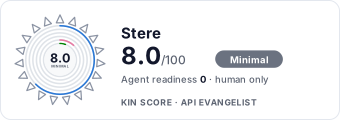
Stere has a Kin Score of 7.0 out of 100 (minimal) and an Agent Readiness score of 0.0 (human-only), scored by API Evangelist on 2026-11-13.
Calls without X-API-Key need no key. Calls with it need a paid plan — get a key.
Get an API key
Free tier, no form to fill in. Signing in shares your email address with us — we
store it to create your key and to recognise you if you sign in with another
provider. See our Privacy Policy and
Terms.