Sphinx
Sphinx is an AI reliability and governance system for data and analytics that works to make AI-generated answers over enterprise data correct and auditable. Its tagline is "AI gets data wrong. Sphinx makes it right." The product pairs a data-science AI agent that lives in the code editor (a VS Code / Cursor extension, a command-line interface, and a Jupyter-native workflow) with a centralized, evolving knowledge base of business definitions and metrics, governance and role-based access controls, self-correcting accuracy that catches drift and hallucinations, and end-to-end auditability with full output lineage. Developers reach the platform through the Sphinx CLI (sphinx-ai-cli), the in-notebook Sphinx Library Python package (sphinxai) for LLM chat, embeddings, vision, and secure access to connections and secrets, and MCP for connecting external tools. Sphinx is SOC 2 Type 2 compliant with a zero data retention posture. The company raised a $9.5M seed round led by Lightspeed Venture Partners.
Sphinx is profiled on the APIs.io network. Tagged areas include Company, Artificial Intelligence, Data Science, Data Governance, and Analytics.
Sphinx’s developer surface includes documentation, getting-started guide, engineering blog, support, signup flow, CLI, authentication, and 12 more developer resources.
Kin Score
 Kin Score
How this is scored →
scored 2026-11-06 · rubric v0.27.0
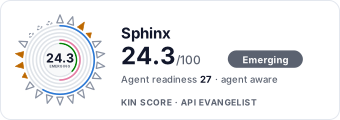 It updates itself when the score changes. Paste this where you link to your API docs:
<a href="https://apis.io/providers/sphinx/"><img src="https://apis.io/badge/sphinx/card.svg" alt="Sphinx on APIs.io — Kin Score by API Evangelist"></a>Other styles, a README pill and a shields.io endpoint are on the badge page.
- Machine-Readable Contract +18 pts — api_specs includes an OpenAPI document
- Agentic Access Contract +10 pts — agentic_access artifact present (x-agentic-access), graded by author
- Idempotency +9 pts — OpenAPI mutating operations declare an idempotency key — a header, a request-body property, or a named de-duplication token whose own description says so (verified); else common[].type matches /idempoten/i (documented)
- Stable Error Semantics +8 pts — OpenAPI $refs a shared error schema across 4xx/5xx responses (verified), else common[].type includes ErrorCatalog / ErrorCodes / DeclineCodes
- A2A Agent Card +8 pts — a2a/
-a2a.yml manifest, graded on conformance.grade against A2A 1.0.0 - Rate-Limit Signaling +7 pts — OpenAPI responses document X-RateLimit-* / RateLimit headers (verified), else a rate_limits artifact or RateLimits link (documented)
- Contract Quality scores 0.0 — up to +25.0 composite points
- Operational Transparency scores 0.0 — up to +13.0 composite points
- Access Clarity scores 36.8 — up to +12.6 composite points
Markets this provider is in provisional
The Kin Score Market layer reads a provider inside its market: its position, and how deep its integrations go. Depth is only comparable within a position. Provisional and unweighted: not part of the Kin Score or agent readiness.
| Market | Position | Depth | Registered MCP server | Declares compatibility |
|---|---|---|---|---|
| IDE Extension Marketplaces (JetBrains, VS Code, Open VSX, Docker Verified Publishers, PyPI orgs) | builds-on | 17.2 (thin) | - | - |
Registered MCP server and declares compatibility are report only — not weighted. Undeclared means we found nothing we can read, so there is no number: we never infer integrations.
Standards implemented 3
Standards this provider implements or carries. De facto ones are profiled and measured by the API Commons; formal ones come from the standards directory and are linked by the provider's own tags. The evidence column says how each claim was established — not that it was made.
MCP Servers 1
Model Context Protocol servers that expose these APIs to AI agents.
Security Posture 3
Authentication, domain security, vulnerability disclosure, and trust-center signals.
Resources
Get Started 4
Portal, sign-up, and the first successful call
Documentation 1
Reference material describing how the API behaves
Agent Surfaces 1
MCP servers, agent skills, and machine-readable catalogs
Design & Contract 1
Pagination, idempotency, versioning, errors, and events
Build 3
SDKs, sample code, and the tooling you integrate with
Access & Security 4
Authentication, authorization, and security posture
Operate 1
Status, limits, changes, and where to get help
Commercial 2
Pricing, plans, and the legal terms of use
Company 2
The organization behind the API
Source (apis.yml)
Sphinx API — frequently asked questions
How do I authenticate with the Sphinx API?
Sphinx documents its authentication (apiKey/http-bearer-jwt · 2 schemes). The details are profiled on APIs.io as Sphinx Authentication.
Does Sphinx have an MCP server?
Yes. APIs.io lists 1 MCP server for Sphinx: Remote MCP server at api.prod.sphinx.ai over HTTP.
Is the Sphinx API ready for AI agents?
Sphinx has a Kin Score of 24.3 out of 100 (emerging) and an Agent Readiness score of 27.3 (agent-aware), scored by API Evangelist on 2026-11-06.
Work with this as data
Every provider here is available over the APIs.io API and to AI agents over MCP.