ShipMonk
ShipMonk is a Florida-headquartered third-party logistics (3PL) and ecommerce fulfillment provider operating a network of fulfillment centres across the United States, Canada, Mexico, the United Kingdom and Czechia. It runs an order management system for direct-to-consumer, retail/B2B and marketplace brands covering inbound receiving, inventory and lot control, pick-and-pack fulfillment, multi-carrier shipping and returns. Its public API is a single REST surface at api.shipmonk.com, described by a self-published OpenAPI 3.1 document covering orders, products and inventory, receivings, returns and warehouses, with four HTTP webhook events for shipment, order, return and receiving status changes and a contract-only sandbox environment with warehouse simulation endpoints.
ShipMonk publishes 8 API contracts indexed on the APIs.io network, including Webhooks, Orders API, Products API, and 5 more. Tagged areas include Logistics, Fulfillment, 3PL, E-Commerce, and Warehousing.
The ShipMonk catalog on APIs.io includes 1 event-driven AsyncAPI specification.
ShipMonk’s developer surface includes documentation, API reference, getting-started guide, support, engineering blog, pricing, signup flow, and 38 more developer resources.
What this lets a business do 1
Business capabilities this provider's published APIs can perform, derived from its own contracts. Browse all capabilities →
Kin Score
 Kin Score
How this is scored →
Kin Score
How this is scored →scored 2026-10-23 · rubric v0.25.0
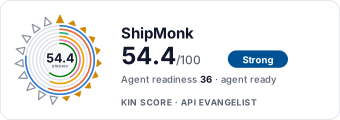 It updates itself when the score changes. Paste this where you link to your API docs:
<a href="https://apis.io/providers/shipmonk/"><img src="https://apis.io/badge/shipmonk/card.svg" alt="ShipMonk on APIs.io — Kin Score by API Evangelist"></a>Other styles, a README pill and a shields.io endpoint are on the badge page.
Markets this provider is in provisional
The Kin Score Market layer reads a provider inside its market: its position, and how deep its integrations go. Depth is only comparable within a position. Provisional and unweighted: not part of the Kin Score or agent readiness.
| Market | Position | Depth | Registered MCP server | Declares compatibility |
|---|---|---|---|---|
| Amazon Seller Ecosystem (Selling Partner Appstore, Amazon Ads partners) | undeclared | - | - | - |
Registered MCP server and declares compatibility are report only — not weighted. Undeclared means we found nothing we can read, so there is no number: we never infer integrations.
APIs 8
Individual APIs this provider publishes, each with its own machine-readable definition.
ShipMonk Webhooks
The ShipMonk event surface: four HTTP callback events (order shipment notification, order status change, return status change, receiving status change) declared in the OpenAPI 3...
ShipMonk MCP Server
A live Model Context Protocol endpoint served from ShipMonk's own developer-docs host. tools/list responds anonymously with five spec-driven tools: four OpenAPI introspection to...
ShipMonk Orders API
The Orders API from ShipMonk — 5 operation(s) for orders.
ShipMonk Products API
The Products API from ShipMonk — 4 operation(s) for products.
ShipMonk Receivings API
The Receivings API from ShipMonk — 4 operation(s) for receivings.
ShipMonk Returns API
The Returns API from ShipMonk — 3 operation(s) for returns.
ShipMonk Warehouses API
The Warehouses API from ShipMonk — 1 operation(s) for warehouses.
ShipMonk Webhooks API
ShipMonk supports webhooks to help you stay updated in real time as key events happen in our system. Currently, we provide webhooks for the following areas: - Orders - Returns -...
Scroll for all 8
Open Collections 5
Open, tool-agnostic API collections (OpenAPI-derived and Bruno).
ShipMonk Orders API
OPEN COLLECTIONShipMonk Products API
OPEN COLLECTIONShipMonk Receivings API
OPEN COLLECTIONShipMonk Returns API
OPEN COLLECTIONShipMonk Warehouses API
OPEN COLLECTIONMCP Servers 1
Model Context Protocol servers that expose these APIs to AI agents.
ShipMonk MCP Server
ShipMonk serves a live MCP endpoint from its own developer-docs host. tools/list responds anonymously over streamable HTTP (SSE) with five spec-driven tools. These are ReadMe's ...
MCP SERVERRate Limits 1
Documented rate limits and quota policies.
Shipmonk Rate Limits
RATE LIMITSEvent Specifications 1
AsyncAPI definitions for this provider's event-driven and streaming APIs.
ShipMonk Webhooks
AsyncAPI 3.0 model of the ShipMonk webhook event surface, derived from the `webhooks` block of ShipMonk's own OpenAPI 3.1 document (https://apidocs.shipmonk.com/openapi/public_a...
ASYNCAPIOpenAPI Overlays 5
Overlays applied on top of this provider's contracts. Each card says who wrote it: a document the provider publishes, or one API Evangelist derived or generated.
Shipmonk Orders Overlay
DERIVEDShipmonk Products Overlay
DERIVEDShipmonk Receivings Overlay
DERIVEDShipmonk Returns Overlay
DERIVEDShipmonk Warehouses Overlay
DERIVEDSecurity Posture 4
Authentication, domain security, vulnerability disclosure, and trust-center signals.
Agentic Access 1
Recommended x-agentic-access execution contracts for AI agents.
Resources
Get Started 5
Portal, sign-up, and the first successful call
Documentation 4
Reference material describing how the API behaves
Agent Surfaces 5
MCP servers, agent skills, and machine-readable catalogs
Design & Contract 7
Pagination, idempotency, versioning, errors, and events
Scroll for all 7
Build 3
SDKs, sample code, and the tooling you integrate with
Access & Security 7
Authentication, authorization, and security posture
Scroll for all 7
Operate 5
Status, limits, changes, and where to get help
Commercial 3
Pricing, plans, and the legal terms of use
Company 3
The organization behind the API
Other 3
Properties that don't map to a standard resource type
Source (apis.yml)
Work with this as data
Every provider here is available over the APIs.io API and to AI agents over MCP.