Ryft
Ryft is the intelligent Apache Iceberg management platform - a data lakehouse optimization layer that continuously monitors, manages, and optimizes Iceberg tables across query engines and clouds. It provides automated table compaction, snapshot and data lifecycle management, orphan-file and compliance cleanup (GDPR/CCPA), an Asset and Query Explorer, and usage-based self-tuning that reduces lakehouse TCO and speeds up queries. Ryft integrates with AWS (Athena, Glue, Redshift, S3 Tables), Google Cloud/BigLake, Azure, Microsoft OneLake, Databricks, Snowflake, Starburst, Trino, StarRocks, and any Iceberg REST Catalog. For engines it does not natively support, the Ryft Ingest API accepts query telemetry directly, and the Ryft MCP server enriches AI agents with live lakehouse context. Backed by Bessemer Venture Partners and Index Ventures; acquired by Cyera in 2026.
Ryft publishes 1 API contract indexed on the APIs.io network: Ingest API. Tagged areas include Company, Data, Data Lake, Lakehouse, and Apache Iceberg.
Ryft’s developer surface includes documentation, API reference, getting-started guide, engineering blog, support, signup flow, authentication, and 15 more developer resources.
Kin Score
 Kin Score
How this is scored →
Kin Score
How this is scored →scored 2026-10-23 · rubric v0.25.0
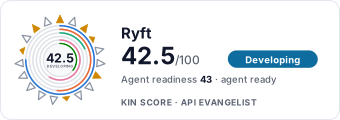 It updates itself when the score changes. Paste this where you link to your API docs:
<a href="https://apis.io/providers/ryft/"><img src="https://apis.io/badge/ryft/card.svg" alt="Ryft on APIs.io — Kin Score by API Evangelist"></a>Other styles, a README pill and a shields.io endpoint are on the badge page.
Standards implemented 1
Standards this provider implements or carries. De facto ones are profiled and measured by the API Commons; formal ones come from the standards directory and are linked by the provider's own tags. The evidence column says how each claim was established — not that it was made.
APIs 1
Individual APIs this provider publishes, each with its own machine-readable definition.
Ryft Ingest API
Push query-execution telemetry to Ryft.
Open Collections 1
Open, tool-agnostic API collections (OpenAPI-derived and Bruno).
Ryft Ingest API
OPEN COLLECTIONMCP Servers 1
Model Context Protocol servers that expose these APIs to AI agents.
Ryft MCP Server
Ryft MCP is a Model Context Protocol server that enriches AI agents with full lakehouse context - table metadata, query history, and domain knowledge - so agents can write accur...
MCP SERVEROpenAPI Overlays 1
Overlays applied on top of this provider's contracts. Each card says who wrote it: a document the provider publishes, or one API Evangelist derived or generated.
Ryft Ingest Overlay
DERIVEDSecurity Posture 2
Authentication, domain security, vulnerability disclosure, and trust-center signals.
Resources
Get Started 3
Portal, sign-up, and the first successful call
Documentation 2
Reference material describing how the API behaves
Agent Surfaces 4
MCP servers, agent skills, and machine-readable catalogs
Design & Contract 2
Pagination, idempotency, versioning, errors, and events
Access & Security 3
Authentication, authorization, and security posture
Operate 1
Status, limits, changes, and where to get help
Commercial 2
Pricing, plans, and the legal terms of use
Company 3
The organization behind the API
Other 2
Properties that don't map to a standard resource type
Source (apis.yml)
Work with this as data
Every provider here is available over the APIs.io API and to AI agents over MCP.