Rhapsody Health Solutions is a US-headquartered (Boston, Massachusetts) healthcare interoperability company trusted by more than 1,900 healthcare organizations across 31 countries, and recognized as Best in KLAS for integration engines for 17 consecutive years. Formed from the lineage of Orion Health's Rhapsody Integration Engine (2000), the 2019 merger with Corepoint Health, and acquisitions of Datica, NextGate EMPI, and CareCom, Rhapsody delivers a single interoperability platform spanning integration engines (Rhapsody and Corepoint), enterprise master patient index (EMPI / Rhapsody Identity), semantic terminology management, data governance (Guardian), and automated integrations (Envoy, Image Director). The platform supports FHIR, HL7 v2, REST, CDA, X12/EDI, SQL, DICOM, AMQP, and Model Context Protocol (MCP) from a single deployment, with embedded AI (Rhapsody Axon). Its home market is the United States, aligned to ONC/CMS interoperability mandates. Rhapsody added Guardian, a healthcare-purpose-built API gateway (OAuth 2.0, SMART on FHIR, Basic Auth), in October 2025. Rhapsody's product REST/administration and FHIR APIs are documented in a developer documentation portal (docs.rhapsody.health) that sits behind an AWS Cognito single-sign-on gate; there is no public self-serve API host or downloadable specification. The one machine-readable document Rhapsody does publish is an authoritative llms.txt at rhapsody.health/llms.txt.
Rhapsody is listed with 6 APIs on the APIs.io network. Tagged areas include Healthcare, United States, Interoperability, Integration Engine, and FHIR.
Rhapsody’s developer surface includes engineering blog, authentication, changelog, documentation, support, and 16 more developer resources.
Regulatory Posture applies to this provider. Its tags matched the
Health regime, so
Regulatory Posture carries 15 points of the composite.
If this regime is wrong for your business, say so on your
provider repo — the
applicability map is public and we will correct it.
Create-or-Update Ergonomics could not be measured. We hold no machine-readable contract for
this provider to read, so there is nothing to measure a write surface against. Excluded rather than scored zero:
never-measured and measured-empty are different facts. Publishing an OpenAPI is what makes this facet — and
several others — scorable at all.
The six quality facets above are damped to 85 points between them,
because the conditional facet above carries the other
15. That is why each facet's contribution is shown against a damped
maximum: raising a quality facet moves the composite by 85% of its nominal
weight, not 100%. The full arithmetic is at apis.io/rating/.
Show this score on your site.
It updates itself when the score changes. Paste this where you link to your API docs:
<a href="https://apis.io/providers/rhapsody/"><img src="https://apis.io/badge/rhapsody/card.svg" alt="Rhapsody on APIs.io — Kin Score by API Evangelist"></a>
Other styles, a README pill and a shields.io endpoint are on the badge page.
Raise your score.
Agent readiness — checks not met, largest first (exact, from this profile):
Idempotency+9 pts — OpenAPI mutating operations declare an idempotency key — a header, a request-body property, or a named de-duplication token whose own description says so (verified); else common[].type matches /idempoten/i (documented)
Stable Error Semantics+8 pts — OpenAPI $refs a shared error schema across 4xx/5xx responses (verified), else common[].type includes ErrorCatalog / ErrorCodes / DeclineCodes
A2A Agent Card+8 pts — a2a/-a2a.yml manifest, graded on conformance.grade against A2A 1.0.0
11 more unmet checks in the Agent Readiness table above.
Kin Score — facets with the most composite points still available (weight × headroom):
Standards this provider implements or carries. De facto ones are profiled and measured by the API Commons; formal ones come from the standards directory and are linked by the provider's own tags. The evidence column says how each claim was established — not that it was made.
Rhapsody's flagship healthcare integration engine, connecting systems across FHIR, HL7 v2, REST, CDA, X12/EDI, SQL, DICOM, AMQP, and MCP from a single platform, with a REST admi...
Corepoint healthcare integration engine (from the 2019 Corepoint Health merger), the top-ranked integration engine since 2009, with an Administration REST API introduced in Core...
Rhapsody's Enterprise Master Patient Index for patient matching and identity resolution (built on the NextGate acquisition), exposing API capabilities for person-data management...
Rhapsody Guardian is a healthcare-purpose-built API gateway, launched October 2025, that lets healthcare organizations securely expose their own APIs and FHIR endpoints. Rhapsod...
Rhapsody Axon embeds AI into the integration platform and adds Model Context Protocol (MCP) support for AI-driven, agent-ready healthcare data workflows. Capabilities are docume...
aid: rhapsody
url: https://raw.githubusercontent.com/api-evangelist/rhapsody/refs/heads/main/apis.yml
name: Rhapsody
kind: company
description: Rhapsody Health Solutions is a US-headquartered (Boston, Massachusetts) healthcare interoperability company trusted
  by more than 1,900 healthcare organizations across 31 countries, and recognized as Best in KLAS for integration engines
  for 17 consecutive years. Formed from the lineage of Orion Health's Rhapsody Integration Engine (2000), the 2019 merger
  with Corepoint Health, and acquisitions of Datica, NextGate EMPI, and CareCom, Rhapsody delivers a single interoperability
  platform spanning integration engines (Rhapsody and Corepoint), enterprise master patient index (EMPI / Rhapsody Identity),
  semantic terminology management, data governance (Guardian), and automated integrations (Envoy, Image Director). The platform
  supports FHIR, HL7 v2, REST, CDA, X12/EDI, SQL, DICOM, AMQP, and Model Context Protocol (MCP) from a single deployment,
  with embedded AI (Rhapsody Axon). Its home market is the United States, aligned to ONC/CMS interoperability mandates. Rhapsody
  added Guardian, a healthcare-purpose-built API gateway (OAuth 2.0, SMART on FHIR, Basic Auth), in October 2025. Rhapsody's
  product REST/administration and FHIR APIs are documented in a developer documentation portal (docs.rhapsody.health) that
  sits behind an AWS Cognito single-sign-on gate; there is no public self-serve API host or downloadable specification. The
  one machine-readable document Rhapsody does publish is an authoritative llms.txt at rhapsody.health/llms.txt.
deliveryModel:
  model: saas
  open_source: false
  commercial: true
  callable_host: false
  label: Hosted service · you call their endpoint
  confidence: medium
  source:
  - pricing
  generated: '2026-08-28'
  method: derived
accessModel:
  pricing: unknown
  onboarding: unknown
  trial: false
  try_now: false
  public: false
  label: Unknown
  confidence: low
  source:
  - authentication
  - rate-limits
  - security
  generated: '2026-11-06'
  method: derived
image: https://kinlane-images.s3.amazonaws.com/shared/apis-json/apis-json-logo.jpg
tags:
- Healthcare
- United States
- Interoperability
- Integration Engine
- FHIR
- HL7
- EMPI
- Terminology
- Health Data
- MCP
- API Gateway
created: '2026-07-24'
modified: '2026-10-06'
specificationVersion: '0.23'
apis:
- aid: rhapsody:rhapsody-integration-engine
  name: Rhapsody Integration Engine
  description: Rhapsody's flagship healthcare integration engine, connecting systems across FHIR, HL7 v2, REST, CDA, X12/EDI,
    SQL, DICOM, AMQP, and MCP from a single platform, with a REST administration/management API. Deployed in customer (self-hosted
    or cloud) environments; API reference is documented in the gated developer documentation portal.
  humanURL: https://rhapsody.health/solutions/rhapsody/
  tags:
  - Integration Engine
  - FHIR
  - HL7
  - Interoperability
  properties:
  - type: Documentation
    url: https://rhapsody.health/solutions/rhapsody/
  - type: APIReference
    url: https://docs.rhapsody.health/
- aid: rhapsody:corepoint-integration-engine
  name: Corepoint Integration Engine
  description: Corepoint healthcare integration engine (from the 2019 Corepoint Health merger), the top-ranked integration
    engine since 2009, with an Administration REST API introduced in Corepoint 7.5.3 for auditing and configuration. Documentation
    is served through the gated developer portal.
  humanURL: https://rhapsody.health/solutions/corepoint/
  tags:
  - Integration Engine
  - HL7
  - Interoperability
  properties:
  - type: Documentation
    url: https://rhapsody.health/solutions/corepoint/
  - type: APIReference
    url: https://docs.rhapsody.health/
- aid: rhapsody:rhapsody-identity-empi
  name: Rhapsody Identity (EMPI)
  description: Rhapsody's Enterprise Master Patient Index for patient matching and identity resolution (built on the NextGate
    acquisition), exposing API capabilities for person-data management. API reference is documented in the gated developer
    portal.
  humanURL: https://rhapsody.health/solutions/empi/
  tags:
  - EMPI
  - Patient Matching
  - Identity
  properties:
  - type: Documentation
    url: https://rhapsody.health/solutions/empi/
  - type: APIReference
    url: https://docs.rhapsody.health/
- aid: rhapsody:rhapsody-semantic
  name: Rhapsody Semantic (Terminology Management)
  description: Rhapsody Semantic terminology management and data standardization services (code-system mapping, LOINC/SNOMED
    standardization) supporting FHIR terminology workflows. Documentation is served through the gated developer portal.
  humanURL: https://rhapsody.health/solutions/terminology-management/
  tags:
  - Terminology
  - Semantic Interoperability
  - FHIR
  properties:
  - type: Documentation
    url: https://rhapsody.health/solutions/terminology-management/
  - type: APIReference
    url: https://docs.rhapsody.health/
- aid: rhapsody:rhapsody-guardian
  name: Rhapsody Guardian (Healthcare API Gateway)
  description: Rhapsody Guardian is a healthcare-purpose-built API gateway, launched October 2025, that lets healthcare organizations
    securely expose their own APIs and FHIR endpoints. Rhapsody states Guardian "supports OAuth 2.0, SMART on FHIR, and Basic
    Auth" out of the box, and adds rate limiting, allow/block rules, audit-ready logging and real-time audit trails, plus
    gateway monitoring, transaction logs, deployment logs and graphical metrics. It manages APIs and HL7 from the same platform
    as the Rhapsody and Corepoint engines. Guardian's own management/API reference is documented in the gated developer portal.
  humanURL: https://rhapsody.health/solutions/guardian/
  tags:
  - API Gateway
  - FHIR
  - SMART on FHIR
  - API Security
  - Interoperability
  properties:
  - type: Documentation
    url: https://rhapsody.health/solutions/guardian/
  - type: APIReference
    url: https://docs.rhapsody.health/
- aid: rhapsody:rhapsody-axon-mcp
  name: Rhapsody Axon (AI + MCP)
  description: Rhapsody Axon embeds AI into the integration platform and adds Model Context Protocol (MCP) support for AI-driven,
    agent-ready healthcare data workflows. Capabilities are documented in the gated developer portal.
  humanURL: https://rhapsody.health/solutions/rhapsody-axon/
  tags:
  - MCP
  - Artificial Intelligence
  - Interoperability
  tags_raw:
  - MCP
  - AI
  - Interoperability
  properties:
  - type: Documentation
    url: https://rhapsody.health/solutions/rhapsody-axon/
maintainers:
- FN: Kin Lane
  email: kin@apievangelist.com
common:
- url: https://rhapsody.health/resources/
  type: Blog
- url: https://rhapsody.health/resources/feed/
  type: BlogRSS
- type: DomainSecurity
  url: security/rhapsody-domain-security.yml
- type: TrustCenter
  url: security/rhapsody-trust-center.yml
- type: Conformance
  url: conformance/rhapsody-conformance.yml
- type: Authentication
  url: authentication/rhapsody-authentication.yml
- type: LLMsTxt
  url: llms/rhapsody-llms.txt
- type: ChangeLog
  url: changelog/rhapsody-changelog.yml
- type: Lifecycle
  url: lifecycle/rhapsody-lifecycle.yml
- type: Plans
  url: plans/rhapsody-plans-pricing.yml
- type: RateLimits
  url: rate-limits/rhapsody-rate-limits.yml
- type: TermsOfService
  url: https://rhapsody.health/rhapsody-terms-and-conditions/
- type: Website
  url: https://rhapsody.health/
- type: DeveloperPortal
  url: https://docs.rhapsody.health/
- type: Documentation
  url: https://docs.rhapsody.health/
- type: Blog
  url: https://rhapsody.health/blog/
- type: Support
  url: https://rhapsody.health/support/
- type: Security
  url: https://rhapsody.health/data-privacy-and-security/
- type: Compliance
  url: https://rhapsody.health/onc-compliance/
- type: PrivacyPolicy
  url: https://rhapsody.health/privacy-policy/
- type: LinkedIn
  url: https://www.linkedin.com/company/rhapsodyhealth
x-enrichment:
  date: '2026-08-14'
  status: enriched
  artifacts_added: 7
  pass: local-v1
Rhapsody API — frequently asked questions
Does Rhapsody have an API?
Yes. APIs.io lists 6 APIs from Rhapsody, including Rhapsody Integration Engine, Corepoint Integration Engine and Rhapsody Identity (EMPI), and 3 more.
How do I authenticate with the Rhapsody API?
Rhapsody uses bearer-token authentication (oauth2/openIdConnect · 2 schemes). The details are profiled on APIs.io as Rhapsody Authentication.
Is the Rhapsody API ready for AI agents?
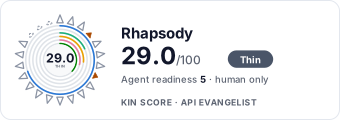
Rhapsody has a Kin Score of 29.0 out of 100 (thin) and an Agent Readiness score of 5.0 (human-only), scored by API Evangelist on 2026-11-06.
Calls without X-API-Key need no key. Calls with it need a paid plan — get a key.
Get an API key
Free tier, no form to fill in. Signing in shares your email address with us — we
store it to create your key and to recognise you if you sign in with another
provider. See our Privacy Policy and
Terms.
 Kin Score
How this is scored →
 It updates itself when the score changes. Paste this where you link to your API docs: