
RapidAI
RapidAI (legal entity iSchemaView, Inc., San Mateo, California) builds a deep clinical AI platform for medical imaging, best known for the Rapid product family used in stroke and vascular care. Founded in 2012 by Stanford researchers Roland Bammer and Gregory Albers, its FDA-cleared modules — Rapid ASPECTS, Rapid CTA, Rapid CTP, Rapid LVO, Rapid ICH, Rapid MRI, Rapid PE, Rapid Aortic, Rapid Aneurysm and Lumina 3D — analyze non-contrast CT, CT angiography, CT perfusion and MRI studies to triage ischemic stroke, hemorrhagic stroke, aneurysm, pulmonary embolism and aortic disease. The Rapid Enterprise Platform runs on-premise, in the cloud, or on Rapid Edge Cloud, and integrates with hospital PACS, RIS, EHR and radiology worklist systems through standard HL7, FHIR and DICOM interfaces plus custom APIs. RapidAI runs a Rapid Technology Partner Program with an API that lets technology partners integrate Rapid results into their own products; that API is commercial and gated — there is no public developer portal, OpenAPI definition, or self-service sign-up.
RapidAI is listed with 1 API on the APIs.io network. Tagged areas include Healthcare, Medical Imaging, Artificial Intelligence, Radiology, and Clinical Decision Support.
RapidAI’s developer surface includes support, engineering blog, authentication, and 20 more developer resources.
Kin Score
 Kin Score
How this is scored →
Kin Score
How this is scored →scored 2026-10-23 · rubric v0.25.0
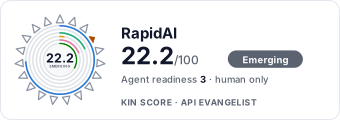 It updates itself when the score changes. Paste this where you link to your API docs:
<a href="https://apis.io/providers/rapidai/"><img src="https://apis.io/badge/rapidai/card.svg" alt="RapidAI on APIs.io — Kin Score by API Evangelist"></a>Other styles, a README pill and a shields.io endpoint are on the badge page.
Markets this provider is in provisional
The Kin Score Market layer reads a provider inside its market: its position, and how deep its integrations go. Depth is only comparable within a position. Provisional and unweighted: not part of the Kin Score or agent readiness.
| Market | Position | Depth | Registered MCP server | Declares compatibility |
|---|---|---|---|---|
| Medical Imaging & IHE Interoperability Profiles | undeclared | - | - | - |
Registered MCP server and declares compatibility are report only — not weighted. Undeclared means we found nothing we can read, so there is no number: we never infer integrations.
Standards implemented 2
Standards this provider implements or carries. De facto ones are profiled and measured by the API Commons; formal ones come from the standards directory and are linked by the provider's own tags. The evidence column says how each claim was established — not that it was made.
APIs 1
Individual APIs this provider publishes, each with its own machine-readable definition.
Rapid Technology Partner API
The commercial API behind the Rapid Technology Partner Program, which lets technology partners integrate Rapid imaging results into their own products and services. Access is gr...
Security Posture 3
Authentication, domain security, vulnerability disclosure, and trust-center signals.
Rapidai Trust Center
HIPAA, GDPR, ISO 13485, ISO 27001, ISO 27701, ISO 42001, SOC 2 Type 2, CSA STAR
SECURITYResources
Get Started 1
Portal, sign-up, and the first successful call
Agent Surfaces 1
MCP servers, agent skills, and machine-readable catalogs
Design & Contract 2
Pagination, idempotency, versioning, errors, and events
Build 1
SDKs, sample code, and the tooling you integrate with
Access & Security 4
Authentication, authorization, and security posture
Operate 3
Status, limits, changes, and where to get help
Commercial 1
Pricing, plans, and the legal terms of use
Company 8
The organization behind the API
Scroll for all 8
Other 2
Properties that don't map to a standard resource type
Source (apis.yml)
Work with this as data
Every provider here is available over the APIs.io API and to AI agents over MCP.