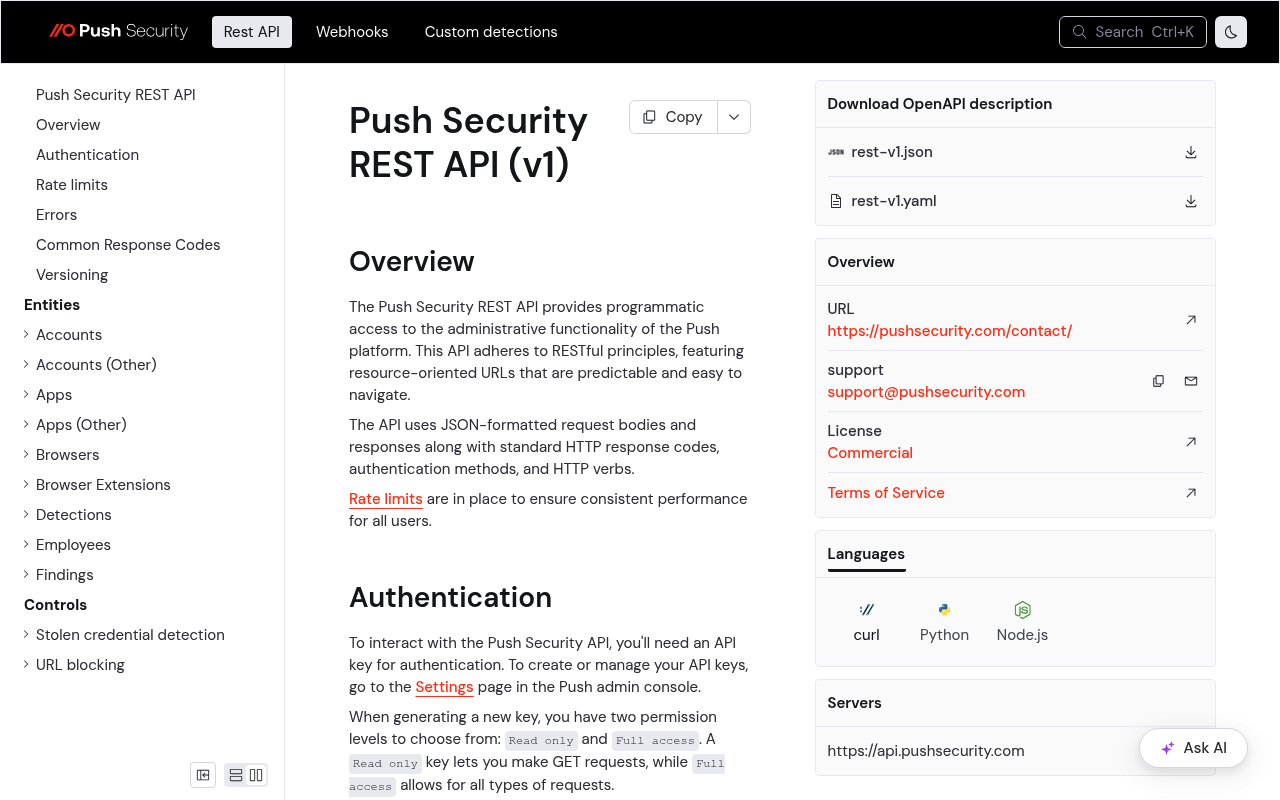
Push Security website screenshot

Push Security

Push Security is an AI-native browser security platform that deploys as a lightweight enterprise browser extension to every employee, giving security teams real-time telemetry, autonomous threat-hunting agents, and deep browser visibility across the full identity and browser attack surface. From the browser, Push tracks logins, AI-tool usage, and identity events to stop advanced identity attacks (account takeover, zero-day phishing, ClickFix, malicious OAuth integrations, session hijacking), discover shadow AI and shadow SaaS, harden unmanaged identities, and accelerate incident response. Push exposes a REST API (v1) and webhooks to programmatically administer the platform and forward events to SIEM/SOAR and ticketing systems. Backed by GV and Redpoint Ventures.

Push Security publishes 1 API on the APIs.io network. Tagged areas include Company, Enterprise, Security, Identity, and Browser Security.

The Push Security catalog on APIs.io includes 1 event-driven AsyncAPI specification.

Push Security’s developer surface includes documentation, API reference, getting-started guide, support, engineering blog, pricing, signup flow, and 20 more developer resources.

44.3/100 developing ▬ flat Agent 20/100 agent aware saas Full breakdown ↓
scored 2026-09-08 · rubric v0.20.0
1 APIs
CompanyEnterpriseSecurityIdentityBrowser SecuritySaaS SecurityCybersecurityThreat DetectionSIEM

Kin Score

Kin Score Kin Score How this is scored →
scored 2026-09-08 · rubric v0.20.0
Create-or-Update Ergonomics could not be measured. We hold no machine-readable contract for this provider to read, so there is nothing to measure a write surface against. Excluded rather than scored zero: never-measured and measured-empty are different facts. Publishing an OpenAPI is what makes this facet — and several others — scorable at all.
Improve this rating by publishing the missing artifacts — every area above can be raised, and the full rubric is at apis.io/rating/. Every facet and dimension name above is a link: it opens that measurement's own page — what it means, the exact checks that feed it, how the whole catalog distributes on it, and the providers at the top of it. This rating is computed from github.com/api-evangelist/push-security: open an issue to ask a question, or submit a pull request to add artifacts. Submit an artifact on GitHub — free → Manage your own listing — the Influence plan, $499/mo →

APIs 1

Individual APIs this provider publishes, each with its own machine-readable definition.

Push Security REST API v1

REST/JSON API to programmatically administer the Push platform (accounts, apps, findings, integrations) plus webhooks for real-time platform events.

Event Specifications 1

AsyncAPI definitions for this provider's event-driven and streaming APIs.

Security Posture 4

Authentication, domain security, vulnerability disclosure, and trust-center signals.

Push Security Authentication

apiKey · 1 scheme

SECURITY

Push Security Domain Security

TLSv1.3 · HSTS · DMARC

SECURITY

Push Security Vulnerability Disclosure

security.txt · contact published

SECURITY

Push Security Trust Center

SOC 2 Type II, ISO/IEC 27001, ISO/IEC 27701, GDPR, Cyber Essentials

SECURITY

Resources

Get Started 4

Portal, sign-up, and the first successful call

Documentation 2

Reference material describing how the API behaves

Agent Surfaces 2

MCP servers, agent skills, and machine-readable catalogs

Design & Contract 3

Pagination, idempotency, versioning, errors, and events

Build 1

SDKs, sample code, and the tooling you integrate with

Access & Security 7

Authentication, authorization, and security posture

Scroll for all 7

Operate 3

Status, limits, changes, and where to get help

Commercial 3

Pricing, plans, and the legal terms of use

Company 2

The organization behind the API

Source (apis.yml)

apis.yml Raw ↑
aid: push-security
name: Push Security
description: Push Security is an AI-native browser security platform that deploys as a lightweight enterprise browser extension
  to every employee, giving security teams real-time telemetry, autonomous threat-hunting agents, and deep browser visibility
  across the full identity and browser attack surface. From the browser, Push tracks logins, AI-tool usage, and identity events
  to stop advanced identity attacks (account takeover, zero-day phishing, ClickFix, malicious OAuth integrations, session
  hijacking), discover shadow AI and shadow SaaS, harden unmanaged identities, and accelerate incident response. Push exposes
  a REST API (v1) and webhooks to programmatically administer the platform and forward events to SIEM/SOAR and ticketing systems.
  Backed by GV and Redpoint Ventures.
url: https://raw.githubusercontent.com/api-evangelist/push-security/refs/heads/main/apis.yml
x-type: company
x-source: vc-portfolio
x-backed-by:
- gv
- redpoint-ventures
x-tier: stub
x-tier-reason: portfolio-lead
deliveryModel:
  model: saas
  open_source: false
  commercial: true
  callable_host: false
  label: Hosted service · you call their endpoint
  confidence: medium
  source:
  - pricing
  generated: '2026-08-28'
  method: derived
accessModel:
  pricing: unknown
  onboarding: unknown
  trial: false
  try_now: false
  public: false
  label: Unknown
  confidence: low
  source:
  - authentication
  - security
  generated: '2026-09-03'
  method: derived
specificationVersion: '0.23'
created: '2026-07-17'
modified: '2026-07-20'
image: https://pushsecurity.com/favicon.ico
tags:
- Company
- Enterprise
- Security
- Identity
- Browser Security
- SaaS Security
- Cybersecurity
- Threat Detection
- SIEM
apis:
- name: Push Security REST API v1
  description: REST/JSON API to programmatically administer the Push platform (accounts, apps, findings, integrations) plus
    webhooks for real-time platform events.
  humanURL: https://pushsecurity.com/help/audience/engineering/rest-v1
  baseURL: https://api.pushsecurity.com
  properties:
  - type: Documentation
    url: https://pushsecurity.com/help/audience/engineering/rest-v1
  - type: APIReference
    url: https://pushsecurity.com/help/audience/engineering/rest-v1
  - type: Authentication
    url: authentication/push-security-authentication.yml
  - type: Webhooks
    url: asyncapi/push-security-webhooks.yml
  - type: Conventions
    url: conventions/push-security-conventions.yml
  - type: Lifecycle
    url: lifecycle/push-security-lifecycle.yml
maintainers:
- FN: Kin Lane
  email: kin@apievangelist.com
- FN: APIs.json
  email: info@apis.io
common:
- type: Website
  url: https://pushsecurity.com
- type: DeveloperPortal
  url: https://pushsecurity.com/help/audience/engineering/rest-v1
- type: Documentation
  url: https://pushsecurity.com/help
- type: APIReference
  url: https://pushsecurity.com/help/audience/engineering/rest-v1
- type: GettingStarted
  url: https://pushsecurity.com/help/audience/administrators/docs/getting-started
- type: HelpCenter
  url: https://pushsecurity.com/help
- type: Support
  url: https://pushsecurity.com/contact
- type: Blog
  url: https://pushsecurity.com/blog
- type: Pricing
  url: https://pushsecurity.com/pricing
- type: Login
  url: https://pushsecurity.com/login
- type: SignUp
  url: https://pushsecurity.com/demo
- type: TermsOfService
  url: https://pushsecurity.com/legal/terms
- type: PrivacyPolicy
  url: https://pushsecurity.com/legal/privacy
- type: GitHubOrganization
  url: https://github.com/pushsecurity
- type: StatusPage
  url: https://status.pushsecurity.com/
- type: TrustCenter
  url: security/push-security-trust-center.yml
- type: Compliance
  url: https://trust.pushsecurity.com/
- type: Security
  url: https://pushsecurity.com/.well-known/security.txt
- type: LLMsTxt
  url: llms/push-security-llms.txt
- type: WellKnown
  url: well-known/push-security-well-known.yml
- type: SecurityTxt
  url: well-known/push-security-security.txt
- type: Authentication
  url: authentication/push-security-authentication.yml
- type: Conventions
  url: conventions/push-security-conventions.yml
- type: Lifecycle
  url: lifecycle/push-security-lifecycle.yml
- type: Webhooks
  url: asyncapi/push-security-webhooks.yml
- type: DomainSecurity
  url: security/push-security-domain-security.yml
- type: VulnerabilityDisclosure
  url: security/push-security-vulnerability-disclosure.yml
x-enrichment:
  date: '2026-07-20'
  status: enriched
  artifacts_added: 10
  pass: local-v1

Work with this as data

Every provider here is available over the APIs.io API and to AI agents over MCP.

MCP server

One button, every client — Claude, Cursor, VS Code and the rest.

https://apis.io/mcp

Tools for providers

9 MCP tools reach this
  • find_providersBrowse and filter every provider in the catalog.
  • get_provider_artifactsEvery artifact this provider publishes, grouped by type.
  • get_provider_operationsEvery operation across all of their OpenAPIs — one call instead of parsing every spec.
  • get_provider_toolsEvery MCP tool they ship, with the operation each wraps.
  • get_provider_evidenceHow each part of their score was established. Free — the basis for a claim should not sit behind it.
  • get_provider_ratingPRO — composite, band, trend and facet scores.
  • apis_io_searchSTART HERE — APIs, providers and tags for one query, each with its total.
  • resolveTurn a domain, URL or GitHub org into the provider it belongs to.
  • find_cohortsEvery scored population of providers in the catalog.
All 92 tools →

Call it yourself

curl for this page
This provider
curl "https://apis.io/api/v1/providers/push-security"
All providers
curl "https://apis.io/api/v1/providers?limit=25"
Every operation they expose
curl "https://apis.io/api/v1/providers/push-security/operations?limit=25"
How their score was established
curl "https://apis.io/api/v1/providers/push-security/evidence"

Discovery needs no key. Ratings and market analysis are Pro.

Get an API key

Free tier, no form to fill in. Signing in shares your email address with us — we store it to create your key and to recognise you if you sign in with another provider. See our Privacy Policy and Terms.

A second provider on the same verified email joins the account you already have.
