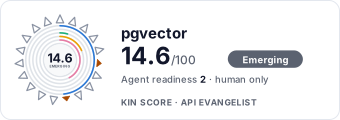
pgvector

pgvector is an open-source PostgreSQL extension for vector similarity search, created and maintained by Andrew Kane. It adds vector, halfvec and sparsevec data types, six distance operators (L2, inner product, cosine, L1, Hamming, Jaccard) and two approximate-nearest-neighbour index access methods (HNSW and IVFFlat) to a Postgres server, so embeddings live beside the rest of an application's data with full ACID semantics, JOINs, point-in-time recovery and existing backup and replication tooling. It is not a service and exposes no HTTP API: the interface is SQL, the contract is the extension's own installation DDL, and consumers reach it through an ordinary Postgres driver. The project also publishes first-party client libraries for seventeen languages, which handle vector encoding for each language's Postgres driver.

pgvector is profiled on the APIs.io network. Tagged areas include Artificial Intelligence, Vector Databases, Databases, Open Source, and PostgreSQL.

pgvector’s developer surface includes documentation, API reference, getting-started guide, support, changelog, and 15 more developer resources.

0 APIs
Artificial IntelligenceVector DatabasesDatabasesOpen SourcePostgreSQLSearchEmbeddingsExtensionsCompany

Pricing Plans 1

Published pricing tiers and plan structures.

Resources

Get Started 1

Portal, sign-up, and the first successful call

Documentation 2

Reference material describing how the API behaves

Agent Surfaces 2

MCP servers, agent skills, and machine-readable catalogs

Design & Contract 5

Pagination, idempotency, versioning, errors, and events

Build 4

SDKs, sample code, and the tooling you integrate with

Operate 3

Status, limits, changes, and where to get help

Commercial 2

Pricing, plans, and the legal terms of use

Company 1

The organization behind the API

Source (apis.yml)

apis.yml Raw ↑
aid: pgvector
name: pgvector
description: 'pgvector is an open-source PostgreSQL extension for vector similarity search, created and maintained by Andrew
  Kane. It adds vector, halfvec and sparsevec data types, six distance operators (L2, inner product, cosine, L1, Hamming,
  Jaccard) and two approximate-nearest-neighbour index access methods (HNSW and IVFFlat) to a Postgres server, so embeddings
  live beside the rest of an application''s data with full ACID semantics, JOINs, point-in-time recovery and existing backup
  and replication tooling. It is not a service and exposes no HTTP API: the interface is SQL, the contract is the extension''s
  own installation DDL, and consumers reach it through an ordinary Postgres driver. The project also publishes first-party
  client libraries for seventeen languages, which handle vector encoding for each language''s Postgres driver.'
image: https://avatars.githubusercontent.com/u/98363230?v=4
url: https://raw.githubusercontent.com/api-evangelist/pgvector/refs/heads/main/apis.yml
x-type: company
x-source: harvest:self-hosted-agent-stack
x-tier: profiled
x-tier-reason: enrichment-pass-2026-08-27
specificationVersion: '0.20'
created: '2026-08-27'
modified: '2026-08-27'
tags:
- Artificial Intelligence
- Vector Databases
- Databases
- Open Source
- PostgreSQL
- Search
- Embeddings
- Extensions
- Company
apis: []
x-apis-note: Deliberately empty. pgvector exposes no HTTP, GraphQL, gRPC or SOAP API and therefore has no baseURL to record;
  repair-api-bases.py returned `missing` on 2026-08-27 because no source names an API host, which is the correct result rather
  than a defect to repair. Its machine-readable contract is the extension DDL at sql/vector.sql, captured under data-model/
  and described in data-model/pgvector-data-model.yml. Inventing an apis[] entry with a fabricated base URL would misrepresent
  the project.
maintainers:
- FN: Kin Lane
  email: kin@apievangelist.com
- FN: APIs.json
  email: info@apis.io
common:
- type: Website
  url: https://github.com/pgvector/pgvector
- type: SourceCode
  url: https://github.com/pgvector/pgvector
- type: GitHubOrganization
  url: https://github.com/pgvector
- type: Documentation
  url: https://github.com/pgvector/pgvector#readme
- type: APIReference
  url: https://github.com/pgvector/pgvector#reference
- type: GettingStarted
  url: https://github.com/pgvector/pgvector#getting-started
- type: Support
  url: https://github.com/pgvector/pgvector/issues
- type: ChangeLog
  url: https://github.com/pgvector/pgvector/blob/master/CHANGELOG.md
- type: License
  url: https://github.com/pgvector/pgvector/blob/master/LICENSE
- type: Packages
  url: packages/pgvector-packages.yml
- type: SDKs
  url: packages/pgvector-packages.yml
- type: ChangeLog
  url: changelog/pgvector-changelog.yml
- type: Lifecycle
  url: lifecycle/pgvector-lifecycle.yml
- type: DataModel
  url: data-model/pgvector-data-model.yml
- type: Conventions
  url: conventions/pgvector-conventions.yml
- type: ErrorCatalog
  url: errors/pgvector-problem-types.yml
- type: Conformance
  url: conformance/pgvector-conformance.yml
- type: Plans
  url: plans/pgvector-plans-pricing.yml
- type: LLMsTxt
  url: llms/pgvector-llms.txt
- type: AgentSkill
  url: skills/_index.yml
x-pointer-verification:
  checked: '2026-08-27'
  method: probed
  note: Every external pointer above was fetched with a browser User-Agent on 2026-08-27. All returned HTTP 200. No dead pointers
    were found and none were removed.
  results:
  - url: https://github.com/pgvector/pgvector
    status: 200
  - url: https://github.com/pgvector
    status: 200
  - url: https://github.com/pgvector/pgvector#readme
    status: 200
  - url: https://github.com/pgvector/pgvector#reference
    status: 200
  - url: https://github.com/pgvector/pgvector#getting-started
    status: 200
  - url: https://github.com/pgvector/pgvector/issues
    status: 200
  - url: https://github.com/pgvector/pgvector/blob/master/CHANGELOG.md
    status: 200
  - url: https://github.com/pgvector/pgvector/blob/master/LICENSE
    status: 200
  - url: https://avatars.githubusercontent.com/u/98363230?v=4
    status: 200
x-contract-discovery:
  checked: '2026-08-27'
  outcome: sql-ddl-only
  note: 'STEP 0b was run in full against every host the project could plausibly control. No OpenAPI, Swagger, GraphQL SDL,
    AsyncAPI, Protobuf, WSDL, MCP endpoint or A2A agent card exists, and none is applicable to a PostgreSQL extension. The
    real machine-readable contract was found and captured: sql/vector.sql, declaring 3 types, 2 access methods, 114 functions,
    64 operators, 24 operator classes, 2 aggregates and 23 casts.'
  probes:
  - url: https://raw.githubusercontent.com/pgvector/pgvector/master/sql/vector.sql
    status: 200
    finding: The extension DDL. Saved verbatim to data-model/pgvector-vector.sql.
  - url: https://raw.githubusercontent.com/pgvector/pgvector/master/openapi.json
    status: 404
  - url: https://raw.githubusercontent.com/pgvector/pgvector/master/llms.txt
    status: 404
  - url: https://raw.githubusercontent.com/pgvector/pgvector/master/AGENTS.md
    status: 404
  - url: https://raw.githubusercontent.com/pgvector/pgvector/master/SECURITY.md
    status: 404
  - url: https://github.com/.well-known/agent-card.json
    status: 404
  - url: https://pgvector.dev/
    status: 302
    finding: Not the project's domain. Redirects to github.com/supabase-community/chatgpt-your-files. Nothing served from
      it was attributed to pgvector.
  - url: https://pgvector.com/
    status: null
    finding: No DNS resolution.
  - url: https://pgvector.org/
    status: null
    finding: No DNS resolution.
x-enrichment:
  date: '2026-08-27'
  status: enriched
  artifacts_added: 15
  pass: local-v1
x-coverage:
  state: covered
  detail: pgvector is a PostgreSQL extension, not a service. Its contract is the SQL DDL the server executes at CREATE EXTENSION
    time, which was found, fetched and captured; the absence of an OpenAPI is inapplicability, not an omission. The one genuine
    gap in the project's own posture is the missing SECURITY.md - probed 404 on both the repository and the organization .github
    repository - which leaves no published coordinated disclosure channel for a project whose last three releases each fixed
    a memory-safety or index-corruption defect running inside the database backend.
  evidence:
  - url: https://raw.githubusercontent.com/pgvector/pgvector/master/sql/vector.sql
    status: 200
  - url: https://raw.githubusercontent.com/pgvector/pgvector/master/SECURITY.md
    status: 404
  checked: '2026-08-27'

Work with this as data

Every provider here is available over the APIs.io API and to AI agents over MCP.

MCP server

One button, every client — Claude, Cursor, VS Code and the rest.

https://apis.io/mcp

Tools for providers

9 MCP tools reach this
  • find_providersBrowse and filter every provider in the catalog.
  • get_provider_artifactsEvery artifact this provider publishes, grouped by type.
  • get_provider_operationsEvery operation across all of their OpenAPIs — one call instead of parsing every spec.
  • get_provider_toolsEvery MCP tool they ship, with the operation each wraps.
  • get_provider_evidenceHow each part of their score was established. Free — the basis for a claim should not sit behind it.
  • get_provider_ratingPRO — composite, band, trend and facet scores.
  • apis_io_searchSTART HERE — APIs, providers and tags for one query, each with its total.
  • resolveTurn a domain, URL or GitHub org into the provider it belongs to.
  • find_cohortsEvery scored population of providers in the catalog.
All 92 tools

Call it yourself

curl for this page
This provider
curl "https://apis.io/api/v1/providers/pgvector"
All providers
curl "https://apis.io/api/v1/providers?limit=25"
Every operation they expose
curl "https://apis.io/api/v1/providers/pgvector/operations?limit=25"
How their score was established
curl "https://apis.io/api/v1/providers/pgvector/evidence"

Discovery needs no key. Ratings and market analysis are Pro.

Get an API key

Free tier, no email required.

A second provider on the same verified email joins the account you already have.