Peking University (北京大学, PKU) is a public research university in Beijing and, with Tsinghua, one of the two apex institutions of the Chinese system. Like most universities it operates no central developer portal and publishes no OpenAPI, but unlike most it runs three genuinely institution-operated machine-readable surfaces. Its Institutional Repository at ir.pku.edu.cn — PKU Library, Handle prefix 20.500.11897, content back to 2015 — answers an unauthenticated JSON REST API, a conforming OAI-PMH 2.0 endpoint advertising twelve metadata formats, and an OpenSearch Atom feed. Its Shibboleth identity provider publishes live SAML 2.0 metadata and has been in eduGAIN production since June 2019. Most significantly, the Peking University Computer Center operates CARSI, China's national research-and-education identity federation and a full eduGAIN member, which is the registration authority for 1,042 federated entities and serves 500+ Chinese universities; PKU also runs the national eduroam service. The PKU HPC group additionally authors OpenSCOW and CraneSched, open-source HPC platform and scheduler whose APIs are defined in some forty Protocol Buffer files, though those describe self-hosted software rather than a hosted endpoint. The Dataverse-based Open Research Data Platform at opendata.pku.edu.cn was verified live in June 2026 but did not answer any HTTPS request during this pass. No API is documented for developers, none carries a versioning or deprecation policy, and campus systems — IAAA authentication, the 教学网 LMS, the registrar — are gated. The footprint is small, real, and almost entirely a by-product of scholarly infrastructure rather than a developer programme.
Peking University publishes 11 API contracts indexed on the APIs.io network, including Collections API, Communities API, Harvesting API, and 8 more. Tagged areas include University, Higher Education, Education, China, and Public Research University.
The Peking University catalog on APIs.io includes 1 JSON-LD context and 1 Spectral governance ruleset.
Peking University’s developer surface includes engineering blog, authentication, code examples, and 28 more developer resources.
Regulatory Posture applies to this provider. Its tags matched the
Education & Research regime, so
Regulatory Posture carries 15 points of the composite.
If this regime is wrong for your business, say so on your
provider repo — the
applicability map is public and we will correct it.
Create-or-Update Ergonomics does not apply to this provider. The published contracts declare
no write operations, and a read-only API cannot create-or-update. The facet is excluded from this provider's
denominator entirely — not scored zero. A reference or data API is not deficient for being unable to
upsert.
The six quality facets above are damped to 85 points between them,
because the conditional facet above carries the other
15. That is why each facet's contribution is shown against a damped
maximum: raising a quality facet moves the composite by 85% of its nominal
weight, not 100%. The full arithmetic is at apis.io/rating/.
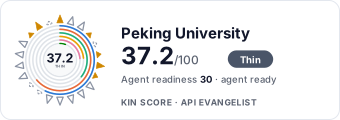
Show this score on your site.
It updates itself when the score changes. Paste this where you link to your API docs:
<a href="https://apis.io/providers/peking/"><img src="https://apis.io/badge/peking/card.svg" alt="Peking University on APIs.io — Kin Score by API Evangelist"></a>
Other styles, a README pill and a shields.io endpoint are on the badge page.
Raise your score.
Agent readiness — checks not met, largest first (exact, from this profile):
MCP Server+12 pts — deployment.mode + probe verdict on the mcp/ manifest, not the pointer; an unprobed slug falls back to authorship
Delegated User Identity+6 pts — a served discovery document listing authorization_code in grant_types_supported (served), else an oauth2 authorizationCode flow or openIdConnect declared in an OpenAPI (documented)
Typed Event Surface+6 pts — AsyncAPI document, OR webhooks/callbacks objects in the as-published OpenAPI, OR common[].type includes Webhooks
5 more unmet checks in the Agent Readiness table above.
Kin Score — facets with the most composite points still available (weight × headroom):
Standards this provider implements or carries. De facto ones are profiled and measured by the API Commons; formal ones come from the standards directory and are linked by the provider's own tags. The evidence column says how each claim was established — not that it was made.
OpenSearch 1.1 query interface returning an Atom feed of repository records, served from the institution's own host. Verified live 2026-08-19 (HTTP 200, 32KB Atom response for q...
The university's federated identity provider, publishing live Shibboleth/SAML 2.0 metadata as machine-readable XML. Declares SAML 2.0 POST, POST-SimpleSign and Redirect SSO/SLO ...
China's national identity federation for higher education and research, operated by Peking University and a full eduGAIN member. 1,042 SAML entities in eduGAIN carry CARSI as th...
OpenSCOW ("Super Computing On Web") is an HPC portal and management system authored at Peking University; CraneSched is its distributed scheduler for HPC and AI workloads. Their...
Dataverse-based research data repository operated by the PKU Library across social science, health, bioinformatics and NLP collections. Verified live by this catalog on 2026-06-...
OAI-PMH 2.0 metadata-harvesting endpoint for the Open Research Data Platform, verified responding to the Identify verb on 2026-06-03 with Dublin Core and DataCite support via th...
Peking University API — frequently asked questions
Does Peking University have an API?
Yes. APIs.io lists 11 APIs from Peking University, including PKU Institutional Repository OpenSearch Feed, Peking University Shibboleth Identity Provider (SAML 2.0 metadata) and CARSI — CERNET Authentication and Resource Sharing Infrastructure, and 8 more.
Is there an OpenAPI specification for the Peking University API?
Yes. APIs.io indexes 5 OpenAPI specifications for Peking University, each linked for download from this page.
How do I authenticate with the Peking University API?
Peking University uses bearer-token authentication (saml2/shibboleth/cas/oauth2/none · 4 schemes). The details are profiled on APIs.io as Peking Authentication.
How much does the Peking University API cost?
APIs.io lists 2 pricing plans for Peking University, with each plan's price, limits and inclusions under Pricing on this page.
Is the Peking University API ready for AI agents?
Peking University has a Kin Score of 37.2 out of 100 (thin) and an Agent Readiness score of 30.4 (agent-ready), scored by API Evangelist on 2026-11-06.
Calls without X-API-Key need no key. Calls with it need a paid plan — get a key.
Get an API key
Free tier, no form to fill in. Signing in shares your email address with us — we
store it to create your key and to recognise you if you sign in with another
provider. See our Privacy Policy and
Terms.

 Kin Score
How this is scored →
 It updates itself when the score changes. Paste this where you link to your API docs: