Paysend
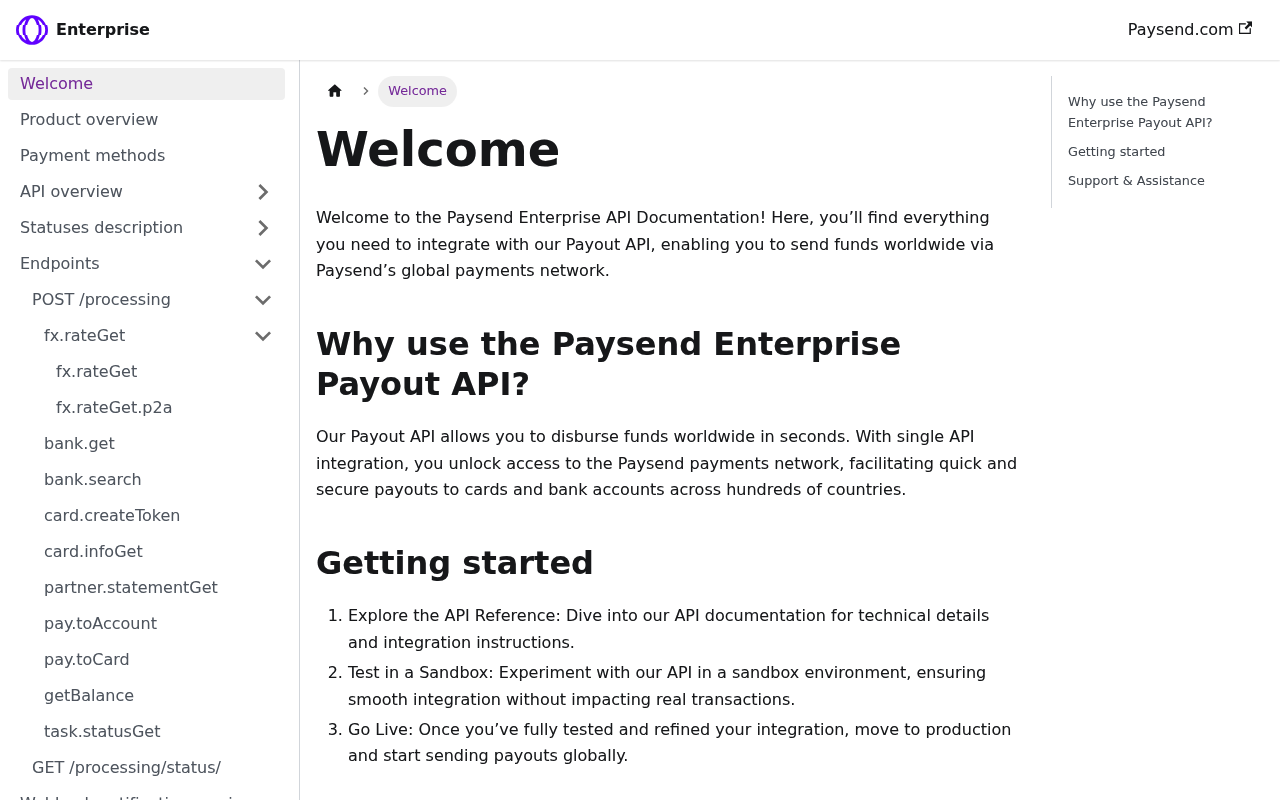
Paysend is a London-headquartered global fintech, founded in 2017, building a cross-border digital payments network that moves money to bank accounts, cards, and wallets across 170+ countries in 40+ currencies for more than 11 million consumers and a growing base of enterprise clients. Alongside its consumer money-transfer app, Paysend operates Paysend Enterprise, a business-facing payments platform whose developer surface is a single Payout API: one integration disburses funds worldwide to cards and accounts, with FX rate lookups, bank and card tokenization utilities, partner statements, and balance queries. The API is a partner-provisioned, enterprise integration (United Kingdom home market) rather than a fully public self-serve product — authentication is API key plus HMAC digital signature (X-OPP-Signature), requests are idempotent via a request id and date, and payout status is delivered through configurable webhook notifications. Paysend documents this surface openly on a Docusaurus developer portal with a sandbox mock service, but does not publish a downloadable OpenAPI/Swagger definition or a public base URL.
Paysend is listed with 1 API on the APIs.io network. Tagged areas include Payments, United Kingdom, Cross-Border, Money Transfer, and Payouts.
The Paysend catalog on APIs.io includes 1 event-driven AsyncAPI specification.
Paysend’s developer surface includes documentation, API reference, authentication, engineering blog, getting-started guide, support, sandbox, and 14 more developer resources.
Kin Score
 Kin Score
How this is scored →
Kin Score
How this is scored →scored 2026-10-17 · rubric v0.24.0
Markets this provider is in provisional
The Kin Score Market layer reads a provider inside its market: its position, and how deep its integrations go. Depth is only comparable within a position. Provisional and unweighted: not part of the Kin Score or agent readiness.
| Market | Position | Depth | Registered MCP server | Declares compatibility |
|---|---|---|---|---|
| RegTech, AML/KYC and Money Transmission | regulated | 19.2 (thin) | - | - |
Registered MCP server and declares compatibility are report only — not weighted. Undeclared means we found nothing we can read, so there is no number: we never infer integrations.
APIs 1
Individual APIs this provider publishes, each with its own machine-readable definition.
Paysend Enterprise Payout API
Paysend Enterprise's single Payout API disburses funds worldwide to cards and bank accounts through the Paysend payments network. A multi-task POST /processing endpoint carries ...
Event Specifications 1
AsyncAPI definitions for this provider's event-driven and streaming APIs.
Paysend Webhooks
ASYNCAPISecurity Posture 2
Authentication, domain security, vulnerability disclosure, and trust-center signals.
Resources
Get Started 3
Portal, sign-up, and the first successful call
Documentation 2
Reference material describing how the API behaves
Agent Surfaces 2
MCP servers, agent skills, and machine-readable catalogs
Design & Contract 5
Pagination, idempotency, versioning, errors, and events
Build 1
SDKs, sample code, and the tooling you integrate with
Access & Security 3
Authentication, authorization, and security posture
Operate 1
Status, limits, changes, and where to get help
Commercial 1
Pricing, plans, and the legal terms of use
Company 2
The organization behind the API
Other 1
Properties that don't map to a standard resource type
Source (apis.yml)
Work with this as data
Every provider here is available over the APIs.io API and to AI agents over MCP.