Microsoft Azure Quantum is Microsoft's cloud quantum computing service — an open, multi-vendor platform that provides access to quantum hardware from IonQ, Quantinuum, Pasqal, and Rigetti alongside Microsoft's own Q# programming language, Quantum Development Kit (QDK), and post-layout fault-tolerant Resource Estimator. The Azure Quantum Workspace REST API exposes jobs, sessions, providers, quotas, items, and storage surfaces; the Microsoft.Quantum ARM provider handles workspace provisioning. The QDK is free and open source, ships as a VS Code extension and Python package, and supports Q#, Qiskit, Cirq, and OpenQASM. Azure Quantum Elements layers in chemistry, materials, and HPC simulation for scientific discovery, with Copilot-assisted workflows on quantum.microsoft.com.
Microsoft Azure Quantum publishes 8 API contracts indexed on the APIs.io network, including Offerings API, Operations API, Subscriptions API, and 5 more. Tagged areas include Quantum, Quantum Computing, Microsoft Azure, Microsoft, and Q#.
The Microsoft Azure Quantum catalog on APIs.io includes 1 JSON-LD context and 2 Spectral governance rulesets.
Microsoft Azure Quantum’s developer surface includes changelog, support, authentication, developer portal, documentation, getting-started guide, pricing, and 86 more developer resources.
The questions people put to an LLM, and the jobs they hand an agent, that Microsoft Azure Quantum's APIs answer — each one linked to the operation that does it.
Generated by API Evangelist
Regulatory Posture applies to this provider. Its tags matched the
Horizontal (data, software, accessibility, platform) regime, so
Regulatory Posture carries 15 points of the composite.
If this regime is wrong for your business, say so on your
provider repo — the
applicability map is public and we will correct it.
Create-or-Update Ergonomics applies to this provider. This API accepts writes, so it
carries 10 points of the composite. It is scored from the published contracts
themselves: whether a caller can create-or-update in one call, whether the write accepts a key the caller already
holds, and whether the response says which branch ran. Without that, every write needs a search-and-branch in
front of it, and the first time that check is skipped a duplicate record is created.
Scored against the observed mean rather than raw — a provider at the catalog average is unchanged by this facet,
not penalised by it.
The six quality facets above are damped to 75 points between them,
because the conditional facet above carries the other
25. That is why each facet's contribution is shown against a damped
maximum: raising a quality facet moves the composite by 75% of its nominal
weight, not 100%. The full arithmetic is at apis.io/rating/.
Show this score on your site.
It updates itself when the score changes. Paste this where you link to your API docs:
<a href="https://apis.io/providers/microsoft-quantum/"><img src="https://apis.io/badge/microsoft-quantum/card.svg" alt="Microsoft Azure Quantum on APIs.io — Kin Score by API Evangelist"></a>
Other styles, a README pill and a shields.io endpoint are on the badge page.
Raise your score.
Agent readiness — checks not met, largest first (exact, from this profile):
MCP Server+12 pts — deployment.mode + probe verdict on the mcp/ manifest, not the pointer; an unprobed slug falls back to authorship
Idempotency+9 pts — OpenAPI mutating operations declare an idempotency key — a header, a request-body property, or a named de-duplication token whose own description says so (verified); else common[].type matches /idempoten/i (documented)
A2A Agent Card+8 pts — a2a/-a2a.yml manifest, graded on conformance.grade against A2A 1.0.0
Delegated User Identity+6 pts — a served discovery document listing authorization_code in grant_types_supported (served), else an oauth2 authorizationCode flow or openIdConnect declared in an OpenAPI (documented)
Typed Event Surface+6 pts — AsyncAPI document, OR webhooks/callbacks objects in the as-published OpenAPI, OR common[].type includes Webhooks
6 more unmet checks in the Agent Readiness table above.
Kin Score — facets with the most composite points still available (weight × headroom):
The Kin Score Market layer reads a provider inside its market:
its position, and how deep its integrations go. Depth is only comparable within a position. Provisional and unweighted:
not part of the Kin Score or agent readiness.
Registered MCP server and declares compatibility are report only — not weighted.
Undeclared means we found nothing we can read, so there is no number: we never infer integrations.
Standards this provider implements or carries. De facto ones are profiled and measured by the API Commons; formal ones come from the standards directory and are linked by the provider's own tags. The evidence column says how each claim was established — not that it was made.
Q# is Microsoft's open-source, hardware-agnostic quantum programming language. The Modern QDK compiler is written in Rust, ships as a VS Code extension and Python package, and p...
Python SDK for submitting jobs to Azure Quantum. Supports Q#, Qiskit, Cirq, and pass-through provider input formats; manages workspaces, jobs, sessions, and target queries again...
Overlays applied on top of this provider's contracts. Each card says who wrote it: a document the provider publishes, or one API Evangelist derived or generated.
aid: microsoft-quantum
url: https://azure.microsoft.com/en-us/products/quantum
name: Microsoft Azure Quantum
tags:
- Quantum
- Quantum Computing
- Microsoft Azure
- Microsoft
- Q#
- QDK
- Resource Estimation
- IonQ
- Quantinuum
- Pasqal
- Rigetti
- Hybrid Quantum
- Fault Tolerance
kind: contract
deliveryModel:
  model: saas
  license_evidence:
    not_product:
    - azure/azure-rest-api-specs
    - microsoft/azure-quantum-python
    - microsoft/qdk
    - microsoft/qsharp-compiler
    - microsoft/qsharp-language
  open_source: unknown
  commercial: true
  callable_host: true
  label: Hosted service · you call their endpoint
  confidence: low
  source:
  - openapi
  - pricing
  - repository-not-product
  generated: '2026-09-25'
  method: derived
accessModel:
  pricing: paid
  onboarding: unknown
  trial: false
  try_now: false
  public: false
  label: Paid
  confidence: medium
  source:
  - plans
  - authentication
  - security
  generated: '2026-11-06'
  method: derived
image: https://kinlane-images.s3.amazonaws.com/shared/apis-json/icons/microsoft-quantum.png
access: 3rd-Party
created: '2026-05-25T00:00:00.000Z'
modified: '2026-05-25'
position: Producing
description: Microsoft Azure Quantum is Microsoft's cloud quantum computing service — an open, multi-vendor platform that
  provides access to quantum hardware from IonQ, Quantinuum, Pasqal, and Rigetti alongside Microsoft's own Q# programming
  language, Quantum Development Kit (QDK), and post-layout fault-tolerant Resource Estimator. The Azure Quantum Workspace
  REST API exposes jobs, sessions, providers, quotas, items, and storage surfaces; the Microsoft.Quantum ARM provider handles
  workspace provisioning. The QDK is free and open source, ships as a VS Code extension and Python package, and supports Q#,
  Qiskit, Cirq, and OpenQASM. Azure Quantum Elements layers in chemistry, materials, and HPC simulation for scientific discovery,
  with Copilot-assisted workflows on quantum.microsoft.com.
maintainers:
- FN: Kin Lane
  email: info@apievangelist.com
  X: apievangelist
  url: https://apievangelist.com
specificationVersion: '0.23'
common:
- type: Spectral
  url: rules/microsoft-quantum-rules.yml
- type: Spectral
  url: rules/microsoft-quantum-jsonschema-spectral-rules.yml
- type: Vocabulary
  url: vocabulary/microsoft-quantum-vocabulary.yml
- type: DataModel
  url: data-model/microsoft-quantum-data-model.yml
- type: ChangeLog
  url: changelog/microsoft-quantum-changelog.yml
- type: Compliance
  url: https://www.microsoft.com/en-us/trust-center
- type: ErrorCatalog
  url: errors/microsoft-quantum-problem-types.yml
- type: Conformance
  url: conformance/microsoft-quantum-conformance.yml
- type: Overlay
  url: overlays/microsoft-quantum-offerings-api-phrasing-overlay.yaml
- type: LLMsTxt
  url: llms/microsoft-quantum-llms.txt
- type: SecurityTxt
  url: well-known/microsoft-quantum-security.txt
- type: WellKnown
  url: well-known/microsoft-quantum-well-known.yml
- type: Hosts
  url: hosts/microsoft-quantum-hosts.yml
- type: Vendors
  url: vendors/microsoft-quantum-vendors.yml
- type: Packages
  url: packages/microsoft-quantum-packages.yml
- type: Support
  url: https://support.microsoft.com/en-us
- type: Security
  url: https://www.microsoft.com/security
- type: Leadership
  url: https://news.microsoft.com/leadership
- type: TrustCenter
  url: security/microsoft-quantum-trust-center.yml
- type: Website
  url: https://www.microsoft.com/
- type: CapabilityMap
  url: capabilities/microsoft-quantum-capability-edges.yml
  name: Microsoft Azure Quantum Business Capability Map
- type: AgenticAccess
  url: agentic-access/microsoft-quantum-agentic-access.yml
- type: VulnerabilityDisclosure
  url: security/microsoft-quantum-vulnerability-disclosure.yml
- type: DomainSecurity
  url: security/microsoft-quantum-domain-security.yml
- type: Authentication
  url: authentication/microsoft-quantum-authentication.yml
- type: OAuthScopes
  url: scopes/microsoft-quantum-scopes.yml
- type: PostmanWorkspace
  url: https://www.postman.com/kinlaneapi/microsoft-azure-quantum/overview
- type: Arazzo
  url: arazzo/microsoft-quantum-cancel-running-job-workflow.yml
  name: Azure Quantum Cancel a Running Job
- type: Arazzo
  url: arazzo/microsoft-quantum-discover-available-target-workflow.yml
  name: Azure Quantum Discover an Available Target
- type: Arazzo
  url: arazzo/microsoft-quantum-quota-capacity-check-workflow.yml
  name: Azure Quantum Quota Capacity Check
- type: Arazzo
  url: arazzo/microsoft-quantum-session-lifecycle-workflow.yml
  name: Azure Quantum Session Lifecycle
- type: Arazzo
  url: arazzo/microsoft-quantum-submit-job-poll-results-workflow.yml
  name: Azure Quantum Submit Job and Retrieve Results
- type: Arazzo
  url: arazzo/microsoft-quantum-workspace-bootstrap-workflow.yml
  name: Azure Quantum Workspace Bootstrap
- url: https://quantum.microsoft.com/
  name: Microsoft Quantum
  type: Portal
- url: https://azure.microsoft.com/en-us/products/quantum
  name: Azure Quantum Product Page
  type: Portal
- url: https://learn.microsoft.com/en-us/azure/quantum/
  name: Azure Quantum Documentation
  type: Documentation
- url: https://learn.microsoft.com/en-us/azure/quantum/overview-azure-quantum
  name: What is Azure Quantum?
  type: GettingStarted
- url: https://learn.microsoft.com/en-us/azure/quantum/install-overview-qdk
  name: Set up the Microsoft Quantum Development Kit
  type: GettingStarted
- url: https://learn.microsoft.com/en-us/azure/quantum/qsharp-quickstart
  name: Create Your First Q# Program
  type: GettingStarted
- url: https://learn.microsoft.com/en-us/rest/api/azurequantum/
  name: Azure Quantum REST API Reference
  type: Documentation
- url: https://learn.microsoft.com/en-us/azure/quantum/qc-target-list
  name: Quantum Computing Targets List
  type: Documentation
- url: https://learn.microsoft.com/en-us/azure/quantum/provider-global-availability
  name: Provider Global Availability
  type: Regions
- url: https://learn.microsoft.com/en-us/azure/quantum/release-notes
  name: QDK and Azure Quantum Release Notes
  type: ChangeLog
- url: https://learn.microsoft.com/en-us/azure/quantum/pricing
  name: Azure Quantum Pricing
  type: Pricing
- url: https://learn.microsoft.com/en-us/azure/quantum/azure-quantum-job-cost-billing
  name: Understanding Job Costs and Billing
  type: Documentation
- url: https://learn.microsoft.com/en-us/azure/quantum/how-to-create-workspace
  name: Create an Azure Quantum Workspace
  type: GettingStarted
- url: https://ms.portal.azure.com/#create/Microsoft.AzureQuantum
  name: Create Workspace in Azure Portal
  type: Signup
- url: https://azure.microsoft.com/en-us/free/
  name: Azure Free Account
  type: Signup
- url: https://azure.microsoft.com/en-us/free/students/
  name: Free Azure Account for Students
  type: Signup
- url: https://learn.microsoft.com/en-us/azure/quantum/credits
  name: Azure Quantum Credits
  type: Documentation
- url: https://status.azure.com/
  name: Azure Status
  type: StatusPage
- url: https://www.microsoft.com/en-us/trust-center
  name: Microsoft Trust Center
  type: TrustCenter
- url: https://learn.microsoft.com/en-us/legal/azure-quantum/
  name: Azure Quantum Service Terms
  type: TermsOfService
- url: https://www.microsoft.com/en-us/legal/terms-of-use
  name: Microsoft Terms of Use
  type: TermsOfService
- url: https://privacy.microsoft.com/en-us/privacystatement
  name: Microsoft Privacy Statement
  type: PrivacyPolicy
- url: https://cloudblogs.microsoft.com/quantum/
  name: Microsoft Azure Quantum Blog
  type: Blog
- url: https://www.microsoft.com/research/research-area/quantum-computing/
  name: Microsoft Quantum Research
  type: Documentation
- url: https://github.com/microsoft
  name: Microsoft GitHub Organization
  type: GitHubOrganization
- url: https://github.com/Azure
  name: Azure GitHub Organization
  type: GitHubOrganization
- url: https://github.com/MicrosoftDocs/quantum-docs
  name: Quantum Docs Source
  type: Documentation
- url: https://github.com/microsoft/qdk
  name: Microsoft QDK (Q# Compiler, Resource Estimator, Quantum Katas)
  type: GitHubRepository
- url: https://github.com/microsoft/qsharp-language
  name: Q# Language Design Repository
  type: GitHubRepository
- url: https://github.com/microsoft/qsharp-compiler
  name: Q# Compiler (legacy)
  type: GitHubRepository
- url: https://github.com/microsoft/qsharp-runtime
  name: Q# Runtime (legacy)
  type: GitHubRepository
- url: https://github.com/microsoft/QuantumLibraries
  name: Q# Quantum Libraries
  type: GitHubRepository
- url: https://github.com/microsoft/azure-quantum-python
  name: Azure Quantum Python SDK
  type: SDKs
- url: https://pypi.org/project/azure-quantum/
  name: azure-quantum on PyPI
  type: SDKs
- url: https://pypi.org/project/qsharp/
  name: qsharp on PyPI
  type: SDKs
- url: https://github.com/microsoft/Quantum
  name: Microsoft Quantum Development Kit Samples
  type: CodeExamples
- url: https://github.com/microsoft/QuantumKatas
  name: Quantum Katas (Tutorials)
  type: Courses
- url: https://github.com/microsoft/quantum-curriculum-samples
  name: Quantum Curriculum Samples
  type: Courses
- url: https://github.com/microsoft/iqsharp
  name: IQ# Jupyter Kernel
  type: Tools
- url: https://github.com/microsoft/quantum-viz.js
  name: quantum-viz.js Circuit Renderer
  type: Tools
- url: https://github.com/microsoft/qdk-chemistry
  name: QDK Chemistry Toolkit
  type: Tools
- url: https://github.com/microsoft/Quantum-NC
  name: Quantum Computing Libraries (Noncommercial)
  type: Tools
- url: https://github.com/microsoft/qmt
  name: Qubit Modeling Tools
  type: Tools
- url: https://github.com/Azure/azure-rest-api-specs/tree/main/specification/quantum
  name: Azure Quantum REST API Specs (Source)
  type: GitHubRepository
- url: https://learn.microsoft.com/en-us/azure/quantum/install-command-line-qdk
  name: Azure CLI Quantum Extension
  type: Documentation
- url: https://learn.microsoft.com/en-us/training/paths/quantum-computing-fundamentals/
  name: Get Started with Azure Quantum (Learn Path)
  type: Training
- url: https://learn.microsoft.com/en-us/azure/quantum/hybrid-computing-overview
  name: Hybrid Quantum Computing
  type: Documentation
- url: https://learn.microsoft.com/en-us/azure/quantum/intro-to-resource-estimation
  name: Resource Estimator
  type: Documentation
- url: https://learn.microsoft.com/en-us/azure/quantum/quickstart-microsoft-resources-estimator
  name: Run Your First Resource Estimate
  type: GettingStarted
- url: https://learn.microsoft.com/en-us/azure/quantum/qsharp-overview
  name: Q# Language Overview
  type: Documentation
- url: https://learn.microsoft.com/en-us/qsharp/api/
  name: Q# Standard Library Reference
  type: Documentation
- url: https://learn.microsoft.com/en-us/azure/quantum/provider-ionq
  name: IonQ Provider
  type: Documentation
- url: https://learn.microsoft.com/en-us/azure/quantum/provider-quantinuum
  name: Quantinuum Provider
  type: Documentation
- url: https://learn.microsoft.com/en-us/azure/quantum/provider-pasqal
  name: Pasqal Provider
  type: Documentation
- url: https://learn.microsoft.com/en-us/azure/quantum/provider-rigetti
  name: Rigetti Provider
  type: Documentation
- url: https://learn.microsoft.com/en-us/azure/quantum/get-started-azure-quantum
  name: Copilot in Microsoft Quantum
  type: Documentation
- url: https://learn.microsoft.com/en-us/answers/tags/3/azure-quantum
  name: Q&A Forum
  type: Forums
- url: plans/microsoft-quantum-plans-pricing.yml
  type: Plans
- url: rate-limits/microsoft-quantum-rate-limits.yml
  type: RateLimits
- url: finops/microsoft-quantum-finops.yml
  type: FinOps
- type: Features
  data:
  - Azure Quantum Workspace — managed cloud control plane for submitting and tracking quantum jobs across multiple hardware
    providers
  - Q# programming language — open-source, hardware-agnostic quantum DSL with a modern Rust-based compiler
  - Microsoft Quantum Development Kit (QDK) — free, open-source SDK with VS Code extension, Python package, Jupyter widgets,
    and language service
  - Microsoft Quantum Resource Estimator — fault-tolerant resource estimation with configurable qubit parameters, QEC codes,
    and error budgets
  - Multi-provider hardware access — IonQ (trapped ion, 25–36 qubits), Quantinuum (trapped ion, H2 series 20–32 qubits), Pasqal
    (neutral atom, 100 qubits), Rigetti (superconducting, 108 qubits)
  - Built-in support for Qiskit, Cirq, OpenQASM in addition to Q#
  - Sessions API for low-latency hybrid quantum-classical workflows
  - Azure Quantum Credits program — USD 500 in free provider credits for new workspaces
  - Azure Quantum Elements — chemistry, materials, and HPC simulation stack (Generative Chemistry, Accelerated DFT) integrated
    with the quantum platform
  - Copilot in Microsoft Quantum — AI-assisted Q# code generation and chemistry workflows on quantum.microsoft.com
  - Azure CLI `az quantum` extension for workspace and job management from the terminal
  - ARM resource manager API for Infrastructure-as-Code provisioning
  - Storage SAS URI delegation for direct blob upload of job inputs/outputs
  - TypeSpec-defined OpenAPI specs published to Azure/azure-rest-api-specs
  - Azure-native integrations (RBAC, Entra ID, Storage, Monitor) and per-region provider availability
  sources:
  - https://azure.microsoft.com/en-us/products/quantum
  - https://learn.microsoft.com/en-us/azure/quantum/overview-azure-quantum
  - https://learn.microsoft.com/en-us/azure/quantum/qc-target-list
  - https://learn.microsoft.com/en-us/azure/quantum/pricing
  - https://github.com/Azure/azure-rest-api-specs/tree/main/specification/quantum
  - https://github.com/microsoft/qdk
  updated: '2026-05-25'
apis:
- aid: microsoft-quantum:qsharp-language
  name: Q# Quantum Programming Language
  tags:
  - Quantum
  - Programming Language
  - Q#
  - QDK
  - Open Source
  tags_raw:
  - Quantum
  - Programming Language
  - Q#
  - QDK
  - Open Source
  - Open-Source
  humanURL: https://learn.microsoft.com/en-us/azure/quantum/qsharp-overview
  properties:
  - url: https://learn.microsoft.com/en-us/azure/quantum/qsharp-overview
    type: Documentation
  - url: https://learn.microsoft.com/en-us/qsharp/api/
    type: Documentation
  - url: https://github.com/microsoft/qdk
    type: GitHubRepository
  - url: https://github.com/microsoft/qsharp-language
    type: GitHubRepository
  description: Q# is Microsoft's open-source, hardware-agnostic quantum programming language. The Modern QDK compiler is written
    in Rust, ships as a VS Code extension and Python package, and powers quantum.microsoft.com. Q# expresses programs as classical
    control-flow that operates on qubits without modeling the quantum state directly, and targets every Azure Quantum provider
    plus the Resource Estimator.
- aid: microsoft-quantum:resource-estimator
  name: Microsoft Quantum Resource Estimator
  tags:
  - Quantum
  - Resource Estimation
  - Fault Tolerance
  - QEC
  humanURL: https://learn.microsoft.com/en-us/azure/quantum/intro-to-resource-estimation
  properties:
  - url: https://learn.microsoft.com/en-us/azure/quantum/intro-to-resource-estimation
    type: Documentation
  - url: https://learn.microsoft.com/en-us/azure/quantum/overview-resources-estimator
    type: Documentation
  - url: https://github.com/microsoft/qdk
    type: GitHubRepository
  description: Open-source post-layout physical resource estimator for fault-tolerant quantum algorithms. Compute qubit counts,
    T-state counts, runtime, and code-distance requirements across configurable qubit physical parameters, QEC schemes, and
    error budgets. Ships inside the QDK and runs locally or as an Azure Quantum target.
- aid: microsoft-quantum:azure-quantum-python-sdk
  name: Azure Quantum Python SDK
  tags:
  - Quantum
  - SDK
  - Python
  - Qiskit
  - Cirq
  humanURL: https://github.com/microsoft/azure-quantum-python
  properties:
  - url: https://github.com/microsoft/azure-quantum-python
    type: GitHubRepository
  - url: https://pypi.org/project/azure-quantum/
    type: SDKs
  description: Python SDK for submitting jobs to Azure Quantum. Supports Q#, Qiskit, Cirq, and pass-through provider input
    formats; manages workspaces, jobs, sessions, and target queries against the Workspace data-plane API.
- aid: microsoft-quantum:microsoft-quantum-offerings-api
  name: Microsoft Azure Quantum Offerings API
  description: The Offerings API from Microsoft Azure Quantum — 1 operation(s) for offerings.
  humanURL: https://learn.microsoft.com/en-us/rest/api/azurequantum/
  tags:
  - Offerings
  properties:
  - type: OpenAPI
    url: openapi/microsoft-quantum-offerings-api-openapi.yml
  - type: Documentation
    url: https://learn.microsoft.com/en-us/rest/api/azurequantum/
  - type: Documentation
    url: https://github.com/Azure/azure-rest-api-specs/tree/main/specification/quantum/data-plane/Microsoft.Quantum/preview/2026-01-15-preview
  - type: JSONSchema
    url: json-schema/azure-quantum-job-schema.json
  - type: JSONSchema
    url: json-schema/azure-quantum-session-schema.json
  - type: JSONSchema
    url: json-schema/azure-quantum-provider-status-schema.json
  - type: JSONLD
    url: json-ld/microsoft-quantum-context.jsonld
  - type: Documentation
    url: https://learn.microsoft.com/en-us/azure/templates/microsoft.quantum/workspaces
  - type: Documentation
    url: https://github.com/Azure/azure-rest-api-specs/tree/main/specification/quantum/resource-manager/Microsoft.Quantum/preview/2025-12-15-preview
- aid: microsoft-quantum:microsoft-quantum-operations-api
  name: Microsoft Azure Quantum Operations API
  description: The Operations API from Microsoft Azure Quantum — 1 operation(s) for operations.
  humanURL: https://learn.microsoft.com/en-us/rest/api/azurequantum/
  tags: []
  tags_raw:
  - Operations
  properties:
  - type: OpenAPI
    url: openapi/microsoft-quantum-operations-api-openapi.yml
  - type: Documentation
    url: https://learn.microsoft.com/en-us/rest/api/azurequantum/
  - type: Documentation
    url: https://github.com/Azure/azure-rest-api-specs/tree/main/specification/quantum/data-plane/Microsoft.Quantum/preview/2026-01-15-preview
  - type: JSONSchema
    url: json-schema/azure-quantum-job-schema.json
  - type: JSONSchema
    url: json-schema/azure-quantum-session-schema.json
  - type: JSONSchema
    url: json-schema/azure-quantum-provider-status-schema.json
  - type: JSONLD
    url: json-ld/microsoft-quantum-context.jsonld
  - type: Documentation
    url: https://learn.microsoft.com/en-us/azure/templates/microsoft.quantum/workspaces
  - type: Documentation
    url: https://github.com/Azure/azure-rest-api-specs/tree/main/specification/quantum/resource-manager/Microsoft.Quantum/preview/2025-12-15-preview
- aid: microsoft-quantum:microsoft-quantum-subscriptions-api
  name: Microsoft Azure Quantum Subscriptions API
  description: The Subscriptions API from Microsoft Azure Quantum — 12 operation(s) for subscriptions.
  humanURL: https://learn.microsoft.com/en-us/rest/api/azurequantum/
  tags:
  - Subscription
  tags_raw:
  - Subscriptions
  properties:
  - type: OpenAPI
    url: openapi/microsoft-quantum-subscriptions-api-openapi.yml
  - type: Documentation
    url: https://learn.microsoft.com/en-us/rest/api/azurequantum/
  - type: Documentation
    url: https://github.com/Azure/azure-rest-api-specs/tree/main/specification/quantum/data-plane/Microsoft.Quantum/preview/2026-01-15-preview
  - type: JSONSchema
    url: json-schema/azure-quantum-job-schema.json
  - type: JSONSchema
    url: json-schema/azure-quantum-session-schema.json
  - type: JSONSchema
    url: json-schema/azure-quantum-provider-status-schema.json
  - type: JSONLD
    url: json-ld/microsoft-quantum-context.jsonld
  - type: Documentation
    url: https://learn.microsoft.com/en-us/azure/templates/microsoft.quantum/workspaces
  - type: Documentation
    url: https://github.com/Azure/azure-rest-api-specs/tree/main/specification/quantum/resource-manager/Microsoft.Quantum/preview/2025-12-15-preview
- aid: microsoft-quantum:microsoft-quantum-suiteoffers-api
  name: Microsoft Azure Quantum SuiteOffers API
  description: The SuiteOffers API from Microsoft Azure Quantum — 1 operation(s) for suiteoffers.
  humanURL: https://learn.microsoft.com/en-us/rest/api/azurequantum/
  tags:
  - SuiteOffers
  properties:
  - type: OpenAPI
    url: openapi/microsoft-quantum-suiteoffers-api-openapi.yml
  - type: Documentation
    url: https://learn.microsoft.com/en-us/rest/api/azurequantum/
  - type: Documentation
    url: https://github.com/Azure/azure-rest-api-specs/tree/main/specification/quantum/data-plane/Microsoft.Quantum/preview/2026-01-15-preview
  - type: JSONSchema
    url: json-schema/azure-quantum-job-schema.json
  - type: JSONSchema
    url: json-schema/azure-quantum-session-schema.json
  - type: JSONSchema
    url: json-schema/azure-quantum-provider-status-schema.json
  - type: JSONLD
    url: json-ld/microsoft-quantum-context.jsonld
  - type: Documentation
    url: https://learn.microsoft.com/en-us/azure/templates/microsoft.quantum/workspaces
  - type: Documentation
    url: https://github.com/Azure/azure-rest-api-specs/tree/main/specification/quantum/resource-manager/Microsoft.Quantum/preview/2025-12-15-preview
- aid: microsoft-quantum:microsoft-quantum-workspaces-api
  name: Microsoft Azure Quantum Workspaces API
  description: The Workspaces API from Microsoft Azure Quantum — 6 operation(s) for workspaces.
  humanURL: https://learn.microsoft.com/en-us/rest/api/azurequantum/
  tags:
  - Workspace
  tags_raw:
  - Workspaces
  properties:
  - type: OpenAPI
    url: openapi/microsoft-quantum-workspaces-api-openapi.yml
  - type: Documentation
    url: https://learn.microsoft.com/en-us/rest/api/azurequantum/
  - type: Documentation
    url: https://github.com/Azure/azure-rest-api-specs/tree/main/specification/quantum/data-plane/Microsoft.Quantum/preview/2026-01-15-preview
  - type: JSONSchema
    url: json-schema/azure-quantum-job-schema.json
  - type: JSONSchema
    url: json-schema/azure-quantum-session-schema.json
  - type: JSONSchema
    url: json-schema/azure-quantum-provider-status-schema.json
  - type: JSONLD
    url: json-ld/microsoft-quantum-context.jsonld
  - type: Documentation
    url: https://learn.microsoft.com/en-us/azure/templates/microsoft.quantum/workspaces
  - type: Documentation
    url: https://github.com/Azure/azure-rest-api-specs/tree/main/specification/quantum/resource-manager/Microsoft.Quantum/preview/2025-12-15-preview
tags_raw:
- Quantum
- Quantum Computing
- Azure
- Microsoft
- Q#
- QDK
- Resource Estimation
- IonQ
- Quantinuum
- Pasqal
- Rigetti
- Hybrid Quantum
- Fault Tolerance
x-parent: microsoft
x-relationship: product
x-enrichment:
  date: '2026-11-05'
  status: enriched
  artifacts_added: 2
  pass: local-v6
Microsoft Azure Quantum API — frequently asked questions
Does Microsoft Azure Quantum have an API?
Yes. APIs.io lists 8 APIs from Microsoft Azure Quantum, including Q# Quantum Programming Language, Microsoft Quantum Resource Estimator and Azure Quantum Python SDK, and 5 more.
Is there an OpenAPI specification for the Microsoft Azure Quantum API?
Yes. APIs.io indexes 5 OpenAPI specifications for Microsoft Azure Quantum, each linked for download from this page.
How do I authenticate with the Microsoft Azure Quantum API?
Microsoft Azure Quantum uses bearer-token authentication (apiKey/oauth2 · 3 schemes). The details are profiled on APIs.io as Microsoft Quantum Authentication.
How much does the Microsoft Azure Quantum API cost?
Microsoft Azure Quantum publishes its prices; its IonQ Pay As You Go Aria-Forte — IonQ simulator plan is Free of charge as of 2026-10-28. APIs.io lists 10 pricing plans for Microsoft Azure Quantum, with each plan's price, limits and inclusions under Pricing on this page.
Is the Microsoft Azure Quantum API ready for AI agents?
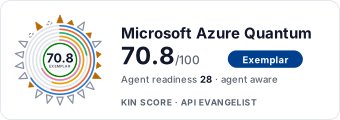
Microsoft Azure Quantum has a Kin Score of 70.8 out of 100 (exemplar) and an Agent Readiness score of 27.6 (agent-aware), scored by API Evangelist on 2026-11-06.
Calls without X-API-Key need no key. Calls with it need a paid plan — get a key.
Get an API key
Free tier, no form to fill in. Signing in shares your email address with us — we
store it to create your key and to recognise you if you sign in with another
provider. See our Privacy Policy and
Terms.
 Kin Score
How this is scored →
 It updates itself when the score changes. Paste this where you link to your API docs: