Lido is the leading liquid staking protocol on Ethereum, allowing anyone to stake ETH without locking it or running validator infrastructure. Stakers deposit ETH and receive stETH — a rebasing ERC-20 that earns daily staking rewards — or its non-rebasing wrapped form wstETH used widely across DeFi. Lido is governed by the Lido DAO via the LDO token, Snapshot signaling, on-chain Aragon voting, and a Dual Governance timelock that gives stETH holders a dynamic veto over the DAO. The protocol's validator set is delegated across multiple Staking Modules — the Curated Module (professional node operators), Simple DVT (distributed validator technology via Obol and SSV), the Community Staking Module (permissionless solo stakers backed by bonded stETH), and stVaults (modular tailored setups). At over $18B TVL and 8.8M+ ETH staked, Lido is the #1 liquid staking provider by total value locked. Lido previously operated on Polygon (stMATIC, sunset June 2025) and Solana (stSOL, sunset February 2024); the protocol is now Ethereum-only. Lido publishes the open-source core smart contracts, a TypeScript SDK (`@lidofinance/lido-ethereum-sdk`), a Python oracle daemon, validator monitoring tooling, frontend widgets, and three public read-only HTTP APIs for protocol APR, reward history, and withdrawal queue timing.
Lido publishes 12 API contracts indexed on the APIs.io network, including APR for Eth and stEth API, Estimate API, NFT API, and 9 more. Tagged areas include Liquid Staking, Ethereum, Staking, DeFi, and stETH.
Lido’s developer surface includes documentation, developer portal, engineering blog, CLI, tooling, YouTube channel, and 54 more developer resources.
Regulatory Posture applies to this provider. Its tags matched the
Horizontal (data, software, accessibility, platform) regime, so
Regulatory Posture carries 15 points of the composite.
If this regime is wrong for your business, say so on your
provider repo — the
applicability map is public and we will correct it.
Open Source Surface applies to this provider. This product is open source and we
read its repository directly, so Open Source Surface carries
10 points of the composite. It is scored from what the repository actually
publishes — a security policy, a contribution guide, a release history, a code of conduct — read live from the
provider rather than inferred from our own catalog pointers.
This facet adds; nothing was taken away to make room for it. An open-source project is not excused from
the commercial facets, because exemption would strip it of the points it does earn.
If we have the wrong repository, or this product is not open source, say so on your
provider repo and we
will drop the facet rather than have you publish against it.
Create-or-Update Ergonomics does not apply to this provider. The published contracts declare
no write operations, and a read-only API cannot create-or-update. The facet is excluded from this provider's
denominator entirely — not scored zero. A reference or data API is not deficient for being unable to
upsert.
The six quality facets above are damped to 75 points between them,
because both conditional facets apply and carry
25 points together. That is why each facet's contribution is shown against a damped
maximum: raising a quality facet moves the composite by 75% of its nominal
weight, not 100%. The full arithmetic is at apis.io/rating/.
Show this score on your site.
It updates itself when the score changes. Paste this where you link to your API docs:
<a href="https://apis.io/providers/lido/"><img src="https://apis.io/badge/lido/card.svg" alt="Lido on APIs.io — Kin Score by API Evangelist"></a>
Other styles, a README pill and a shields.io endpoint are on the badge page.
Improve this rating by publishing the missing artifacts — every area above can be raised, and the full rubric is at apis.io/rating/. Every facet and dimension name above is a link: it opens that measurement's own page — what it means, the exact checks that feed it, how the whole catalog distributes on it, and the providers at the top of it. This rating is computed from github.com/api-evangelist/lido: open an issue to ask a question, or submit a pull request to add artifacts.
Submit an artifact on GitHub — free →Manage your own listing — the Influence plan, $499/mo →
Markets this provider is in provisional
The Kin Score Market layer reads a provider inside its market:
its position, and how deep its integrations go. Depth is only comparable within a position. Provisional and unweighted:
not part of the Kin Score or agent readiness.
Registered MCP server and declares compatibility are report only — not weighted.
Undeclared means we found nothing we can read, so there is no number: we never infer integrations.
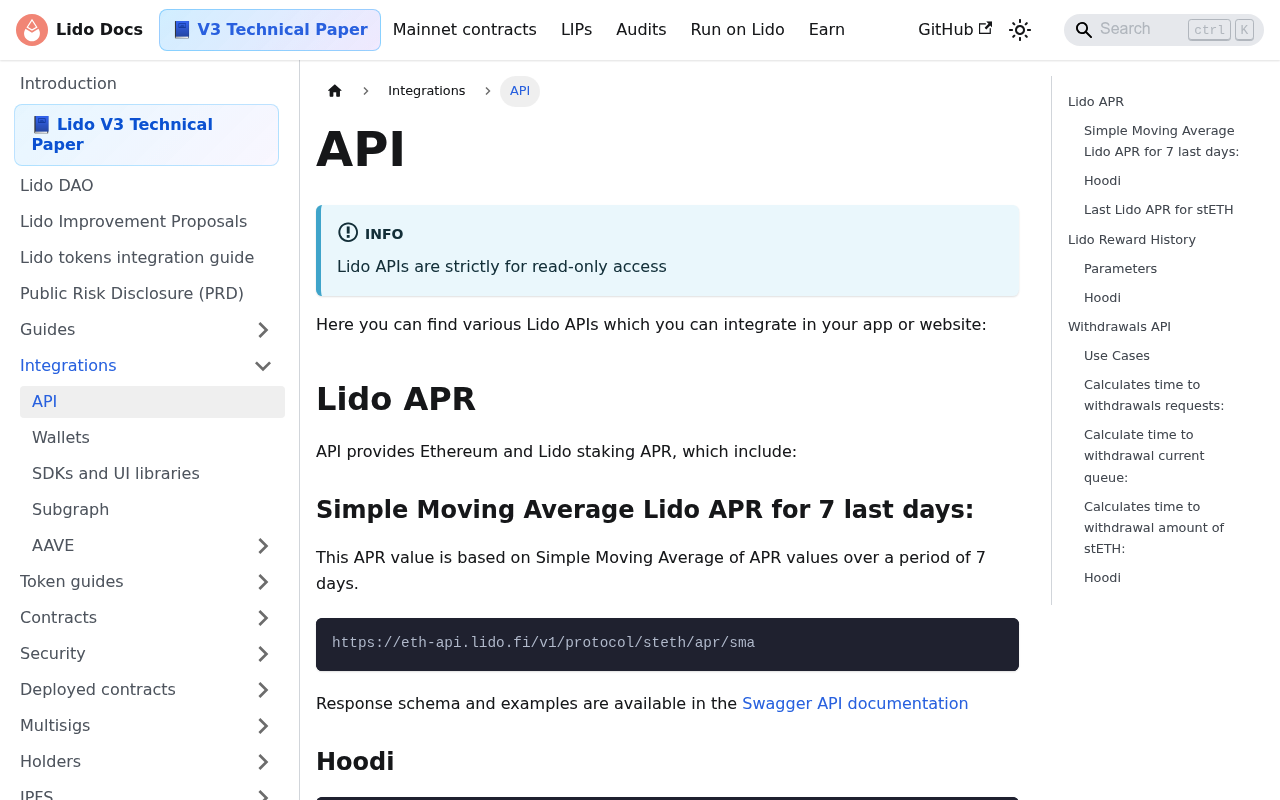
Read-only HTTP API returning the latest stETH staking APR and a 7-day simple moving average APR. Used by integrators, dashboards, and DeFi protocols to display Lido's current an...
Read-only HTTP API returning a per-address stETH reward history including USD/EUR/GBP fiat conversions, with options to filter to rewards-only, sort, paginate, and choose archiv...
Read-only HTTP API for the Lido stETH withdrawal queue. Returns estimated finalization times for one or more withdrawal request IDs, and can forecast the expected wait time for ...
Service that exposes node operator validator keys from each Lido staking module (Curated, Simple DVT, CSM) for use by deposit security infrastructure, validator monitoring, and ...
Lido Finance exposes on-chain protocol data through a subgraph on The Graph protocol. The subgraph indexes Ethereum mainnet events from the Lido stETH contract, the Withdrawal Q...
Discovery needs no key. Ratings and market analysis are Pro.
Get an API key
Free tier, no form to fill in. Signing in shares your email address with us — we
store it to create your key and to recognise you if you sign in with another
provider. See our Privacy Policy and
Terms.
 Kin Score
How this is scored →
Kin Score
How this is scored →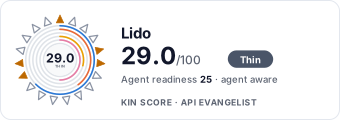 It updates itself when the score changes. Paste this where you link to your API docs: